
Roofs with a pitch of 2:12 (17 percent) or greater are referred to as “steep” roofs. Roof coverings for steep roofs fall into three general categories: thatch, shingles, and architectural sheet metal. Thatch, an attractive and effective roofing, consisting of bundles of reeds, grasses, or leaves (Figures 16.1 and 16.2), is highly labor-intensive and is rarely used today. Shingle and sheet metal roofs of many types are common to every type of building and range in price from the most economical roof coverings to the most expensive.
The insulation and vapor retarder in most steep roofs are installed below the roof sheathing or deck. Typical details of this practice are shown in Chapters 6 and 7. Where the underside of the deck is to be left exposed as a finish surface, a vapor retarder (if needed) and rigid insulation boards are applied above the deck, just below the roofing. A layer of plywood or OSB is then nailed over the insulation boards as a nail base for fastening the shingles or sheet metal, or special composite insulation boards with an integral nail base layer can be used.
In cold climates, steep roofs may have a tendency to form ice dams at the eaves under wintertime conditions. Where the risk of such ice damming is high, building codes require installation of a rubberized underlayment or other ice barrier material along the eaves to prevent trapped water from entering the building, as described on pages 227–228.
Shingles
The word shingle is used here in a generic sense to include wood shingles and shakes, asphalt shingles, slates, clay tiles, and concrete tiles. What these materials have in common is that they are applied to the roof in small units and in overlapping layers with staggered vertical joints.
Wood shingles are thin, tapered slabs of wood sawn from short pieces of tree trunk with the grain of the wood running approximately parallel to the face of the shingle (Figures 16.37 and 16.58). Wood shakes are split from the wood, rather than sawn, and exhibit a much rougher face texture than wood shingles (Figures 16.38 and 16.39). Most wood shingles and shakes in North America are made from Red cedar, White cedar, or Redwood because of the natural decay resistance of these woods. Wood shingles and shakes are frequently recommended to be installed over spaced sheathing or a breather mat (a wiry plastic mat that creates a continuous airspace) to permit airflow under the shingles and prevent the accumulation of moisture and the accelerated deterioration of the shingles or shakes. Wood roof coverings are moderately expensive and are not highly resistant to fire unless the shakes or shingles have been pressure treated with fire-retardant chemicals. They eventually fail from erosion of the wood fibers and may be expected to last 15 to 25 years under average conditions.
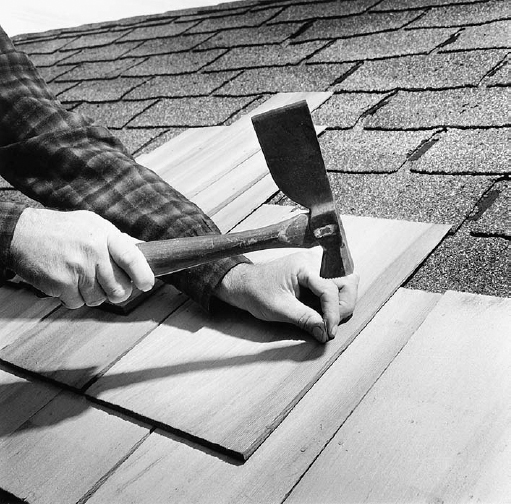
FIGURE 16.37 Applying Red cedar shingles, in this example as reroofing over asphalt shingles. Small corrosion-resistant nails are driven near each edge at the midheight of the shingle. Each succeeding course covers the joints and nails in the course below. (Courtesy of Red Cedar Shingle and Handsplit Shake Bureau)
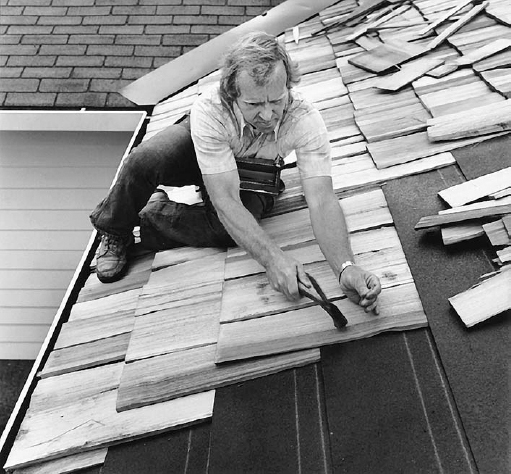
FIGURE 16.38 Application of handsplit Red cedar shakes over an existing roof of asphalt shingles. Compare the shape, thickness, and surface texture of these shakes with those of the cedar shingles in the preceding illustration. Each course is interleaved with strips of heavy asphalt-saturated felt 18 inches (460 mm) wide as extra security against the passage of wind and water between the highly irregular and therefore loosely mated shakes. The nail stripper hung around the roofer’s neck speeds his work by holding the nails and aligning them with points down, ready for driving. (Courtesy of Fed Cedar Shingle and Handsplit Shake Bureau)
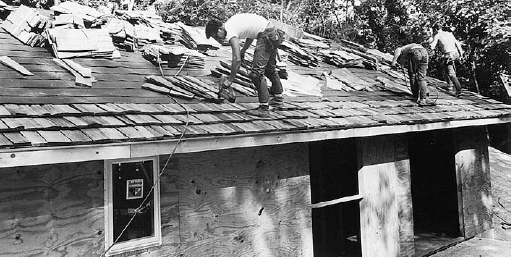
FIGURE 16.39 Shake application over a new roof deck using air-driven heavy-duty staplers for greater speed. The strips of asphalt-saturated felt have all been placed in advance with their lower edges unfastened. Each course of shakes is laid out, slipped up under its felt strip, then quickly fastened by roofers walking across the roof and inserting staples as fast as they can pull the trigger. (Courtesy of Senco Products, Inc.)
Asphalt or composition shingles are die-cut from heavy sheets of asphalt-impregnated felt faced with mineral granules that act as a wearing layer and decorative finish. Most felts are based on glass fibers, but some still retain the older cellulose composition. The most common type of asphalt shingle, which covers probably 90 percent of the single-family houses in North America, is 12 inches by 36 inches (305 mm by 914 mm) in size. (A metric-size shingle 337 mm by 1000 mm is also widely marketed.) In the most popular pattern, each shingle is slotted twice to produce a roof that looks as though it were made of smaller shingles (Figures 16.40–16.43). Other sizes and many other styles are available, including thicker shingles that are laminated from several layers of material. Asphalt shingles are inexpensive to buy, quick to install, moderately fire resistant, and have a life expectancy of 15 to 25 years, depending on their composition.
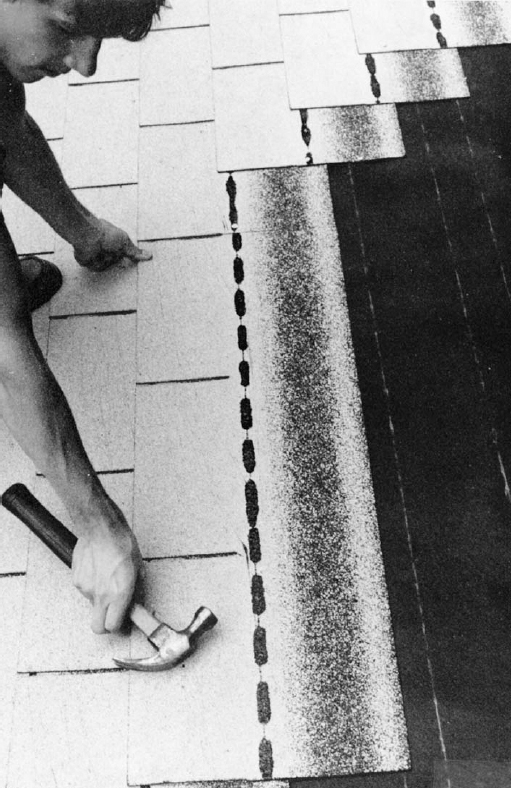
FIGURE 16.40 Installing asphalt shingles. To give a finer visual scale to the roof, the slots make each shingle appear to be three smaller shingles when the roof is finished. Many different patterns of asphalt shingles are available, including ones that do not have slots. (Photo by Edward Allen)
The same sheet material from which asphalt shingles are cut is also manufactured in rolls 3 feet (914 mm) wide as asphalt roll roofing. Roll roofing is very inexpensive and is used primarily on storage and agricultural buildings. Its chief drawbacks are that thermal expansion of the roofing or shrinkage of the wood deck can cause unsightly ridges to form in the roofing and that thermal contraction can tear it.
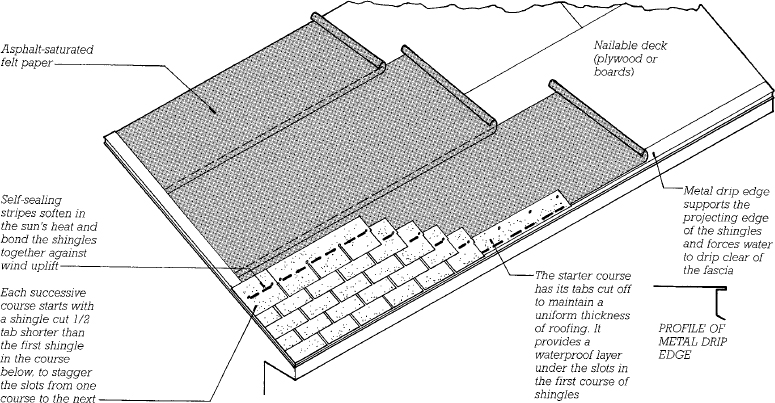
FIGURE 16.41 Starting an asphalt shingle roof. As explained in Chapter 6, building codes require the installation of an ice barrier beneath the shingles along the eave in regions with cold winters prone to ice damming. Where required, the ice barrier would replace the lowest course of asphalt-saturated felt paper shown in this illustration.
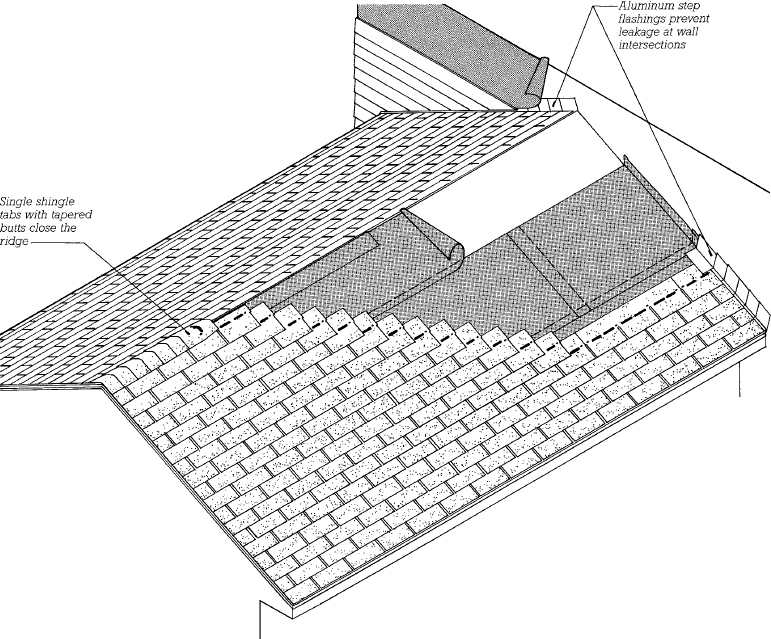
FIGURE 16.42 Completing an asphalt shingle roof. A metal or plastic ridge vent strip (see Chapter 6) is often substituted for the shingle tabs on the ridge to provide an outlet for ventilation under the roof sheathing.
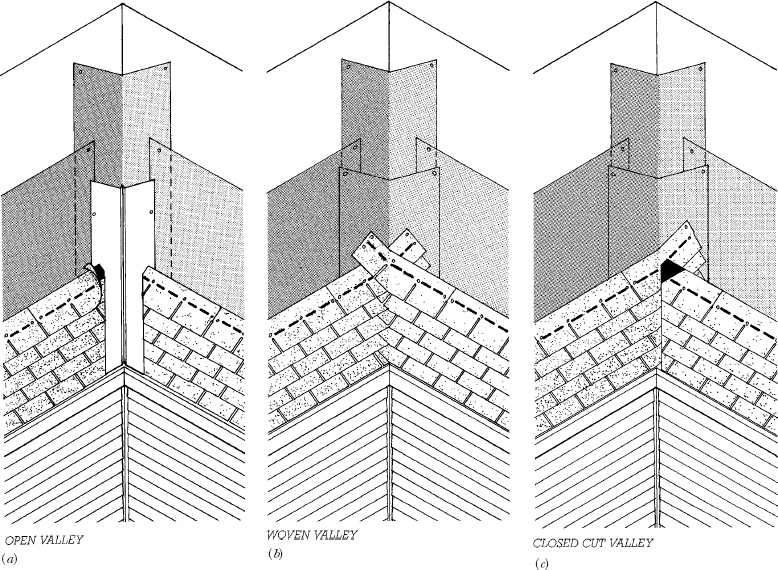
FIGURE 16.43 A valley is formed in a roof where two sloping roof planes meet above an inside corner of the building. Three alternative methods of making a valley in an asphalt shingle roof are shown here. (a) The open valley uses a sheet metal flashing; the ridge in the middle of the flashing helps prevent water that is coming off one slope from washing up under the shingles on the opposite slope. The woven valley (b) and cut valley (c) are favorites of roofing contractors because they require no sheet metal. The solid black areas on shingles in the open and cut valleys indicate areas to which asphaltic roofing cement is applied to adhere shingles to each other.
Slate shingles for roofing are delivered to the site split, trimmed to size, and punched or drilled for nailing (Figures 16.44 and 16.45). They form a fire-resistant, long-lasting roof that is suitable for buildings of the highest quality. Its first cost is high, but a slate roof typically lasts 60 to 80 years.

FIGURE 16.44 Splitting slate for roofing. The thin slates in the background will next be trimmed square and to dimension, after which nail holes will be punched in them. (Photo by Flournoy. Courtesy of Buckingham-Virginia Slate Corporation)

FIGURE 16.45 A slate roof during installation. (Courtesy of Buckingham-Virginia Slate Corporation)
Clay tiles have been used on roofs for thousands of years. It is said that the tapered barrel tiles traditional to the Mediterranean region (similar to the mission tiles in Figure 16.46) were originally formed on the thighs of the tilemakers. Many other patterns of clay tiles are now available, both glazed and unglazed. Concrete tiles are generally less expensive than those of clay and are available in some of the same patterns. Tile roofs in general are heavy, durable, highly resistant to fire, and relatively expensive in first cost. Expected lifetimes range from 30 to 75 years, depending on climate and the resistance of the tiles to water absorption.
Other materials used for roof shingles include sheet metal, rubber, fiber-reinforced cement, and plastic. Each type of shingle must be laid on a roof deck that slopes sufficiently to ensure leakproof performance. Minimum slopes for each material are specified by the manufacturer and the building codes. For example, the minimum slope for a standard asphalt shingle roof is usually 4:12 (33 percent), although with specially protective underlayments, slopes as low as 2:12 (17 percent) may be acceptable in some circumstances. For any shingle type, slopes greater than the minimum should be used in locations where water is likely to be driven up the roof surface by heavy storm winds.
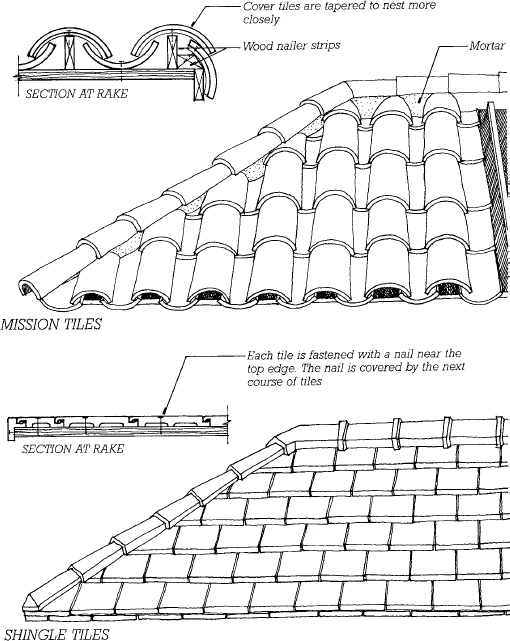
FIGURE 16.46 Two styles of clay tile roofs. The mission tile has ancient origins.
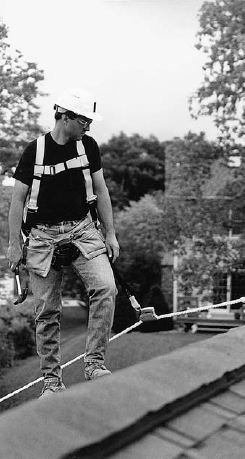
FIGURE 16.47 Protective devices keep workers from falling long distances off steep roofs. (Courtesy of DBI/SALA, Red Wing, Minnesota)
Architectural Sheet Metal Roofing
Thin sheets of metal have been used for roofing since ancient times and remain a popular roofing material to this day. They are installed using ingenious systems of joining and fastening to maintain watertightness (Figures 16.48–16.52). Seams between sheets must be spaced close enough to secure the sheets adequately against wind uplift and to absorb expansion and contraction between sheets due to changes in temperature. These seams also create strong visual patterns that can be manipulated by the designer to emphasize the qualities of the roof shape. Architectural sheet metal roofing is relatively high in first cost but, when properly installed, can be expected to last for many decades.
Various types of metal may be used in the production of architectural sheet metal roofs:
• Lead is a soft, easily formed, very long-lasting metal that oxidizes over time to a dull white color. It is also a toxic material that requires special health precautions during its handling.
• Copper is a relatively soft metal that turns a beautiful blue-green in clean air and a dignified black in an industrial atmosphere; various chemical treatments can be used to obtain and preserve the desired color.
• Lead-coated copper sheet is sometimes used to combine the greater strength of copper with the gray-white color of lead and to avoid the staining of wall materials by oxides of copper that can occur with rainwater runoff from uncoated copper roofs.
• Zinc metal roofing is a long-lasting roofing metal made of zinc alloyed with small amounts of copper and titanium to improve its workability. It normally ages to a dark gray color and can also be treated in various ways to alter or preserve its appearance.
• Stainless steel and titanium are strong and long-lasting but less easily worked than other roofing metals. Both are silvery-white in color.
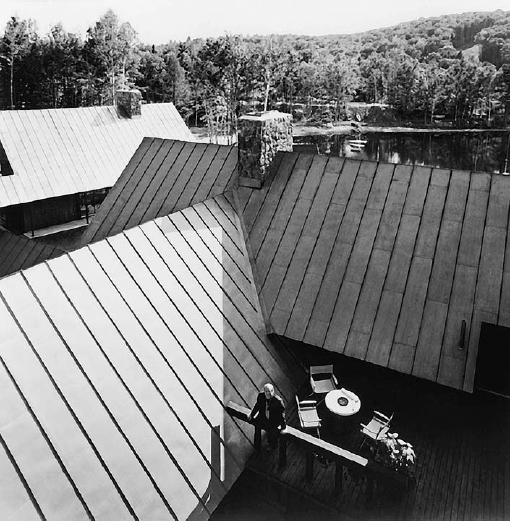
FIGURE 16.48 Standing-seam copper roofs. (Designer: Emil Hanslin. Courtesy of Copper Development Association, Inc.)
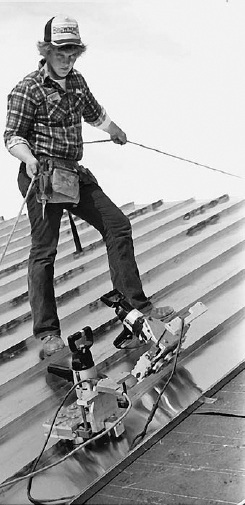
FIGURE 16.49 An automatic roll seamer, moving under its own power, locks standing seams in a copper roof. A cleat is just visible at the lower right. (Courtesy of Copper Development Association, Inc.)
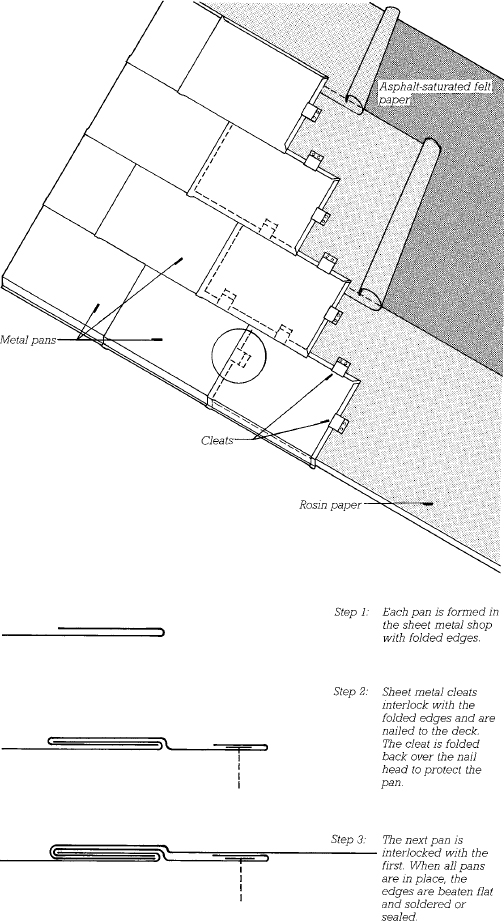
FIGURE 16.50 Installing a flat-seam metal roof. The three diagrams at the bottom of the illustration show the three steps in creating the seam, viewed in cross section. The cleats, which fasten the roofing to the deck, are completely concealed when the roof is finished.
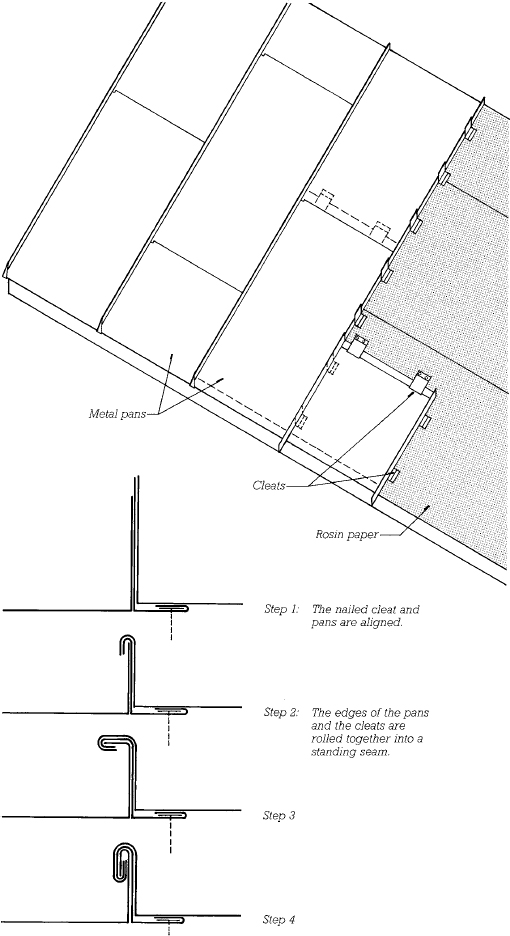
FIGURE 16.51 Installing an architectural standing-seam metal roof.
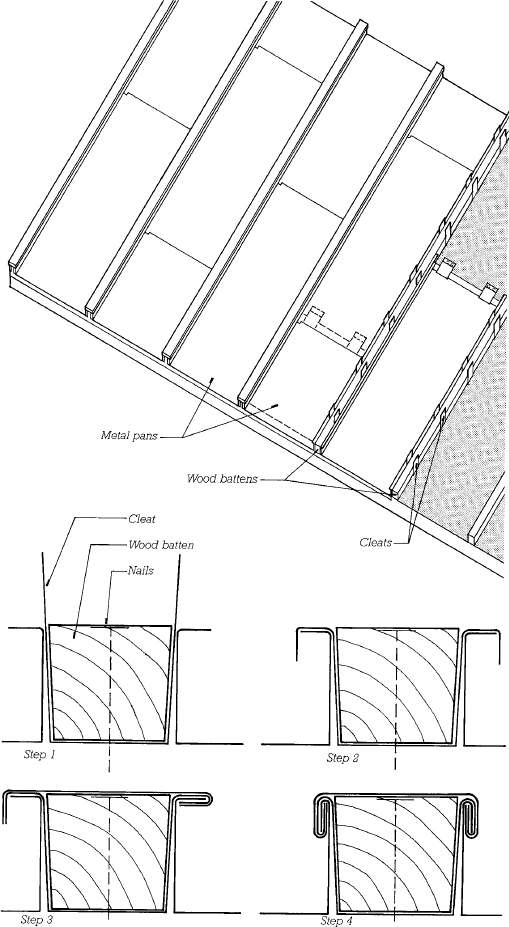
FIGURE 16.52 Installing a batten-seam metal roof. The battens are tapered in cross section to allow for expansion of the roofing metal.
• Zinc-tin alloy coated stainless steel has a darker, duller appearance than uncoated stainless steel. This material is very similar in appearance to—and is sometimes confused with—a lead-tin alloy coated metal called ternecoated stainless steel that is no longer manufactured but may still be found on older buildings.
The metals listed above all form self-protecting oxide coatings (patinas) that provide long-lasting resistance to corrosion. They are usually installed uncoated and allowed to patinate naturally. Other, less expensive metals, which are not as long-lasting in an uncoated condition, are commonly factory coated with high-performance organic (paint-like) coatings that extend their life expectancy and provide a wide range of color choice. These include aluminum, metallic-coated steel (steel coated with alloys of zinc or zinc-aluminum), or zinc-tin alloy coated steel, and even, occasionally, ferrous steel without any protective, metallic coating. (For more about architectural metals, see pages 505–508.)
The thickness of steel sheet traditionally has been specified by gauge (also spelled gage), a system of whole numbers in which lower numbers correspond to greater metal thickness. However, due to the absence of a uniform standard for the translation between gauge and actual metal thickness, ASTM standards discourage the use of gauge numbers to specify sheet metal thickness and instead recommend reliance on decimal or fractional inches to indicate thickness. The thickness of copper sheet is normally specified by weight, expressed in ounces per square foot (0.092 m2). Aluminum is specified simply in decimal inches. In general, thicker metal sheets are longer-lasting, less prone to waviness or “oil canning,” often more difficult to form into shapes, and more expensive than thinner sheets. Figure 16.53 lists typical thicknesses for some common sheet metal roofing materials.
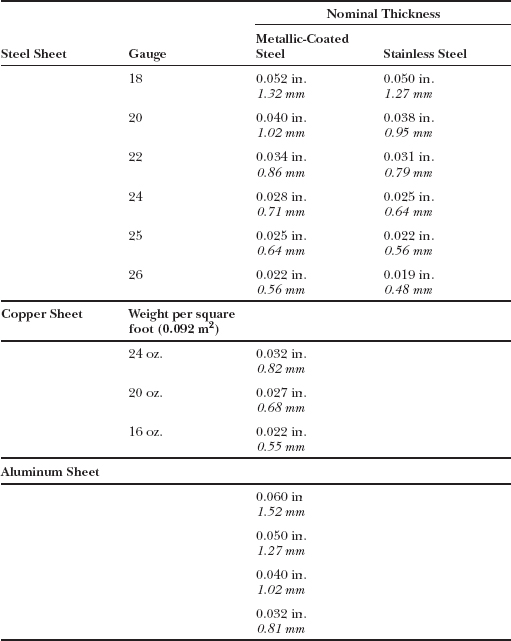
FIGURE 16.53 Thicknesses of common sheet metals used in architectural sheet metal roofing.
Metal roofing may be fabricated and supplied in two distinct ways. When a roofing installer purchases unformed sheet metal stock and custom-forms the panels to the required shapes, the roofing is specified as sheet metal roofing. Alternatively, roofing panels may be factory-formed into a family of shapes that can be selected from a manufacturer’s catalog. In this case, the roofing is specified as metal roof panels (Figure 16.54). Metal roof panels are most commonly made from aluminum or metallic-coated steel with factory-applied coatings. They may rely on interlocking seams with concealed fastener systems that imitate the appearance of traditional site-fabricated standing seam or batten seam sheet metal roofing, or they may consist of simpler corrugated or folded shapes fastened with exposed screws and rubber washers. Metal roof panels are generally less expensive than traditional, custom-formed sheet metal roofing. They may also be used in low-slope roofing applications as discussed earlier this chapter.
The roof plays a primal role in our lives. The most primitive buildings are nothing but a roof. If the roof is hidden, if its presence cannot be felt around the building, or if it cannot be used, then people will lack a fundamental sense of shelter.
Christopher Alexander et al., A Pattern Language, New York, Oxford University Press, 1977, p. 570.
Minimum recommended slopes for sheet metal roofing vary with the type of seam, the manner in which the seams are sealed, and the type of roofing underlayment. For premanufactured metal roof panels, consult the manufacturer’s recommendations. For custom-fabricated sheet metal roofing, consult the appropriate references listed at the end of this chapter.
Protection from Corrosion Between Dissimilar Metals
The ideal way to avoid the corrosion that can occur between dissimilar metals is to use the same metal for every component of a sheet metal roof system, including its fasteners, anchor clips, roofing sheets, flashings, gutters, and downspouts. Alternatively, where this is not practical, metals must be mixed with an understanding of the reactions that can occur between them. For example, sheet metal roofs of copper, lead, or zinc may generally be safely anchored with fasteners and anchor clips made of stronger, harder stainless steel, because the stainless steel is electrochemically noble (passive) in relation to these other metals. For a more detailed discussion of galvanic action and corrosion between dissimilar metals, see pages 698–700.
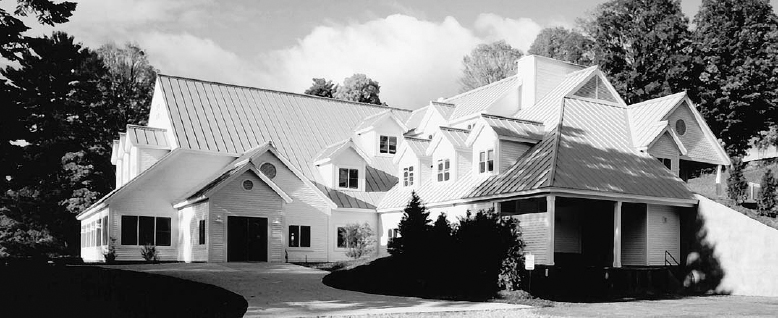
FIGURE 16.54 The raised seams in the architectural panel metal roof accentuate the complex roof geometries of the International Center in Brattleboro, Vermont. (Architect: William A. Hall Partnership. Photo by Stanley Jesudowich)
CONSIDERATIONS OF SUSTAINABILITY IN ROOFING
The roof can contribute in many ways to the sustainability of a building:
• A roof can capture rainwater and snowmelt and conduct them to a cistern, tank, or pond for use as domestic water, industrial water, or irrigation.
• A properly proportioned overhang can shade south-facing windows from the high summer sun but admit warming light from the low winter sun.
• A light-colored roof covering, if kept clean, can reflect half or more of the solar radiation striking its surface, improving occupant comfort and significantly reducing the heating load on the occupied space below. Even darker-hued roof materials, when coated with specially formulated cool color pigments, can reflect 25 percent or more of solar radiation. Such cool roofs can reduce cooling energy costs for buildings by 10 to 25 percent and extend the life of the roofing materials.
• Reflective roofs that reduce the absorption of solar heat can decrease the elevation of air temperatures in densely built areas, thereby reducing a building’s indirect contributions to smog, degraded air quality, environmental discomfort, and other heat island effects.
• In a hot climate, a shading layer above a roof, with a freely ventilated space between, can eliminate most solar heat gain through the roof surfaces. The shading layer might consist of latticework, fabric, or corrugated metal; the exact material is less important than providing both shading and ventilation.
• A roof surface can support flat-plate solar heat collectors used to reduce building heating costs or arrays of photovoltaic cells to provide electrical power. Electrical power for building use can also be produced from thin-film photovoltaic materials laminated directly onto a variety of conventional roof coverings.
Roof Insulation
Thermal insulating materials in roofs and walls are probably the most cost-effective, planet-saving materials used in buildings. They increase occupant comfort by moderating the radiant temperatures of ceilings and walls. They reduce heating and cooling energy requirements to a fraction of what they would otherwise be. They pay for themselves through energy savings in a very short period of time.
Other environmental implications of thermal insulating materials are more complex:
• Cellulose insulation is the most environmentally friendly thermal insulating material. It can be specified to contain not less than 85 percent recycled material, primarily newspapers. Its embodied energy is only about 150 BTU per pound (0.35 MJ/kg). The borate compound used to make it fire resistant is generally not harmful to human beings. The binder used to hold the cellulose fibers in place is usually a simple glue that does not outgas. Installers should wear breathing protection, but the fibers are not known to be carcinogenic.
• Glass wool and mineral wool can be manufactured primarily from waste materials, recycled glass and blast furnace slag, respectively. The embodied energy in glass wool is about 13,000 BTU per pound (30 MJ/kg), but a pound of it goes a long way. The binders used in some glass fiber insulations give off small quantities of formaldehyde, but nonoutgassing products are available. In a large number of scientific studies, glass and mineral wools have not been shown to be carcinogenic. However, they do irritate and congest the lungs, and installers must wear breathing protection.
• Polystyrene foam is made from petroleum and has an embodied energy of about 50,000 BTU per pound (120 MJ/kg). It can be made from recycled styrene and polystyrene. Expanded polystyrene foam (bead foam) is made using pentane gas, which is not an ozone-destroying substance, as a blowing agent.
• Extruded polystyrene, polyisocyanurate, and polyurethane foams were formerly manufactured using ozone-depleting blowing agents. All are now manufactured using pentane or other chemicals less harmful to the atmosphere.
Low-Slope Membranes
Low-slope roof membranes have varying impacts on the environment:
• Bituminous roofing is largely based on asphaltic compounds derived from coal and petroleum.
• Roofing operations with hot asphalt and pitch give off plentiful quantities of fumes that are decidedly unpleasant and potentially unhealthful, but once the roof has cooled, these emissions subside.
• Most roofing felts today are made with cellulose or glass fibers, but very old felts in buildings being demolished or reroofed may contain asbestos, a proven carcinogen.
• The various rubber and plastic formulations used in single-ply membranes generally utilize petroleum as the primary raw material. Each has its own characteristics with regard to embodied energy and outgassing.
• Adhesive bonding, solvent welding, and heat welding of seams may give off volatile organic compounds (VOCs). Some single-ply membrane materials also emit VOCs.
• Materials from demolition of built-up roof membranes are generally incinerated or taken to landfills. Thermoplastic single-ply membranes can be recycled, although most are not at the present time. Thermosetting membranes cannot be recycled.
• Low-slope roofs may be developed as green roofs, in which the membrane is covered with soil and plants. These living constituents of the roof consume carbon dioxide, generate oxygen, shield the membrane and the inhabited space below from temperature extremes, cool the roof surface by evaporation and transpiration, delay the passage of stormwater into sewers and reduce its volume, and create a pleasant roofscape.
Steep Roof Materials
Steep roof materials—shingles, slates, tiles, sheet metal— come from a variety of sources with different environmental impacts:
• Asphalt shingles consist mostly of petroleum.
• The environmental impact of wood shingles is much the same as that of other wood products; see pages 90 and 91.
• Slates are quarried stone, and concrete tiles are, of course, concrete (pages 520 and 521).
• Copper, stainless steel, aluminum, terne, and lead roofing materials originate as ores that must be mined, refined, and manufactured into finished form, all at various environmental costs.
• Metal roofing materials can be recycled. There is little recycling of the other steep roof materials. There are available, however, proprietary shingles made almost entirely of recycled tires or other recycled materials.
Leave a Reply