The major ingredient of glass is sand (silicon dioxide). Sand is mixed with soda ash (sodium hydroxide or sodium carbonate), lime, and small amounts of alumina, potassium oxide, and various elements to control color, then heated to form glass. The finished material, while seemingly crystalline and convincingly solid, is actually a supercooled liquid, for it has no fixed melting point and an open, noncrystalline microstructure.
When drawn into small fibers, glass is stronger than steel, though not nearly as stiff. In larger pieces, the microscopic imperfections that are an inherent characteristic of glass reduce its useful strength to significantly lower levels, particularly in tension. When a surface of a sheet of glass is placed in sufficient tension, as happens when an object strikes the glass, cracks propagate from an imperfection near the point of maximum tension and the glass shatters.
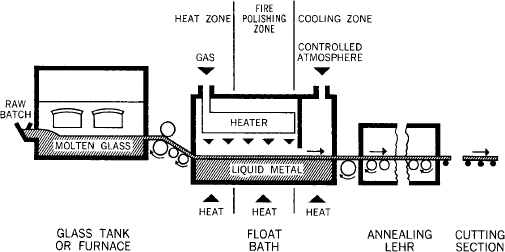
FIGURE 17.4 In the float glass process, molten glass from the furnace is floated on a bath of liquid tin to form a continuous sheet of glass. The annealing lehr cools the glass at a controlled rate to avoid internal stresses, after which it is cut into smaller sheets. (Courtesy of PPG Industries)
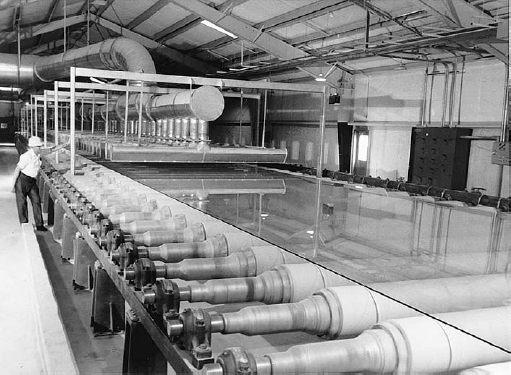
FIGURE 17.5 The superior flatness and bright surface finish of float glass are readily seen in the reflections on the glass ribbon emerging from the annealing lehr. (Photo courtesy of LOF Glass, a Libby-Owens-Ford Company)
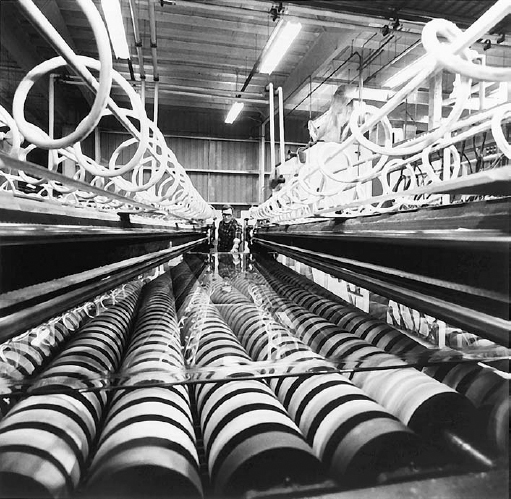
FIGURE 17.6 Track-mounted cutting devices score the ribbon of cooled float glass as part of a computer-controlled cutting operation that automatically produces the glass sizes ordered by customers. (Courtesy of PPG Industries)
CONSIDERATIONS OF SUSTAINABILITY RELATING TO GLASS
Glass Production
• The major raw materials for glass—sand, limestone, and sodium carbonate—are finite but abundant minerals.
• The high embodied energy of glass manufactured using traditional methods, roughly 7000 BTU per pound (16 MJ/kg), can be reduced by as much as 30 to 65 percent as new, more energy efficient manufacturing technologies are introduced.
• Some glass production involves the generation of potentially unhealthful or pollution-causing waste materials. Traditional mirror glass manufacturing, for example, generates an acidic waste effluent with high concentrations of copper or lead. However, recently, mirror glass manufactured with more environmentally friendly production techniques has become available.
• Although glass bottles and containers are recycled into new containers at a high rate, there is little recycling of flat glass at the present time. Most old glass goes to landfills.
• Efforts are underway to find new uses for waste glass. For example, vitrified glass aggregate (glass that has been melted and rapidly quenched to trap heavy metals and other contaminants) can be reused in asphalt, concrete, construction backfill, roofing shingles, and ceramic tiles.
Uses of Glass
• If it is not broken by accident or improper installation, glass lasts for a very long time with little degradation of quality, often much longer than most other building components.
• Glass is inert and does not affect indoor air quality. It is easily kept clean and free of molds and bacteria.
• The impact of glass on energy consumption can be very detrimental, very beneficial, or anything in between, depending on how intelligently it is used.
• If badly used, glass can contribute to summertime overheating from unwanted solar gain, excessive wintertime heat losses due to inherently low R-values, visual glare, wintertime discomfort caused by radiant heat loss from the body to cold glass surfaces, and condensation of moisture that can damage other building components.
• Well used, glass can bring solar heat into a building in winter and exclude it in summer, with attendant savings in heating and cooling energy. It can bring daylight into a building without glare, reducing both the use of electricity for lighting and the cooling load produced by that lighting.
• These benefits accrue over the entire life of the building, and the payoffs can be huge. Thus, glass is a key component of every energy-efficient building and a chief accomplice of the ill-informed designer in most energy-wasting buildings.
Thicknesses of Glass
Glass is manufactured in a series of thicknesses typically ranging from  inch (2.5 mm), also called single-strength, through ⅛ inch (3 mm), called double-strength, up to as much as 1 inch (25.4 mm), depending on the manufacturer. Glass thickness for a particular window is determined by the size of the light and the expected maximum wind loads on the glass. For low buildings with relatively small windows, glass ⅛ inch thick is usually sufficient. For larger windows and for windows in tall buildings, where wind velocities are high at higher altitudes, thicker glass is generally required, along with increased attention to how the glass is supported in its frame. (It has become standard practice for architects and structural engineers to order extensive wind tunnel testing of models of tall buildings during the design process to establish the expected maximum wind pressures and suctions on the windows.)
Because of unavoidable manufacturing defects in the glass, as well as the probability of damage to the glass during installation and while it is in service, a certain amount of breakage must always be anticipated in a large building. ASTM E1300 establishes standard procedures for evaluating the structural stability and probability of breakage in glass. These are used to determine the glass thickness that will result in an acceptably low probability of breakage for a window of given dimensions, support conditions, and wind pressure.
During its manufacture, ordinary window glass is annealed, meaning that it is cooled slowly under controlled conditions to avoid locked-in thermal stresses that might cause it to behave unpredictably in use. But other types of glass have come into use for particular purposes in buildings.
Heat-Treated Glass
Heat-treated glass is produced by reheating annealed glass in an oven to approximately 1150 degrees Fahrenheit (620°C) and then cooling (quenching) both of its surfaces rapidly with blasts of air while its core cools much more slowly. This process induces permanent compressive stresses in the edges and faces of the glass and tensile stresses in the core. The resulting glass is stronger in bending than annealed glass and more resistant to thermal stress and impact. These properties make heat-treated glass useful for windows exposed to heavy wind pressures, impact, or intense heat or cold. By adjusting the quenching process, greater or lesser degrees of residual stress may be introduced into the glass, producing products referred to as either “tempered” or “heat-strengthened glass.”
Tempered Glass
Tempered glass has higher residual stresses than heat-strengthened glass and is about four times as strong in bending as annealed glass. If it does break, the sudden release of its internal stresses reduces tempered glass instantaneously to small, square-edged granules rather than long, sharp-edged shards. This characteristic, combined with its high strength, qualifies it for use as safety glazing (discussed below), that is, in situations of possible occupant impact. Tempered glass is also used for all-glass doors that have no frame at all (Figure 17.7), for whole walls of squash and handball courts, for hockey rink enclosures, and for basketball backboards.
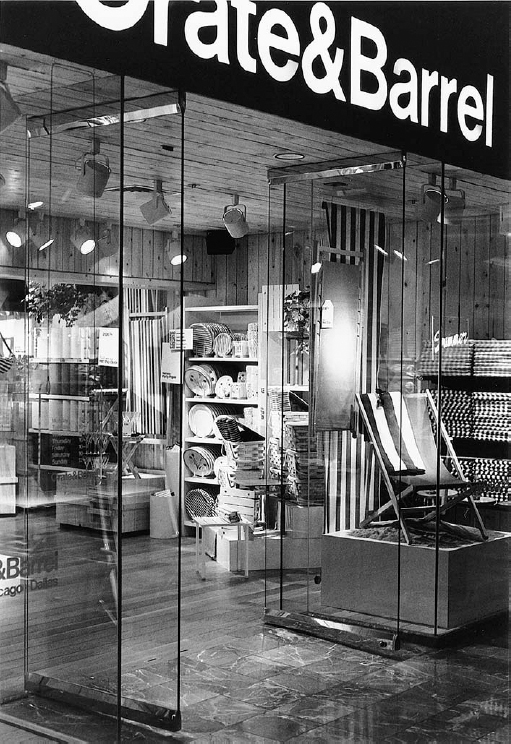
FIGURE 17.7 Tempered glass is used for strength and breakage safety in both the doors and windows of this store in a downtown shopping mall. (Photo by Edward Allen)
Tempered glass is more costly than annealed glass. It often has noticeable optical distortions created by the tempering process. In addition, all cutting to size, drilling, and edging must be done before the heat treatment of the glass because any such operations after tempering will release the stresses in the glass and cause it to disintegrate. Tempered glass is also sometimes referred to as fully tempered glass to distinguish it more clearly from heat-strengthened glass.
Heat-Strengthened Glass
For many applications, lower-cost heat-strengthened glass may be used instead of tempered glass. The induced compressive stresses in the surface and edges of heat-strengthened glass are about one-third as high as those in fully tempered glass (typically 5000 psi compared to 15,000 psi for tempered glass, or 34 MPa versus 104 MPa). Heat-strengthened glass is about twice as strong in bending as annealed glass and is more resistant to thermal stress. It usually has fewer distortions than tempered glass. Its breakage behavior is more like that of annealed glass than tempered glass. For that reason, it cannot be used where safety glazing is required except in laminated form (laminated glass is discussed below).
Laminated Glass
Laminated glass is made by sandwiching a transparent polyvinyl butyral (PVB) interlayer between sheets of glass and bonding the three layers together under heat and pressure. Laminated glass is not as strong as annealed glass of the same thickness, but when laminated glass breaks, the soft interlayer holds the shards of glass in place rather than allowing them to fall out of the frame of the window. This makes laminated glass useful for skylights and overhead glazing, because it reduces the risk of injury to people below in case of breakage (Figures 17.8 and 17.9). The PVB interlayer may be colored or patterned to produce a wide range of visual effects in laminated glass. Because laminated glass does not create dangerous, loose shards of glass when it breaks, it also qualifies as safety glazing.
Laminated glass is a better barrier to the transmission of sound than solid glass. It is used to glaze windows of residences, classrooms, hospital rooms, and other rooms that must be kept quiet in the midst of noisy environments. It is especially effective when installed in two or more layers with airspaces between. In comparison to solid glass, laminated glass also reduces the transmission of ultraviolet (UV) radiation, a component of sunlight that contributes significantly to fading and the degradation of interior finishes, furnishings, and fabrics.
Security glass, used for drive-in banking windows and other facilities that need to be resistant to burglary, is made of multiple layers of glass and PVB, and is available in a range of thicknesses to stop any desired caliber of bullet. Laminated glass is also used in blast-resistant and windborne debris-resistant glazing systems, which are described in more detail in the next chapter.
Chemically Strengthened Glass
Chemically strengthened glass is produced by an ion exchange process that takes place when annealed glass is immersed in a molten salt bath. As smaller sodium ions in the glass are replaced with larger potassium ions from the salt solution, the faces of the glass are put into compression relative to the core, and the glass is prestressed in a manner similar to the one that occurs with heat treating. However, because the temperatures involved in chemical strengthening are lower, chemically strengthened glass does not experience the optical distortions or warping that are common with heat-treated glass. Depending on the particulars of the treatment process, the strength and toughness of chemically strengthened glass can exceed those of tempered glass.
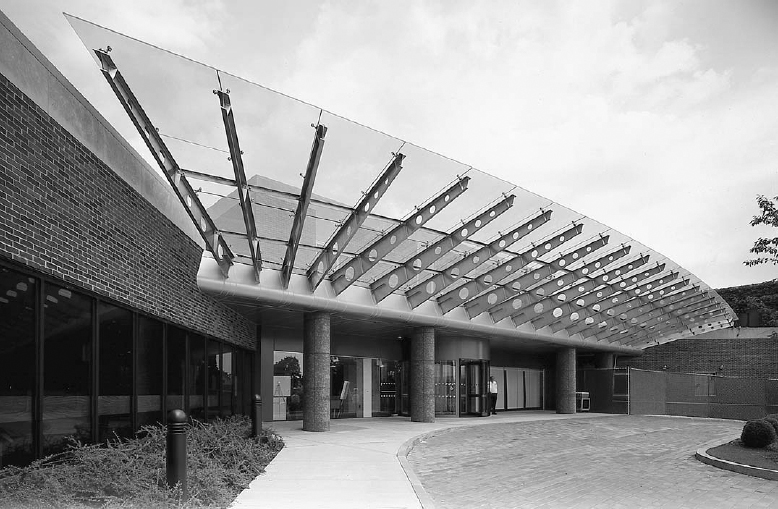
FIGURE 17.8 The entrance canopy of the Newport, Rhode Island Hospital is made of laminated glass supported by stainless steel spider fittings that transmit the weight of the roof to cantilevered steel beams. The heads of the bolts that fasten the glass to the fittings are recessed unobtrusively within the thickness of the glass. (Taylor & Partners, Architects. Photo of Pilkington Planar System courtesy of W&W Glass Systems, Inc.)
Unlike tempered glass, chemically strengthened glass can be cut after strengthening, although its strength is diminished along the cut edges. When chemically strengthened glass breaks, it produces large, hazardous shards. So, like heat-strengthened glass, it cannot be used where safety glazing is required unless it is laminated. Chemical strengthening is used for pieces of glass that are not easily heat treated, such as those that are small, thin, or oddly shaped. It is also used in some fire-rated glass products (discussed below) and in laminated form for security glass, blast-resistant glass, and windborne debris-resistant glass.
Fire-Rated Glass
Fire-rated glass in fire doors, fire windows, and fire resistance rated walls must maintain its integrity as a barrier to the passage of smoke and flames even after it has been exposed to heat for a period of time. Some tempered or laminated glass products can achieve test ratings of up to 20 minutes of fire resistance. Wired glass is produced by rolling a mesh of small wires into a sheet of hot glass. When wired glass breaks from thermal stress, the wires hold the sheets of glass in place so that the glass continues to act as a fire barrier. It carries a fire resistance rating of 45 minutes. Optical-quality ceramic is more stable against thermal breakage than any type of glass. It looks and feels like glass and can achieve fire resistance ratings ranging from 20 minutes to 3 hours.
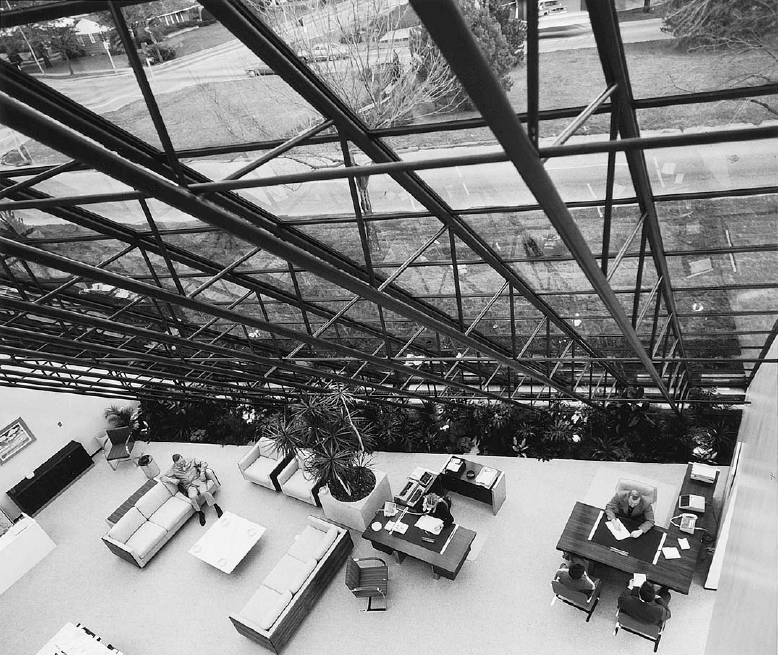
FIGURE 17.9 Laminated glass provides safety against falling shards in an overhead sloped glazing installation. (Courtesy of PPG Industries)
Two other fire-rated glass types are fire-retardant filled double glazing and intumescent interlayer laminated glazing. Fire retardant filled double glazing consists of a clear, heat-absorbing polymer gel contained between two sheets of tempered glass. Intumescent interlayer laminated glazing is made of thin layers of transparent intumescent material sandwiched between multiple layers of annealed glass. When either glass type is heated by fire, the gel or intumescent interlayers react to form opaque, insulating layers. As a result, these products not only resist the passage of flame and smoke, they also limit the rise in surface temperature of the glass on the side opposite the fire and prevent the transfer of radiant heat through the glass. These added protective properties make these glass types suitable for use in larger sizes and in a broader range of applications than other types of fire-rated glass. Fire resistance ratings of up to 2 hours can be achieved.
According to the International Building Code fire-rated glass must meet the fire endurance requirements of one of three tests—NFPA 252, NFPA 257, or ASTM E119— depending on whether the glass is part of a fire door, fire window, or fire-rated wall assembly, respectively. Fire-rated glass tested for use in doors and windows is limited in the maximum size of individual lights permitted. However, glass products that can pass the more stringent requirements of ASTM E119 for wall assemblies, including fire-retardant filled double glazing and intumescent interlayer laminated glazing, have no such size limits and can be used as full substitutes for fire resistance–rated wall construction. To distinguish between products that can meet all the requirements of fire-rated wall construction and those that are suitable only for use in fire doors and windows, the terms glass fire walls or fire resistive glazing may be applied to the former and fire protective glazing to the latter.
Due to its frequent use in doors and other hazardous locations, firerated glass must often also meet the impact resistance and breakage safety requirements of safety glazing. To meet these requirements, optical-quality ceramic is either laminated or film-faced to protect it from shattering dangerously when used in such locations. Ordinary annealed wired glass does not meet safety glazing requirements. While historically its use was permitted in fire doors and windows due to a lack of suitable alternatives, this is no longer the case. Where wired glass is now used in hazardous locations, it also is either film-faced or laminated. Fire-retardant filled glazing and intumescent laminated glazing are both capable of meeting safety glazing requirements.
Fritted Glass
A number of producers are equipped to imprint the surface of glass with silk-screened patterns of ceramic-based paints. The paints consist primarily of pigmented glass particles called frit. After the frit has been printed on the glass, the glass is dried and then fired in a tempering furnace, transforming the frit into a hard, permanent ceramic coating. Many colors are possible in both translucent and opaque finishes. Typical patterns for fritted or silkscreened glass are various dot and stripe motifs (Figure 17.10), but custom-designed patterns and even text are easily reproduced. Fritted glass is often used to control the penetration of solar light and heat into a space.
Spandrel Glass
Frits are used to create special opaque glasses for covering spandrel areas (the bands of wall around the edges of floors) in glass curtain wall construction (Figure 17.11). A uniform coating of frit is applied to what will be the interior surface of the glass. Some spandrel glasses are made as similar as possible in exterior appearance to the glass that will be used for the windows on a specific project. It is very difficult, however, even with reflective coated glass, to make the spandrels indistinguishable from the windows under all lighting conditions. Most spandrel glasses are made to contrast with the windows of the building. Many suppliers can apply thermal insulation on the interior of the glass, complete with vapor retarder. Spandrel glass is usually tempered or heat strengthened to resist the thermal stresses that can be caused by accumulation of solar heat behind the spandrel.
Tinted and Reflective Coated Glass
Solar heat buildup can be problematic in buildings with large areas of glass, especially during the warm part of the year. Fixed sun-shading devices outside the windows are the best ways of blocking unwanted sunlight, but glass manufacturers have also developed tinted and reflective glasses that reduce glare and cut down on solar heat gain.
Tinted Glass
The transparency of glass to visible light is called its visible light transmittance (VT). It is measured as the ratio of visible light that passes through the glass relative to the amount of light striking the glass. Clear glasses have visible light transmittance in the range of 0.80 to 0.90, meaning that 80 to 90 percent of the visible light striking the glass passes through to the building interior. The remaining 10 to 20 percent is either reflected or absorbed by the glass and converted to heat.
By tinting glass, its visible light transmittance is reduced. Tinted glass is made by adding small amounts of selected chemical elements to the molten glass mixture to produce the desired hue and intensity of color in grays, bronzes, blues, greens, and golds. The visible light transmittance of commercially available tinted glasses ranges from about 0.75 in the lightest tints to 0.10 for dark gray. The overall reduction in solar heat gain is often significantly less, however, because the solar radiation absorbed by the glass and converted to heat must go somewhere, and a substantial portion of it is conducted or reradiated to the interior of the building (Figure 17.12).
To evaluate the effectiveness of glass in reducing heat gain from solar radiation, a measure called the solar heat gain coefficient (SHGC) is used; it is the ratio of solar heat admitted through a particular glass to the total heat energy striking the glass. SHGC accounts for the solar radiation that passes through glass, as well as for heat that is conducted or radiated into the space due to heating of the glass itself. Clear glasses have solar heat gain coefficients ranging from about 0.90 to 0.70, depending on the clarity and thickness of the glass. Solar heat gain coefficients for tinted glasses range from about 0.70 to 0.35, meaning that these glasses allow 70 to 35 percent of the solar heat energy striking the glass to pass through. Generally speaking, for buildings dominated by a heating load, glass with a high SHGC is desirable to take advantage of passive solar heat gains. In buildings dominated by cooling, glass with a low SHGC is preferable to minimize unwanted solar heating. (Shading coefficient, a measure similar to SHGC, is an older measure of reduction in solar heat gain that has been mostly replaced by SHGC.)
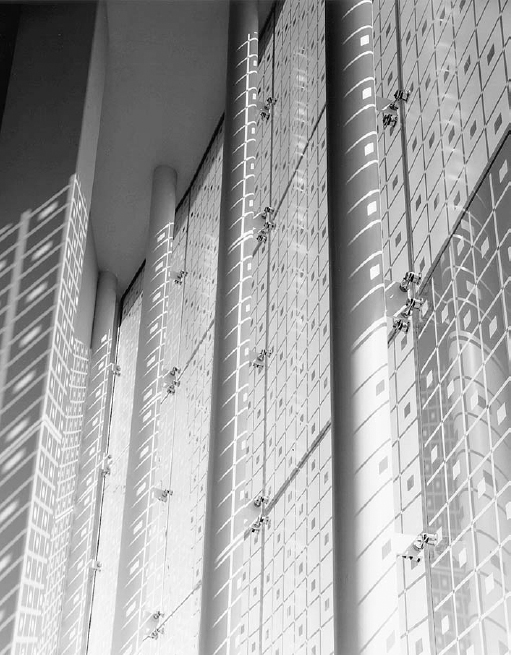
FIGURE 17.10 Fritted patterns modulate the sunlight that enters a theater lobby. (Photo of Pilkington Planar System courtesy of W&W Glass Systems, Inc.)
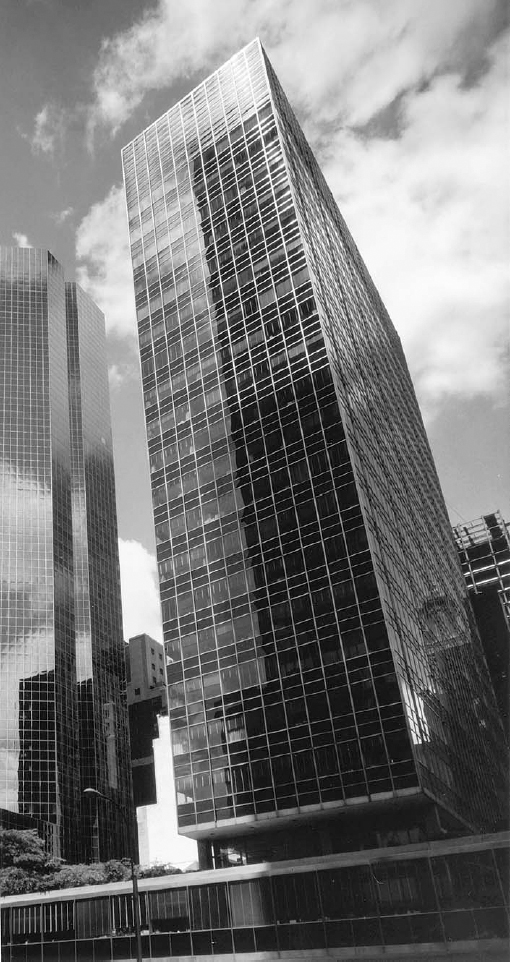
FIGURE 17.11 Lever House in New York, an early glass curtain wall building designed by architects Skidmore, Owings and Merrill, uses dark-green glass for the spandrels and lighter-green glass for the windows. (Courtesy of PPG Industries)
Visible transmittance and solar heat gain coefficient can be combined to determine the light to solar gain (LSG) ratio, a useful measure of the overall energy-conserving potential of glass. The LSG ratio is defined as the visible light transmittance divided by the solar heat gain coefficient. A glass with high LSG admits a relatively large portion of visible light in comparison to the amount of solar heat admitted, combining the greatest daylighting potential with the least solar heating potential. Green-and blue-tinted glasses tend to have high LSG ratios values, while those of bronze, gold, and gray tints tend to be lower.
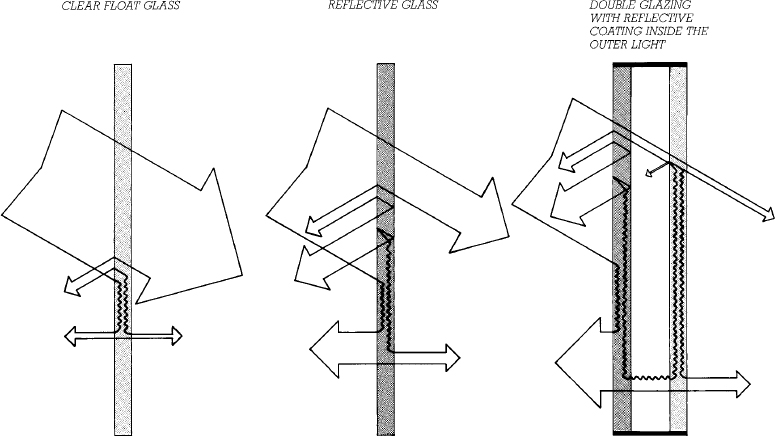
FIGURE 17.12 A schematic representation of the effect of three different glazing assemblies on incoming sunlight. Outdoors is to the left. The relative widths of the arrows indicate the relative percentages of the incoming light transmitted, reflected, and absorbed. In clear float glass, to the left, most of the light is transmitted, with small quantities reflected, absorbed, and reradiated as heat. Reflective coated glass, at the center, bounces a large proportion of the light back to the outdoors, and also absorbs and reradiates a significant amount. In double glazing, many different combinations of types of glass are possible; the one shown to the right of this diagram utilizes glass with a reflective coating on the inner side of the outer light.
Reflective Coated Glass
Thin, durable films of metal or metal oxide can be deposited on a surface of either clear or tinted glass sheets under closely controlled conditions to make reflective coated glass, also called solar control glass. Depending on its composition, the film may be applied to either the inside of the glass or the outside. In double glazing, it may also be applied to either of the surfaces that face the space between the layers of glass. While remaining thin enough to see through, the film reflects a substantial portion of the incident visible light. Visible light transmittance and solar heat gain coefficients (SHGC) for reflective coated glasses vary significantly, depending on the density of the metallic coating and the tinting of the glass to which it is applied. Reflective coated glasses appear as mirrors from the outside on a bright day and are often chosen by architects for this property alone (Figure 17.13). At night, with lights on inside the building, they appear as dark but transparent glass.
The sunlight reflected by a building glazed with reflective coated glass can be helpful in some circumstances by lighting an otherwise dark urban street space. It can also create problems in other situations by bouncing solar heat and glare into neighboring buildings and onto the street.

FIGURE 17.13 Reflective coated windows with subtly different reflective coated glass spandrels. (Architects: Paul Rudolph and 3D International. Photo courtesy of PPG Industries)
Who when he first saw the sand and ashes . . . would have imagined that in this shapeless lump lay concealed so many conveniences in life . . . by some such fortuitous liquefaction was mankind taught to procure a body at once in a high degree solid and transparent; which might admit the light of the sun, and exclude the violence of the wind; which might extend the sight of the philosopher to new ranges of existence. . . .
Dr. Samuel Johnson, writer and lexicographer, The Rambler, April 17, 1750.
Insulating Glass
Window glass is a poor thermal insulator. A single sheet of glass (single glazing) conducts heat about 5 times as fast as 1 inch (25 mm) of polystyrene foam insulation and 20 times as fast as a well-insulated wall. A second sheet of glass applied to a window with an airspace between the two sheets (double glazing) cuts this rate of heat loss in half, and a third sheet with its additional airspace (triple glazing) reduces the rate of heat loss to about a third of the rate through a single sheet. A triple-glazed window, however, still loses heat about six times as fast as the wall in which it is placed. Continuing to add additional sheets of glass and airspaces adds weight, bulk, and expense to the glazing unit and the frame that holds it, making double and triple glazing the practical maximums for normal building glazing applications.
To prevent moisture condensation within the airspace of double or triple glazing (also called insulating glass units or IGUs), the units are usually hermetically sealed at the time of manufacture with dry air inserted in the space between the glass lights. Originally, for small lights of double glass, the edges of the two sheets were simply fused together (Figure 17.14). However, this detail is seldom used now because the fused glass edge is highly conductive of heat. Instead, a hollow metal edge spacer (also called a spline) is inserted between the edges of the sheets of glass, and the edges are closed with an organic sealant compound. A small amount of a chemical drying agent, or desiccant, is left inside the spacer to remove any residual moisture from the trapped air. The air is always inserted at atmospheric pressure to avoid structural pressures on the glass. (When insulating glass units do exhibit internal condensation, it is a sign of failure of the edge seal, and the unit must be replaced.)
The thickness of the airspace in insulating glass units is less critical to the units’ insulating value than the mere presence of the airspace: From ⅜ inch (9 mm) up to about 1 inch (25 mm) of thickness, the insulating value of the airspace increases somewhat, but above that thickness little additional benefit is gained. A standard overall thickness for large lights of double glazing is 1 inch (25.4 mm), which results in an airspace ½ inch (13 mm) thick if ¼-inch (6-mm) glass is used.
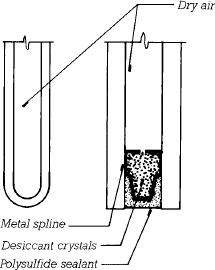
FIGURE 17.14 Two methods of sealing the edge of double glazing: fused glass edges, to the left, and a metal spline and organic sealant, to the right. Desiccant crystals in the spline (edge spacer) absorb any residual moisture in the airspace. Splines also improve the thermal performance of the insulated units in the areas close to the unit edges in comparison to fused glass edges.
For slightly improved thermal performance, stainless steel, which is less conductive of heat, may be used instead of aluminum for the spacer, and a sealant material may be placed between the glass and the spacer as a thermal break. For even better thermal performance, so-called warm edge spacers made of thermally broken aluminum or extruded rubber may be used.
The thermal performance of insulated glazing units can also be improved by introducing gases with greater density and lower thermal conductivity than that of ordinary air between the sheets of glass. Depending on the gas used and the thickness of the space between the glass sheets, improvements in thermal performance of 12 to 18 percent are possible. Argon and krypton are the gases most commonly used.
The performance of glazing as a thermal insulator is quantified as its U-Factor. U-Factor is expressed as BTUs per square foot-hour-degree Fahrenheit (BTU/ft2-hr-°F) or, in metric units, as watts per square meter-degree Kelvin (W/m2-°K). U-Factor is the mathematical reciprocal of R (see page 658), and as such, lower values represent improved thermal performance. Some examples glazing configurations and their U-Factors are listed in Figure 17.15. For more detailed information, glass manufacturers’ product literature should be consulted.
Insulated glazing products that rely on the evacuation of most of the air from the space between the glass sheets are also under development. When combined with low-emissivity coatings (see below), such vacuum-insulated glazing units are predicted to achieve U-Factors as low as 0.080 BTU/ft2-hr-°F (0.45 W/m2-°K) in units not more than ½-inch (12 mm) in total thickness.
Low-Emissivity Coated Glass
The thermal performance of glazing can be improved substantially by the use of glass with a low-emissivity ( low-e) coating. Low-e coatings are ultrathin, virtually transparent, and almost colorless metallic coatings that selectively reflect solar radiation of different wavelengths. They have a high visible light transmittance and, depending on the particular coating, a low transmittance for some or all types of infrared radiation (heat).
Low-e coated glass is most commonly used as one of the two lights in double glazing, where it offers several benefits: By reducing the radiant transfer of heat between individual lights, the overall thermal transmittance of the glazing unit is reduced to the extent that low-e double glazing can meet or exceed the thermal performance of ordinary triple glazing. By reflecting the majority of the infrared component of solar radiation, low-e double glazing can simultaneously provide high visible light transmittance with low solar heat gain, allowing such units to achieve the highest light to solar gain ratios of any insulated glass type.
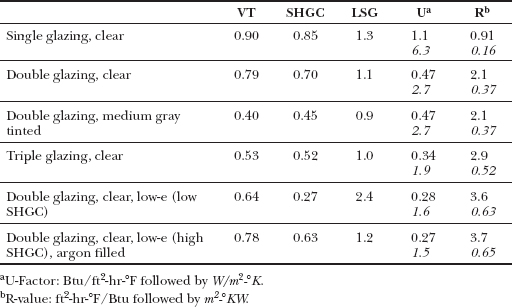
FIGURE 17.15 Comparative properties of some example glass types. Note the high light to solar gain (LSG) ratio possible with low-e double glazing. LSG is the quotient of visible transmittance (VT) over solar heat gain coefficient (SHGC). Higher LSG values indicate better overall energy efficiency of the glazing unit (in buildings where cooling loads dominate). U-Factors and R-values are center-of-glass values and, for the insulating glass units listed, do not account for reduced thermal performance around the edges of the units due to the greater conductivity of the spacers. The lower the U-Factor (higher the R-value), the better the thermal performance of the unit.
By varying the properties of the low-e coating and by combining it with different types of tinted glass, the performance characteristics of the glazing unit can be tailored to meet different needs. For buildings dominated by wintertime heating, low-e units with high U-Factors (to minimize heat loss) and high solar heat gain coefficients (to promote wintertime solar heat gains) may be selected. For buildings dominated by cooling loads, units with low solar heat gain coefficients (to minimize solar heating) and lower visible light transmittance are used (Figure 17.15). Like laminated glass, low-e coated glass also has low UV radiation transmittance, a benefit to interior finishes and furnishings. Though less common, low-e coated glass may also be used in single or triple glazing to improve the thermal performance of these glass types.
When specifying glass with any type of coating (low-e glass or reflective coated glass), it is necessary to specify on which glass surface the coating is to be located. By convention, glass surfaces are numbered starting from the exterior side of a glazing unit and working inward. In single glazing, the outward face is surface number 1 and the inward face is surface number 2. In double glazing, the outward face of the outer glass light is surface number 1 and the inward face of this light is surface number 2; the outward face of the inner glass light is surface number 3, and its inward face is surface number 4. In low-e double glazing, the low-e coating is most commonly located on the number 2 surface, although, where a high solar heat gain coefficient is desired, it may be located on the number 3 surface instead.
Low-e coatings can also be applied to very thin membranes of transparent plastic. One or two of these plastic films can be installed within the center of the airspace or gas space of a double glazed unit, stretched tight, parallel to the sheets of glass, where they act as virtually weightless additional glazing elements. Combined with selective properties of the low-e coating, thermal performance values ranging from R-6 to R-20 are claimed by manufacturers of these films.
Self-Cleaning Glass
Glass tends to attract dirt, and must be washed periodically both inside and out to maintain its transparency. Self-cleaning glass is coated with titanium oxide on its exterior surface. This coating acts as a catalyst that enables sunlight to convert organic dirt to carbon dioxide and water. It also causes rainwater to run down the surface in sheets rather than to bead up. Nonorganic dirt, such as sand, is unaffected by the catalyst, but the sheets of water are more effective at removing such matter than beaded water. The coating is applied only to the outside of the glass; therefore, the interior surface of the glass must be washed manually.
Glass That Changes Its Properties
Glass that can change its optical properties is called chromogenic glass. Thermochromic glass becomes darker when it is warmed by the sun. Photochromic glass becomes darker when exposed to bright light. Both types are potentially valuable as passive devices to reduce cooling loads in buildings.
Electrochromic glass changes its transparency in response to the passage of electric current. Also called switchable glass, it can be actively controlled by building occupants or automated systems, allowing, in comparison to passive technologies, more precise response to requirements for control of solar heat gain, daylighting, or occupant privacy. Currently available electrochromic glass products mostly rely on solid state liquid crystal technology, similar to that used in electronic flat panel displays. These products are limited to interior applications where control over transparency and privacy is desired, but they are not suitable to the conditions to which exterior glazing is subjected. Other technologies currently under development are expected to result in products that are suitable for both exterior as well interior exposures, that can selectively control portions of the solar spectrum (such as infrared radiation), and that can switch between transparent and reflective states.
Gasochromic glass is another developing switchable technology for altering the light transmittance of glass, in which the transparency of a reactive coating on the number 2 surface of an insulated glass unit is altered by the pumping of gas into or out of the interstitial space of the unit.
Other Types of Glass
Glass can be produced with an amazing range of physical properties and variations in appearance, and new products with unique characteristics continue to be developed. Fins of structural glass function as beams to resist wind loads in very tall or wide curtain walls, and one glass manufacturer has produced hollow glass cylinders prestressed with steel wire running through its center axis that it claims can take the place of concrete or steel elements in resisting structural compressive loads.
Antireflective glass minimizes residual reflections that normally occur when light levels differ significantly on the opposite sides of glass. It is used for glazing in showrooms, display areas, sports stadiums, artwork framing, and other applications where the highest possible optical quality is desired. Mirrors are made of mirror glass, which has a thin silver-based coating on its back side. A thin layer of copper applied over the silver prevents corrosion, and a second layer of backing paint provides additional protection. Patterned glass, hot glass rolled into sheets with many different surface patterns and textures, is used where light transmission is desired but vision must be obscured for privacy. Glass manufactured with a high percentage of lead oxide can be used as radiation-shielding glass. Photovoltaic glass is coated with a thin film of amorphous silicon that generates electricity from sunlight. It allows a building with a large glazed area to create at least some of the electric energy that it uses for lights and machinery. Traditional stained glass and contemporary colored glass, formulated with ingredients that alter the color of the glass, can be used in a wide range of artistic and architectural applications. Glass may be blown, molded, fused, and colored to produce an infinite variety of types of art glass used for decorative and sculptural purposes.
Plastic Glazing Sheets
Transparent plastic sheet materials are often used instead of glass for specialized glazing applications. The two most common plastic glazing materials are acrylic and polycarbonate. Both are more expensive than ordinary float glass. Both have very high coefficients of thermal expansion, which cause them not merely to expand and contract with temperature changes, but also to bow visibly toward the warm side when subjected to high indoor–outdoor temperature differentials. This, in turn, requires that plastic sheet materials be installed in their frames with relatively expensive glazing details that allow for plenty of linear movement and rotation. Both polycarbonate and acrylic are soft and easily scratched, although more scratch-resistant formulations are available.
Plastic glazing is most commonly used where glass is inappropriate: Plastics can be cut to shapes with inside corners (L-shapes and T-shapes, for example) that are likely to crack if cut from glass. They can be bent easily to fit in curved frames. They can be heat-formed into domed glazing for skylights. And the plastics, especially polycarbonate, which is literally impossible to break under ordinary conditions, are widely used for windows in buildings where vandalism is a problem or high impact resistance is required. Polycarbonate plastics can be manufactured in a variety of colors and varying degrees of transparency. They can also be manufactured in a double-walled configuration, called cellular polycarbonate glazing, creating hollow panels, roughly ¼ inch to 1½ inches (6–40 mm) thick, with greater stiffness and better thermal performance than solid sheets. Plastic glazing sheets can also meet safety requirements for glazing used in areas subject to human impact.
Translucent but nontransparent plastic sheets reinforced with glass fibers (fiberglass-reinforced polyester glazing) are also used in buildings. Corrugated sheets are used for industrial skylights and residential patio roofs. Thin, flat sheets of a special formulation with a high translucency to solar energy are used for skylights and low-cost solar collector glazing.
Aerogel-Filled Glazing
Aerogel, a silicon-based foam that is 99.8 percent air, can be used to fill the cavity in double-glazed glass or plastic products. Though aerogel was invented many decades ago, its commercialization was delayed by its fragility and high cost of manufacture—problems that have only recently been solved. Aerogel is milky in color, not fully transparent, and has a visible transmittance that varies with its thickness. Aerogel-filled glazing has a good light to solar gain ratio, making it an efficient source of diffuse, low-contrast, natural daylight. Currently available aerogel products can achieve insulating values of R-8 per inch (RSI-1.4 per 25 mm), more than twice that of glass fiber insulation. Products under development that rely on nanotechnology to improve thermal performance are claimed to have insulating values as high as R-40 per inch (RSI-7 per 25 mm).
Leave a Reply