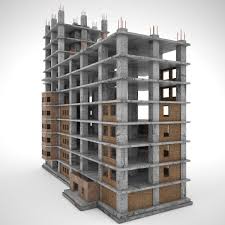
Underpinning is the method of supporting structures while providing new foundations or strengthening the foundation or carrying out repairs and alterations without affecting the stability of the existing structures.

Figure 22.12 Dead-shores used for repairs
22.6.1 Uses of Underpinning
Underpinning techniques are adopted under the following situations:
- To strengthen the existing shallow foundation of a building when an adjoining building has to be constructed with a deep foundation.
- To safeguard the existing structure from the danger of excessive or differential settlement.
- To deepen and widen an existing foundation to increase the bearing capacity of the foundation soil.
- To build a basement floor to an existing building.
- To lift a building fully or partly to alter the foundation so as to prevent from waterlogging.
22.6.2 Precautionary Measures Before Underpinning
The following general measures should be undertaken before starting the underpinning operations:
- The existing strength of the building should be ascertained before resorting to underpinning (e.g., inferior material used or use of construction method which is not standard or poor workmanship).
- Temporary support should be provided by adequate shoring and strutting wherever needed.
- During underpinning of buildings, a watch on possible movements should be checked and rectified then and there.
- No damage should be caused to the adjoining structures.
- It should be ensured that no obstruction is created to the passage of people or vehicles in the adjoining areas.
22.6.3 Methods of Underpinning
Several methods are available for underpinning foundations but four routine methods which are used in general are:
- Pit Method
- Pile Method
- Pier Method
- Chemical Method
1. Pit Method
Generally underpinning by pit method is carried out by excavating slowly in stages. For this the existing wall is divided into suitable width of about 1.20–1.50 m. Holes are made in the existing wall in the required points. Needles with bearing plates are then inserted through these holes and supported on jacks, Fig. 22.13. This is followed by excavation, first up to the existing foundation level and then to the required depth.

Figure 22.13 Pit method
During the process of excavation, the following precautions are to be taken to avoid formation of crakes or settlement:
- Excavation should be done one at a time preferably starting at the middle and progressing sideways.
- Proper timbering is to be provided to the excavated trenches.
- Instead of central needle beam, cantilever needle beam may be adopted as shown in Fig. 22.14.
- After completion of excavation, foundation concrete is laid.
- A suitable connection between the old foundation and new foundation has to be made using vertical mild steel bars.
- After the new foundation is completely set, then only the needle beams and raking shores are removed.

Figure 22.14 Support by cantilever needle
2. Pile Method
Pit method may be impracticable or uneconomical in the following cases:
- Waterlogged area
- Heavy loads on existing structures
- Loads to be transferred to a deeper depth
In such situations pile method may be adopted.
In this method, the piles are driven along both the sides of the existing wall. Then needles in the form of pile caps are provided through the existing wall as shown in Fig. 22.15. Thus, the existing wall is relieved of the loads coming on it.

Figure 22.15 Underpinning by piles
This method is particularly useful in clayey soils and for waterlogged areas and for walls bearing heavy loads. In case of light structures piles are driven along the structure and then brackets or cantilever needles are provided.
In another approach, pre-cast piles are installed beneath the existing foundation using jacks and digging approach pits. The materials surrounding the pit is removed by water jets or air lifts and then filled with cement concrete.
3. Pier Method
This method is generally resorted to in dry ground. This is a simple method of underpinning. It involves the installation of piers under foundations of structures through the approach pits. Filling the pits with concrete and finally wedging up to transfer the loads to the new piers, Fig. 22.16.

Figure 22.16 Underpinning by pier
4. Chemical Method
In this method the foundation soil is consolidated by employing chemicals.
Perforated pipes are driver in an inclined direction beneath the foundation, Fig. 22.17. The slopes are provided such that the entire area under the existing footing corners under the area used to be strengthened.

Figure 22.17 Chemical method
After the pipes are installed, solution of sodium silicate in water is injected through the pipes. This is a two-injection method. The pipes are withdrawn and at the time of withdrawal of pipes, calcium or magnesium chloride is injected through the pipes. Chemical reaction takes place between these two chemicals and the soil is strengthened by consolidation. This method is suitable for granular soils.
Leave a Reply