
Energy is considered a prime agent in the generation of wealth and a significant factor in economic development. The importance of energy in economic development is recognized universally and historical data verify that there is a strong relationship between the availability of energy and economic activity. Although in the early 1970s, after the oil crisis, the concern was on the cost of energy, during the past two decades the risk and reality of environmental degradation have become more apparent. The growing evidence of environmental problems is due to a combination of several factors since the environmental impact of human activities has grown dramatically. This is due to the increase of the world population, energy consumption, and industrial activity. Achieving solutions to the environmental problems that humanity faces today requires long-term potential actions for sustainable development. In this respect, renewable energy resources appear to be one of the most efficient and effective solutions.
A few years ago, most environmental analysis and legal control instruments concentrated on conventional pollutants such as sulfur dioxide (SO2), nitrogen oxides (NOx), particulates, and carbon monoxide (CO). Recently, however, environmental concern has extended to the control of hazardous air pollutants, which are usually toxic chemical substances harmful even in small doses, as well as to other globally significant pollutants such as carbon dioxide (CO2). Additionally, developments in industrial processes and structures have led to new environmental problems. Carbon dioxide as a GHG plays a vital role in global warming. Studies show that it is responsible for about two-thirds of the enhanced greenhouse effect. A significant contribution to the CO2 emitted to the atmosphere is attributed to fossil fuel combustion (EPA, 2007).
The United Nations Conference on Environment and Development (UNCED), held in Rio de Janeiro, Brazil, in June 1992, addressed the challenges of achieving worldwide sustainable development. The goal of sustainable development cannot be realized without major changes in the world’s energy system. Accordingly, Agenda 21, which was adopted by UNCED, called for “new policies or programs, as appropriate, to increase the contribution of environmentally safe and sound and cost-effective energy systems, particularly new and renewable ones, through less polluting and more efficient energy production, transmission, distribution, and use”.
The division for sustainable development of the United Nations Department of Economics and Social Affairs defined sustainable development as “development that meets the needs of the present without compromising the ability of future generations to meet their own needs”. Agenda 21, the Rio Declaration on Environment and Development, was adopted by 178 governments. This is a comprehensive plan of action to be taken globally, nationally, and locally by organizations of the United Nations system, governments, and major groups in every area in which there are human impacts on the environment (United Nations, 1992). Many factors can help to achieve sustainable development. Today, one of the main factors that must be considered is energy and one of the most important issues is the requirement for a supply of energy that is fully sustainable (Rosen, 1996; Dincer and Rosen, 1998). A secure supply of energy is generally agreed to be a necessary but not a sufficient requirement for development within a society. Furthermore, for a sustainable development within a society, it is required that a sustainable supply of energy and an effective and efficient utilization of energy resources are secure. Such a supply in the long term should be readily available at reasonable cost, sustainable, and able to be utilized for all the required tasks without causing negative societal impacts. This is the reason why there is a close connection between renewable sources of energy and sustainable development.
Sustainable development is a serious policy concept. In addition to the definition just given, it can be considered as a development that must not carry the seeds of destruction, because such a development is unsustainable. The concept of sustainability has its origin in fisheries and forest management in which prevailing management practices, such as overfishing or single-species cultivation, work for limited time, then yield diminishing results and eventually endanger the resource. Therefore, sustainable management practices should not aim for maximum yield in the short run but for smaller yields that can be sustained over time.
Pollution depends on energy consumption. In 2011, the world daily oil consumption is 87.4 million barrels. Despite the well-known consequences of fossil fuel combustion on the environment, this is expected to increase to 123 million barrels per day by the year 2025 (Worldwatch, 2007). A large number of factors are significant in the determination of the future level of energy consumption and production. Such factors include population growth, economic performance, consumer tastes, and technological developments. Furthermore, government policies concerning energy and developments in the world energy markets certainly play a key role in the future level and pattern of energy production and consumption (Dincer, 1999).
In 1984, 25% of the world population consumed 70% of the total energy supply, while the remaining 75% of the population was left with 30%. If the total population were to have the same consumption per inhabitant as the Organization for Economic Cooperation and Development member countries have on average, it would result in an increase in the 1984 world energy demand from 10 TW (tera, T = 1012) to approximately 30 TW. An expected increase in the population from 4.7 billion in 1984 to 8.2 billion in 2020 would raise the figure to 50 TW.
The total primary energy demand in the world increased from 5536 GTOE3 in 1971 to 11,235 GTOE in 2007, representing an average annual increase of about 2%. It is important, however, to note that the average worldwide growth from 2001 to 2004 was 3.7%, with the increase from 2003 to 2004 being 4.3%. The rate of growth is rising mainly due to the very rapid growth in Pacific Asia, which recorded an average increase from 2001 to 2004 of 8.6%.
The major sectors using primary energy sources include electrical power, transportation, heating, and industry. The International Energy Agency data shows that the electricity demand almost tripled from 1971 to 2002. This is because electricity is a very convenient form of energy to transport and use. Although primary energy use in all sectors has increased, their relative shares have decreased, except for transportation and electricity. The relative share of primary energy for electricity production in the world increased from about 20% in 1971 to about 30% in 2002 as electricity became the preferred form of energy for all applications.
Fueled by high increases in China and India, worldwide energy consumption may continue to increase at rates between 3% and 5% for at least a few more years. However, such high rates of increase cannot continue for too long. Even at a 2% increase per year, the primary energy demand of 2002 would double by 2037 and triple by 2057. With such high energy demand expected 50 years from now, it is important to look at all the available strategies to fulfill the future demand, especially for electricity and transportation.
At present, 95% of all energy for transportation comes from oil. Therefore, the available oil resources and their production rates and prices greatly influence the future changes in transportation. An obvious replacement for oil would be biofuels such as ethanol, methanol, biodiesel, and biogases. It is believed that hydrogen is another alternative because, if it could be produced economically from renewable energy sources, it could provide a clean transportation alternative for the future.
Natural gas will be used at rapidly increasing rates to make up for the shortfall in oil production; however, it may not last much longer than oil itself at higher rates of consumption. Coal is the largest fossil resource available and the most problematic due to environmental concerns. All indications show that coal use will continue to grow for power production around the world because of expected increases in China, India, Australia, and other countries. This, however, would be unsustainable, from the environmental point of view, unless advanced clean coal technologies with carbon sequestration are deployed.
Another parameter to be considered is the world population. This is expected to double by the middle of this century and as economic development will certainly continue to grow, the global demand for energy is expected to increase. For example, the most populous country, China, increased its primary energy consumption by 15% from 2003 to 2004. Today, much evidence exists to suggest that the future of our planet and the generations to come will be negatively affected if humans keep degrading the environment. Currently, three environmental problems are internationally known: acid precipitation, the stratospheric ozone depletion, and global climate change. These issues are analyzed in more detail in the following subsections.
Acid rain
Acid rain is a form of pollution depletion in which SO2 and NOx produced by the combustion of fossil fuels are transported over great distances through the atmosphere, where they react with water molecules to produce acids deposited via precipitation on the earth, causing damage to ecosystems that are exceedingly vulnerable to excessive acidity. Therefore, it is obvious that the solution to the issue of acid rain deposition requires an appropriate control of SO2 and NOx pollutants. These pollutants cause both regional and transboundary problems of acid precipitation.
Recently, attention also has been given to other substances, such as volatile organic compounds (VOCs), chlorides, ozone, and trace metals that may participate in a complex set of chemical transformations in the atmosphere, resulting in acid precipitation and the formation of other regional air pollutants.
It is well known that some energy-related activities are the major sources of acid precipitation. Additionally, VOCs are generated by a variety of sources and comprise a large number of diverse compounds. Obviously, the more energy we expend, the more we contribute to acid precipitation; therefore, the easiest way to reduce acid precipitation is by reducing energy consumption.
Ozone layer depletion
The ozone present in the stratosphere, at altitudes between 12 and 25 km, plays a natural equilibrium-maintaining role for the earth through absorption of ultraviolet (UV) radiation (240–320 nm) and absorption of infrared radiation (Dincer, 1998). A global environmental problem is the depletion of the stratospheric ozone layer, which is caused by the emissions of chlorofluorocarbons (CFCs), halons (chlorinated and brominated organic compounds), and NOx. Ozone depletion can lead to increased levels of damaging UV radiation reaching the ground, causing increased rates of skin cancer and eye damage to humans, and is harmful to many biological species. It should be noted that energy-related activities are only partially (directly or indirectly) responsible for the emissions that lead to stratospheric ozone depletion. The most significant role in ozone depletion is played by the CFCs, which are mainly used in air-conditioning and refrigerating equipment as refrigerants, and NOx emissions, which are produced by the fossil fuel and biomass combustion processes, natural denitrification, and nitrogen fertilizers.
In 1998, the size of the ozone hole over Antarctica was 25 million km2 whereas in 2012 it is 18 million km2. It was about 3 million km2 in 1993 (Worldwatch, 2007). Researchers expect the Antarctic ozone hole to remain severe in the next 10–20 years, followed by a period of slow healing. Full recovery is predicted to occur in 2050; however, the rate of recovery is affected by the climate change (Dincer, 1999).
1.3.3 Global climate change
The term greenhouse effect has generally been used for the role of the whole atmosphere (mainly water vapor and clouds) in keeping the surface of the earth warm. Recently, however, it has been increasingly associated with the contribution of CO2, which is estimated to contribute about 50% to the anthropogenic greenhouse effect. Additionally, several other gases, such as CH4, CFCs, halons, N2O, ozone, and peroxyacetylnitrate (also called GHGs), produced by the industrial and domestic activities can contribute to this effect, resulting in a rise of the earth’s temperature. Increasing atmospheric concentrations of GHGs increase the amount of heat trapped (or decrease the heat radiated from the earth’s surface), thereby raising the surface temperature of the earth. According to Colonbo (1992), the earth’s surface temperature has increased by about 0.6 °C over the past century, and as a consequence the sea level is estimated to have risen by perhaps 20 cm. These changes can have a wide range of effects on human activities all over the world. The role of various GHGs is summarized by Dincer and Rosen (1998).
According to the EU, climate change is happening. There is an overwhelming consensus among the world’s leading climate scientists that global warming is being caused mainly by carbon dioxide and other GHGs emitted by human activities, chiefly the combustion of fossil fuels and deforestation.
A reproduction of the climate over the past 420,000 years was made recently using data from the Vostok ice core in Antarctica. An ice core is a core sample from the accumulation of snow and ice over many years that has recrystallized and trapped air bubbles from previous time periods. The composition of these ice cores, especially the presence of hydrogen and oxygen isotopes, provides a picture of the climate at the time. The data extracted from this ice core provide a continuous record of temperature and atmospheric composition. Two parameters of interest are the concentration of CO2 in the atmosphere and the temperature. These are shown in Figure 1.1, considering 1950 as the reference year. As can be seen, the two parameters follow a similar trend and have a periodicity of about 100,000 years. If one considers, however, the present (December 2012) CO2 level, which is 392.92 ppm (www.co2now.org), the highest ever recorded, one can understand the implication that this would have on the temperature of the planet.
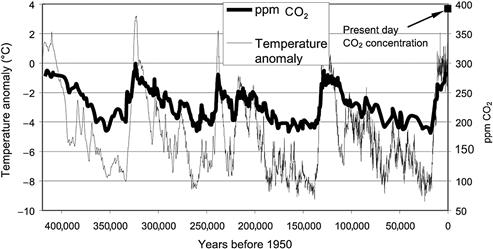
FIGURE 1.1 Temperature and CO2 concentration from the Vostok ice core.
Humans, through many of their economic and other activities, contribute to the increase of the atmospheric concentrations of various GHGs. For example, CO2 releases from fossil fuel combustion, methane emissions from increased human activities, and CFC releases contribute to the greenhouse effect. Predictions show that if atmospheric concentrations of GHGs, mainly due to fossil fuel combustion, continue to increase at the present rates, the earth’s temperature may increase by another 2–4 °C in the next century. If this prediction is realized, the sea level could rise by 30–60 cm before the end of this century (Colonbo, 1992). The impacts of such sea level increase can easily be understood and include flooding of coastal settlements, displacement of fertile zones for agriculture to higher latitudes, and decrease in availability of freshwater for irrigation and other essential uses. Thus, such consequences could put in danger the survival of entire populations.
Nuclear energy
Nuclear energy, although non-polluting, presents a number of potential hazards during the production stage and mainly for the disposal of radioactive waste. Nuclear power environmental effects include the effects on air, water, ground, and the biosphere (people, plants, and animals). Nowadays, in many countries, laws govern any radioactive releases from nuclear power plants. In this section some of the most serious environmental problems associated with electricity produced from nuclear energy are described. These include only the effects related to nuclear energy and not the emissions of other substances due to the normal thermodynamic cycle.
The first item to consider is radioactive gases that may be removed from the systems supporting the reactor cooling system. The removed gases are compressed and stored. The gases are periodically sampled and can be released only when the radioactivity is less than an acceptable level, according to certain standards. Releases of this nature are done very infrequently. Usually, all potential paths where radioactive materials could be released to the environment are monitored by radiation monitors (Virtual Nuclear Tourist, 2007).
Nuclear plant liquid releases are slightly radioactive. Very low levels of leakage may be allowed from the reactor cooling system to the secondary cooling system of the steam generator. However, in any case where radioactive water may be released to the environment, it must be stored and radioactivity levels reduced, through ion exchange processes, to levels below those allowed by the regulations.
Within the nuclear plant, a number of systems may contain radioactive fluids. Those liquids must be stored, cleaned, sampled, and verified to be below acceptable levels before release. As in the gaseous release case, radiation detectors monitor release paths and isolate them (close valves) if radiation levels exceed a preset set point (Virtual Nuclear Tourist, 2007).
Nuclear-related mining effects are similar to those of other industries and include generation of tailings and water pollution. Uranium milling plants process naturally radioactive materials. Radioactive airborne emissions and local land contamination were evidenced until stricter environmental rules aided in forcing cleanup of these sites.
As with other industries, operations at nuclear plants result in waste; some of it, however, is radioactive. Solid radioactive materials leave the plant by only two paths:
• Radioactive waste (e.g. clothes, rags, wood) is compacted and placed in drums. These drums must be thoroughly dewatered. The drums are often checked at the receiving location by regulatory agencies. Special landfills must be used.
• Spent resin may be very radioactive and is shipped in specially designed containers.
Generally, waste is distinguished into two categories: low-level waste (LLW) and high-level waste (HLW). LLW is shipped from nuclear plants and includes such solid waste as contaminated clothing, exhausted resins, or other materials that cannot be reused or recycled. Most anti-contamination clothing is washed and reused; however, eventually, as with regular clothing, it wears out. In some cases, incineration or super-compaction may be used to reduce the amount of waste that has to be stored in the special landfills.
HLW is considered to include the fuel assemblies, rods, and waste separated from the spent fuel after removal from the reactor. Currently the spent fuel is stored at the nuclear power plant sites in storage pools or in large metal casks. To ship the spent fuel, special transport casks have been developed and tested.
Originally, the intent had been that the spent fuel would be reprocessed. The limited amount of highly radioactive waste (also called HLW) was to be placed in glass rods surrounded by metal with low long-term corrosion or degradation properties. The intent was to store those rods in specially designed vaults where the rods could be recovered for the first 50–100 years and then made irretrievable for up to 10,000 years. Various underground locations can be used for this purpose, such as salt domes, granite formations, and basalt formations. The objective is to have a geologically stable location with minimal chance for groundwater intrusion. The intent had been to recover the plutonium and unused uranium fuel and then reuse it in either breeder or thermal reactors as mixed oxide fuel. Currently, France, Great Britain, and Japan are using this process (Virtual Nuclear Tourist, 2007).
Renewable energy technologies
Renewable energy technologies produce marketable energy by converting natural phenomena into useful forms of energy. These technologies use the sun’s energy and its direct and indirect effects on the earth (solar radiation, wind, falling water, and various plants; i.e., biomass), gravitational forces (tides), and the heat of the earth’s core (geothermal) as the resources from which energy is produced. These resources have massive energy potential; however, they are generally diffused and not fully accessible, and most of them are intermittent and have distinct regional variabilities. These characteristics give rise to difficult, but solvable, technical and economical challenges. Nowadays, significant progress is made by improving the collection and conversion efficiencies, lowering the initial and maintenance costs, and increasing the reliability and applicability of renewable energy systems.
Worldwide research and development in the field of renewable energy resources and systems has been carried out during the past two decades. Energy conversion systems that are based on renewable energy technologies appeared to be cost-effective compared with the projected high cost of oil. Furthermore, renewable energy systems can have a beneficial impact on the environmental, economic, and political issues of the world. At the end of 2001 the total installed capacity of renewable energy systems was equivalent to 9% of the total electricity generation (Sayigh, 2001). As was seen before, by applying the renewable energy-intensive scenario, the global consumption of renewable sources by 2050 would reach 318 EJ (Johanson et al., 1993).
The benefits arising from the installation and operation of renewable energy systems can be distinguished into three categories: energy saving, generation of new working posts, and decrease in environmental pollution.
The energy-saving benefit derives from the reduction in consumption of the electricity and diesel used conventionally to provide energy. This benefit can be directly translated into monetary units according to the corresponding production or avoiding capital expenditure for the purchase of imported fossil fuels.
Another factor of considerable importance in many countries is the ability of renewable energy technologies to generate jobs. The penetration of a new technology leads to the development of new production activities, contributing to the production, market distribution, and operation of the pertinent equipment. Specifically for the case of solar energy collectors, job creation is mainly related to the construction and installation of the collectors. The latter is a decentralized process, since it requires the installation of equipment in every building or for every individual consumer.
The most important benefit of renewable energy systems is the decrease in environmental pollution. This is achieved by the reduction of air emissions due to the substitution of electricity and conventional fuels. The most important effects of air pollutants on the human and natural environment are their impact on the public health, agriculture, and on ecosystems. It is relatively simple to measure the financial impact of these effects when they relate to tradable goods, such as the agricultural crops; however, when it comes to non-tradable goods, such as human health and ecosystems, things become more complicated. It should be noted that the level of the environmental impact and therefore the social pollution cost largely depend on the geographical location of the emission sources. Contrary to the conventional air pollutants, the social cost of CO2 does not vary with the geographical characteristics of the source, as each unit of CO2 contributes equally to the climate change thread and the resulting cost.
All renewable energy sources combined account for only 22.5% share of electricity production in the world (2010), with hydroelectric power providing almost 90% of this amount. However, as the renewable energy technologies mature and become even more cost competitive in the future, they will be in a position to replace a major fraction of fossil fuels for electricity generation. Therefore, substituting fossil fuels with renewable energy for electricity generation must be an important part of any strategy of reducing CO2 emissions into the atmosphere and combating global climate change.
In this book, emphasis is given to solar thermal systems. Solar thermal systems are non-polluting and offer significant protection of the environment. The reduction of GHG pollution is the main advantage of utilizing solar energy. Therefore, solar thermal systems should be employed whenever possible to achieve a sustainable future.
The benefits of renewable energy systems can be summarized as follows (Johanson et al., 1993):
• Social and economic development. Production of renewable energy, particularly biomass, can provide economic development and employment opportunities, especially in rural areas, that otherwise have limited opportunities for economic growth. Renewable energy can thus help reduce poverty in rural areas and reduce pressure for urban migration.
• Land restoration. Growing biomass for energy on degraded lands can provide the incentive and financing needed to restore lands rendered nearly useless by previous agricultural or forestry practices. Although lands farmed for energy would not be restored to their original condition, the recovery of these lands for biomass plantations would support rural development, prevent erosion, and provide a better habitat for wildlife than at present.
• Reduced air pollution. Renewable energy technologies, such as methanol or hydrogen for fuel cell vehicles, produce virtually none of the emissions associated with urban air pollution and acid deposition, without the need for costly additional controls.
• Abatement of global warming. Renewable energy use does not produce carbon dioxide or other greenhouse emissions that contribute to global warming. Even the use of biomass fuels does not contribute to global warming, since the carbon dioxide released when biomass is burned equals the amount absorbed from the atmosphere by plants as they are grown for biomass fuel.
• Fuel supply diversity. There would be substantial interregional energy trade in a renewable energy-intensive future, involving a diversity of energy carriers and suppliers. Energy importers would be able to choose from among more producers and fuel types than they do today and thus would be less vulnerable to monopoly price manipulation or unexpected disruptions of supply. Such competition would make wide swings in energy prices less likely, leading eventually to stabilization of the world oil price. The growth in world energy trade would also provide new opportunities for energy suppliers. Especially promising are the prospects for trade in alcohol fuels, such as methanol, derived from biomass and hydrogen.
• Reducing the risks of nuclear weapons proliferation. Competitive renewable resources could reduce incentives to build a large world infrastructure in support of nuclear energy, thus avoiding major increases in the production, transportation, and storage of plutonium and other radioactive materials that could be diverted to nuclear weapons production.
Solar systems, including solar thermal and PVs, offer environmental advantages over electricity generation using conventional energy sources. The benefits arising from the installation and operation of solar energy systems fall into two main categories: environmental and socioeconomical issues.
From an environmental viewpoint, the use of solar energy technologies has several positive implications that include (Abu-Zour and Riffat, 2006):
• Reduction of the emission of the GHGs (mainly CO2 and NOx) and of toxic gas emissions (SO2, particulates),
• Reclamation of degraded land,
• Reduced requirement for transmission lines within the electricity grid, and
• Improvement in the quality of water resources.
The socioeconomic benefits of solar technologies include:
• Increased regional and national energy independence,
• Creation of employment opportunities,
• Restructuring of energy markets due to penetration of a new technology and the growth of new production activities,
• Diversification and security (stability) of energy supply,
• Acceleration of electrification of rural communities in isolated areas, and
It is worth noting that no artificial project can completely avoid some impact to the environment. The negative environmental aspects of solar energy systems include:
• Pollution stemming from production, installation, maintenance, and demolition of the systems,
These adverse impacts present difficult but solvable technical challenges.
The amount of sunlight striking the earth’s atmosphere continuously is 1.75 × 10⁵ TW. Considering a 60% transmittance through the atmospheric cloud cover, 1.05 × 10⁵ TW reaches the earth’s surface continuously. If the irradiance on only 1% of the earth’s surface could be converted into electric energy with a 10% efficiency, it would provide a resource base of 105 TW, while the total global energy needs for 2050 are projected to be about 25–30 TW. The present state of solar energy technologies is such that single solar cell efficiencies have reached more than 20%, with concentrating PVs at about 40%, and solar thermal systems provide efficiencies of 40–60%.
Solar PV panels have come down in cost from about $30/W to about $0.8/W in the past three decades. At $0.8/W panel cost, the overall system cost is around $2.5-5/W (depending on the size of the installation), which is still too high for the average consumer. However, solar PV is already cost-effective in many off-grid applications. With net metering and governmental incentives, such as feed-in laws and other policies, even grid-connected applications such as building-integrated PV have become cost-effective. As a result, the worldwide growth in PV production has averaged more than 30% per year during the past 5 years.
Solar thermal power using concentrating solar collectors was the first solar technology that demonstrated its grid power potential. A total of 354 MWe solar thermal power plants have been operating continuously in California since 1985. Progress in solar thermal power stalled after that time because of poor policy and lack of R&D. However, the past 5 years have seen a resurgence of interest in this area, and a number of solar thermal power plants around the world are constructed and more are under construction. The cost of power from these plants (which so far is in the range of $0.12–$0.16/kWh) has the potential to go down to $0.05/kWh with scale-up and creation of a mass market. An advantage of solar thermal power is that thermal energy can be stored efficiently and fuels such as natural gas or biogas may be used as backup to ensure continuous operation.
Leave a Reply