
In solar energy calculations, apparent solar time (AST) must be used to express the time of day. AST is based on the apparent angular motion of the sun across the sky. The time when the sun crosses the meridian of the observer is the local solar noon. It usually does not coincide with the 12:00 o’clock time of a locality. To convert the local standard time (LST) to AST, two corrections are applied; the equation of time (ET) and longitude correction. These are analyzed next.
Equation of time
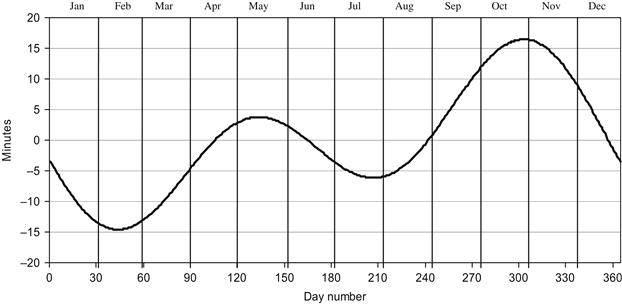
Due to factors associated with the earth’s orbit around the sun, the earth’s orbital velocity varies throughout the year, so the AST varies slightly from the mean time kept by a clock running at a uniform rate. The variation is called the equation of time (ET). The ET arises because the length of a day, that is, the time required by the earth to complete one revolution about its own axis with respect to the sun, is not uniform throughout the year. Over the year, the average length of a day is 24 h; however, the length of a day varies due to the eccentricity of the earth’s orbit and the tilt of the earth’s axis from the normal plane of its orbit. Due to the ellipticity of the orbit, the earth is closer to the sun on January 3 and furthest from the sun on July 4. Therefore the earth’s orbiting speed is faster than its average speed for half the year (from about October through March) and slower than its average speed for the remaining half of the year (from about April through September).
The values of the ET as a function of the day of the year (N) can be obtained approximately from the following equations:
 (2.1)
(2.1)
and
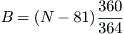 (2.2)
(2.2)
A graphical representation of Eq (2.1) is shown in Figure 2.2, from which the ET can be obtained directly.
Longitude correction
The standard clock time is reckoned from a selected meridian near the center of a time zone or from the standard meridian, the Greenwich, which is at longitude of 0°. Since the sun takes 4 min to transverse 1° of longitude, a longitude correction term of 4× (Standard longitude [SL] − Local longitude [LL]) should be either added or subtracted to the standard clock time of the locality. This correction is constant for a particular longitude, and the following rule must be followed with respect to sign convention. If the location is east of the standard meridian, the correction is added to the clock time. If the location is west, it is subtracted. The general equation for calculating the AST is:
 (2.3)
(2.3)
DS = daylight saving (it is either 0 or 60 min).
If a location is east of Greenwich, the sign of Eq (2.3) is minus (−), and if it is west, the sign is plus (+). If a daylight saving time is used, this must be subtracted from the LST. The term DS depends on whether daylight saving time is in operation (usually from end of March to end of October) or not. This term is usually ignored from this equation and considered only if the estimation is within the DS period.
EXAMPLE 2.1
Find the equation of AST for the city of Nicosia, Cyprus.
Solution
For the locality of Cyprus, the SL is 30°E. The city of Nicosia is at a LL of 33.33° east of Greenwich. Therefore, the longitude correction is −4 × (30–33.33) = +13.32 min. Thus, Eq (2.3) can be written as:

Leave a Reply