Flat-plate collectors
The performance Eqs (4.9) and (4.11) for FPCs assume that the sun is perpendicular to the plane of the collector, which rarely occurs. For the glass cover plates of an FPC, specular reflection of radiation occurs, thereby reducing the (τα) product. The incidence angle modifier, Kθ, is defined as the ratio of (τα) at some incident angle θ to (τα) at normal incidence (τα)n. According to ISO 9806-1:1994, data are collected for angles of incidence of approximately 0°, 30°, 45°, and 60° (ISO, 1994). A plot of incidence angle modified against incident angle is shown in Figure 4.5.
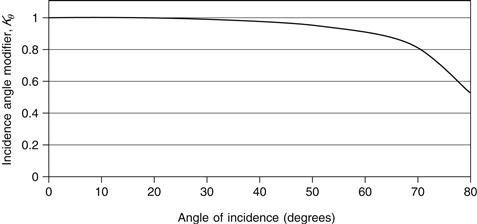
FIGURE 4.5 Incidence angle modified graph.
If we plot the incidence angle modifier against 1/cos(θ) − 1, it is observed that a straight line is obtained, as shown in Figure 4.6, which can be described by the following expression:
 (4.25)
For a single glass cover, the factor bo in Eq. (4.25), which is the slope of the line in Figure 4.6, is about 0.1. A more general expression for the incidence angle modifier is a second-order equation given by:
 (4.26)
With the incidence angle modifier the collector efficiency, Eq. (4.11) can be modified as:
 (4.27)
The equation for the useful energy collected, Eq. (4.9), is also modified in a similar way.
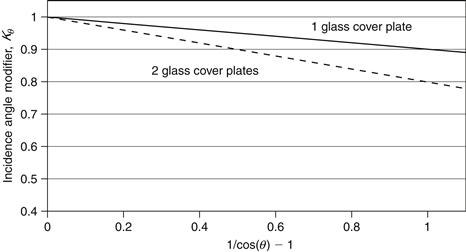
FIGURE 4.6 Plot of incidence angle modifier against 1/cos(θ) − 1 for two types of flat-plate collectors.
The incidence angle modifier for collectors that do not have symmetric optical characteristics can be approximated by the product of two orthogonal incidence angle modifiers in the longitudinal (l) and transverse (t) planes of the collector [Kθ = Kθ,lKθ,t], where in each plane the appropriate incidence angle is used. Collectors requiring this treatment are the evacuated tube, which have covers that are optically non-symmetrical.
4.2.2 Concentrating collectors
Similarly, for concentrating collectors, the performance Eqs (4.10) and (4.13) described previously are reasonably well defined as long as the direct beam of solar irradiation is normal to the collector aperture. For off-normal incidence angles, the optical efficiency term (ηo) is often difficult to be described analytically, because it depends on the actual concentrator geometry, concentrator optics, receiver geometry, and receiver optics, which may differ significantly. As the incident angle of the beam radiation increases, these terms become more complex. Fortunately, the combined effect of these parameters at different incident angles can be accounted for with the incident angle modifier. This is simply a correlation factor to be applied to the efficiency curve and is a function of only the incident angle between the direct solar beam and the outward drawn normal to the aperture plane of the collector. It describes how the optical efficiency of the collector changes as the incident angle changes. With the incident angle modifier, Eq. (4.13) becomes:
 (4.28)
If the inlet fluid temperature is maintained equal to ambient temperature, the incident angle modifier can be determined from:
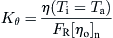 (4.29)
where η(Ti = Ta) is the measured efficiency at the desired incident angle for an inlet fluid temperature equal to the ambient temperature. The denominator in Eq. (4.29) is the test intercept taken from the collector efficiency test with Eq. (4.13), with [ηo]n being the normal optical efficiency, that is, at a normal angle of incidence.
As an example, the results obtained from such a test are denoted by the small squares in Figure 4.7. By using a curve-fitting method (second-order polynomial fit), the curve that best fits the points can be obtained (Kalogirou et al., 1994):
 (4.30)
For the IST collector, the incidence angle modifier Kθ of the collector given by the manufacturer is:
 (4.31)
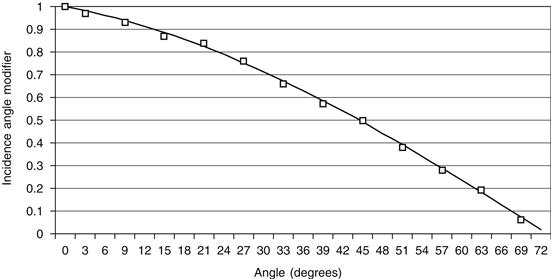
FIGURE 4.7 Parabolic trough collector incidence angle modifier test results.
Leave a Reply