
In the equations representing the performance of the solar collectors presented so far, the inlet fluid temperature is used. In some European standards, however (e.g. EN 12975-2: 2006), the average temperature is used, Tm, defined as the arithmetic average of the inlet and outlet temperatures [(Ti + To)/2] and the efficiency is plotted against (Tm − Ta)/Gt. In this case the collector instantaneous efficiency is given by:
 (4.35)
where  is the mean temperature collector efficiency factor.
If the temperature rise through the collector is linear with distance, which is correct for most applications  and the collector efficiency factor given by Eq. (3.48).
Therefore, in the case where Tm is used for the collector performance, Eq. (4.35) plots as a straight line and the intercept  and slope
  of the curve are related to FR(τα)n and FRUL, respectively, by eliminating η and To from Eq. (4.2) and (4.4) and using the equation for Tm:
 (4.36a)
 (4.36b)
And
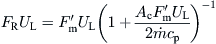 (4.36c)
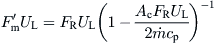 (4.36d)
To apply these equations the fluid flow rate through the collector must be known.
Similarly in the case where To is used for the collector performance and the efficiency is plotted against (To − Ta)/Gt, sometimes applied in the case of air collectors, the collector instantaneous efficiency is given by:
 (4.37)
Equation (4.37) also plots as a straight line and as above, the intercept  and slope
  of the curve are related to FR(τα)n and FRUL, respectively, from:
 (4.38a)
 (4.38b)
And
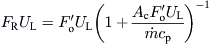 (4.38c)
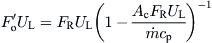
Leave a Reply