
The most important parameter that needs to be considered in the design of a water-heating system is the hot water demand over a certain period of time (hourly, daily, or monthly). The energy demand, D, required for the generation of sanitary hot water can be obtained if the volumetric consumption, V, is known for the required time period. Also required are the temperatures of the cold water supplied by public mains, Tm, and the water distribution, Tw. Then,
 (5.77)
If the two temperatures in Eq. (5.77) are known for a particular application, the only parameter on which the energy demand depends is the hot water volumetric consumption. This can be estimated according to the period of time investigated. For example, for the monthly water demand, the following equation can be used:
 (5.78)
Ndays = number of days in a month;
Npersons = number of persons served by the water-heating system; and
Vperson = Volume of hot water required per person.
The volumetric consumption, V, varies considerably from person to person and from day to day. It has to do with the habits of the users, the weather conditions of a locality, and various socioeconomic conditions. It can be estimated by considering the hot water use for various operations. Typical operations and consumption for residential usage are given in Table 5.6. More details and other applications, such as water consumption in hotels, schools, and so forth, can be found in the ASHRAE Handbook of Applications (ASHRAE, 2007).
Table 5.6
Typical Residential Usage of Hot Water per Task
| Use | Flow (l) |
| Food preparation | 10–20 |
| Manual dish washing | 12–18 |
| Shower | 10–20 |
| Bath | 50–70 |
| Face and hand washing | 5–15 |
In addition to the quantities shown in Table 5.6, hot water is consumed in automatic dish washing and clothes washing, but these quantities of hot water are produced by the washer with electricity as part of the washing process.
By using the data shown in Table 5.6 for a four-person family and normal daily tasks consisting of two food preparations, two manual dish washings, one shower for each person, and two face or hand washings per person per day, the low, medium, and high demand values in liters per person shown in Table 5.7 can be obtained. The maximum consumption case is where the shower for each person is replaced with a bath for each person per day.
EXAMPLE 5.6
Estimate the hot water energy demand for a family of four, with medium normal consumption, cold water mains supply of 18 °C, and water distribution temperature of 45 °C.
Solution
According to Table 5.7, the consumption per day per person is 40 l. Therefore, the daily demand, V, is 160 l/day or 0.16 m3/day. From Eq. (5.65),

Table 5.7
Hot Water Daily Demand for a Family of Four Persons in Liters per Person

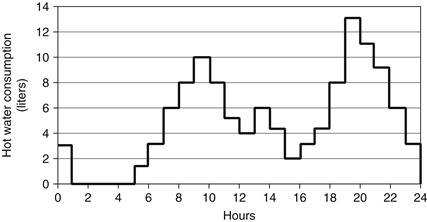
In hourly simulations, the hourly distribution of hot water demand is required. Although the hot water demand is subject to a high degree of variation from day to day and consumer to consumer, it is impractical to use anything but a repetitive load profile. This is not quite correct during the summer period, when the consumption pattern is somewhat higher. However, during this period, the temperature requirement for hot water is not as high as during winter. Consequently, the total thermal energy requirement is reasonably constant throughout the year. The demand profile usually used in hour simulations is the Rand profile, illustrated in Figure 5.32. This assumes a daily hot water consumption of 120 l at 50 °C for a family of four (30 l/person).
Leave a Reply