Beyond the low-temperature applications, there are several potential fields of application for solar thermal energy at a medium and medium–high temperature level (80–240 °C). The most important of them is heat production for industrial processes, which represents a significant amount of heat. For example, industrial heat demand constitutes about 15% of the overall demand of final energy requirements in the southern European countries. In 2000 the demand in the EU for medium and medium–high temperatures was estimated to be about 300 TWh/a (Schweiger et al., 2000).
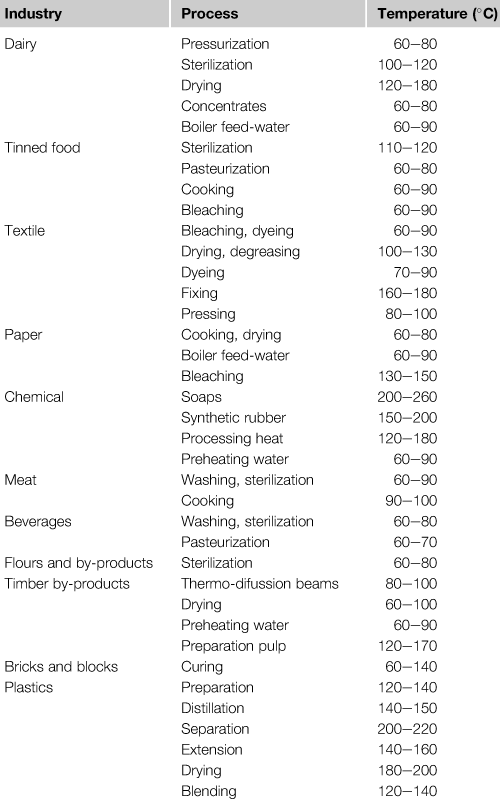
From a number of studies on industrial heat demand, several industrial sectors have been identified as having favorable conditions for the application of solar energy. The most important industrial processes using heat at a medium temperature level are sterilizing, pasteurizing, drying, hydrolyzing, distillation and evaporation, washing and cleaning, and polymerization. Some of the most important processes and the range of the temperatures required for each are shown in Table 7.1 (Kalogirou, 2003).
Table 7.1
Temperature Ranges for Various Industrial Processes
Large-scale solar applications for process heat benefit from the effect of scale. Therefore, the investment costs should be comparatively low, even if the costs for the collector are higher. One way to ensure economical terms is to design systems with no heat storage, that is, the solar heat is fed directly into a suitable process (fuel saver). In this case, the maximum rate at which the solar energy system delivers energy must not be appreciably larger than the rate at which the process uses energy. This system, however, cannot be cost-effective in cases where heat is needed at the early or late hours of the day or at nighttime, when the industry operates on a double-shift basis.
The usual types of industries that use most of the energy are the food industry and non-metallic mineral product manufacturing. Particular types of food industries that can employ solar process heat are the milk (dairy) and cooked pork meats (sausage, salami, etc.) industries and breweries. Most of the process heat is used in the food and textile industries for such diverse applications as drying, cooking, cleaning, and extraction. Favorable conditions exist in the food industry because food treatment and storage are processes with high energy consumption and high running time. Temperatures for these applications may vary from near ambient to those corresponding to low-pressure steam, and energy can be provided either from flat-plate or low-concentration-ratio concentrating collectors.
The principle of operation of collectors and other components of the solar systems outlined in the previous chapters also apply to industrial process heat applications. These applications, however, have some unique features; the main ones are the scale on which they are applied and the integration of the solar energy supply with an auxiliary energy source and the industrial process.
Generally, two primary problems need to be considered when designing an industrial process heat application. These concern the type of energy to be employed and the temperature at which the heat is to be delivered. For example, if hot water is needed for cleaning in food processing, the solar energy should be a liquid heater. If a process requires hot air for drying, an air heating system is probably the best solar energy system option. If steam is needed to operate a sterilizer, the solar energy system must be designed to produce steam, probably with concentrating collectors.
Another important factor required for the determination of the most suitable system for a particular application is the temperature at which the fluid will be fed to the collector array. Other requirements concern the fact that the energy may be needed at a particular temperature or over a range of temperatures, and possible sanitation requirements of the plant that must also be met, as, for example, in food processing applications.
The investments required in industrial solar application are generally large, and the best way to design the solar energy supply system can be done by modeling methods (see Chapter 11) that consider the transient and intermittent characteristics of the solar resource. In this way, designers can study various options in solar industrial applications at costs that are very small compared with the investments. For the preliminary design, the simple modeling methods presented in previous chapters apply here as well.
Another important consideration is that, in many industrial processes, large amounts of energy are required in small spaces. Therefore, there may be a problem for the location of collectors. If the need arises, collector arrays can be located on adjacent buildings or grounds. Locating the collectors in such areas, however, results in long runs of pipes or ducts, which cause heat losses that must be considered in the design of the system. Where feasible, when no land area is available, collectors can be mounted on the roof of a factory in rows. In this case, shading between adjacent collector rows should be avoided and considered. However, the collector area may be limited by the roof area, shape, and orientation. Additionally, roofs of existing buildings are not designed or oriented to accommodate arrays of collectors, and in many cases, structures to support collector arrays must be installed on existing roofs. It is usually much better and cost-effective if new buildings are readily designed to allow for collector mounting and access.
In a solar industrial process heat system, interfacing of the collectors with conventional energy supplies must be done in a way which is compatible with the process. The easiest way to accomplish this is by using heat storage, which can also allow the system to work in periods of low irradiation and nighttime.
The central system for heat supply in most factories uses hot water or steam at a pressure corresponding to the highest temperature needed in the different processes. Hot water or low-pressure steam at medium temperatures (<150 °C) can be used for preheating water (or other fluids) used for processes (washing, dyeing, etc.), for steam generation, or by direct coupling of the solar system to an individual process working at temperatures lower than that of the central steam supply. Various possibilities are shown in Figure 7.1. In the case of water preheating, higher efficiencies are obtained due to the low input temperature to the solar system; thus low-technology collectors can work effectively and the required load supply temperature has no or little effect on the performance of the solar energy system.
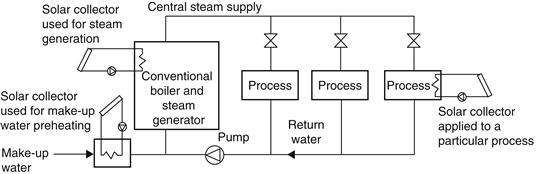
FIGURE 7.1 Possibilities of combining the solar energy system with the existing heat supply.
Norton (1999) presented the history of solar industrial and agricultural process applications. The most common applications of industrial process heat and practical examples are described.
A system for solar process heat for decentralized applications in developing countries was presented by Spate et al. (1999). The system is suitable for community kitchens, bakeries, and post-harvest treatment. The system employs a fixed-focus parabolic collector, a high temperature flat-plate collector, and a pebble bed oil storage.
Benz et al. (1998) presented the planning of two solar thermal systems producing process heat for a brewery and a dairy in Germany. In both industrial processes, the solar yields were found to be comparable with the yields of solar systems for domestic solar water heating or space heating. Benz et al. (1999) also presented a study for the application of non-concentrating collectors for the food industry in Germany. In particular, the planning of four solar thermal systems producing process heat for a large and a small brewery, a malt factory, and a dairy was presented. In the breweries, the washing machines for the returnable bottles were chosen as a suitable process to be fed by solar energy; in the dairy, the spray dryers for milk and whey powder production were chosen; and in the malt factory, the wither and kiln processes. Up to 400 kWh/m2/a was delivered from the solar collectors, depending on the type of collector.
7.1.1 Solar industrial air and water systems
The two types of applications employing solar air collectors are the open circuit and the recirculating applications. In the open circuit, heated ambient air is used in industrial applications where, because of contaminants, recirculation of air is not possible. Examples are paint spraying, drying, and supplying fresh air to hospitals. It should be noted that heating outside air is an ideal operation for the collector because it operates very close to ambient temperature, thus more efficiently.
In recirculating air systems, a mixture of recycled air from the dryer and ambient air is supplied to the solar collectors. Solar-heated air supplied to a drying chamber can be applied to a variety of materials, including lumber and food crops. In this case, adequate control of the rate of drying, which can be performed by controlling the temperature and humidity of the supply air, can improve product quality.
Similarly, the two types of applications employing solar water collectors are the once-through systems and the recirculating water heating applications. The latter are exactly similar to the domestic water heating systems presented in Chapter 5. Once-through systems are employed in cases where water is used for cleaning in food industries, and recycling the used water is not practical because of the contaminants picked up by the water in the cleaning process.
A solar energy system may deliver energy to the load either in series or parallel with the auxiliary heater. In a series arrangement, shown in Figure 7.2, solar energy is used to preheat the load heat transfer fluid, which may be heated more, if necessary, by the auxiliary heater, to reach the required temperature. If the temperature of the fluid in the storage tank is higher than that required by the load, a three-way valve, also called a tempering valve, is used to mix it with cooler make-up or returning fluid. The parallel configuration is shown in Figure 7.3. Since the energy cannot be delivered to the load at a temperature lower than that of the load temperature, the solar system must be able to produce the required temperature before energy can be delivered.
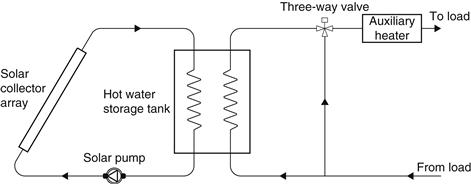
FIGURE 7.2 Simple industrial process heat system with a series configuration of auxiliary heater.
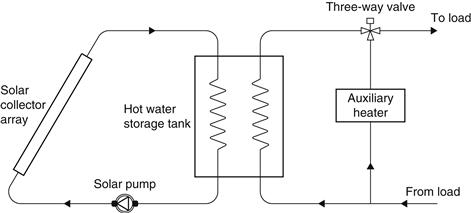
FIGURE 7.3 Simple industrial process heat system with a parallel configuration of auxiliary heater.
Therefore, a series configuration is preferred over the parallel one because it provides a lower average collector operating temperature, which leads to higher system efficiency. The parallel feed, however, is common in steam-producing systems, as shown in Figure 7.4, and is explained in the next section.
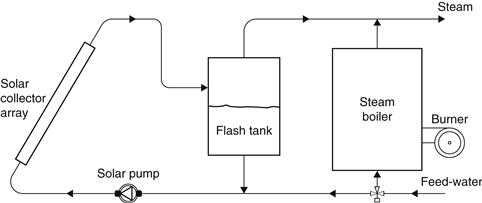
FIGURE 7.4 Simple industrial process heat steam system with a parallel configuration with an auxiliary steam boiler.
One of the most important design characteristics to consider when designing a solar industrial process heat system is the time matching of the solar energy source to the load. As was seen in the previous chapter, heating and cooling loads vary from day to day. In industrial process heat systems, however, the loads are pretty much constant and small variations are due to the seasonal variation of the make-up water temperature.
The thermal analysis of air and water solar industrial process heat systems is similar to the analysis presented in Chapter 5 for the solar water heating systems and will not be repeated here. The main difference is in the determination of the energy required by the load.
Leave a Reply