
The equations presented in this chapter can be combined and used to model the whole system. The model includes all physical components of the system, such as the collector, storage tank, heat exchanger, loads, and heat losses from the system components, such as pipes and storage tank. Detailed models result in a set of coupled algebraic and differential equations, with time as the independent variable. The inputs to these equations are meteorological data and load variations (e.g. water draw-off profile). The time step for such a model is usually 1 h, and for annual calculations, a computer is required. More details on these models are given in Chapter 11. In this section, we deal with only simple models that can be solved by hand calculations or the help of a spreadsheet.
According to the system configuration, the equations presented in Section 4.1.1, for operating at a flow rate different from the one used in collector performance testing; Section 4.1.2 for collectors in series and previous sections for considering pipe loses in performance equations, for partially shaded collectors and the use of a heat exchanger in the collector circuit; and Section 5.5 for the differential temperature controller, need to be considered in a logical way. All these modifications were obtained from the basic collector performance model given by Eq. (3.60). Usually we start with the collector performance parameters and apply any corrections for different flow rate and/or connection of collectors in series, if needed, add the pipe losses, then the heat exchanger, if present. Generally, we start from the collector and move toward the storage tank.
A simple model considers a fully mixed or unstratified storage tank supplying hot water at a fixed flow rate and a make-up water constant temperature, Tmu. Therefore, by ignoring pipe losses and considering that the storage tank is at a uniform temperature, Ts, Eq. (5.31) for the storage tank can be combined with Eq. (4.3) for the collector and Eq. (5.32) for the storage tank losses, to give:
 (5.80)
The middle term of the right-hand side in this equation is the energy delivered to the load through a load heat exchanger, which has an effectiveness εL. If no load heat exchanger is used, the term 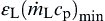 is replaced by
  , where in both cases
  is the load flow rate. This is, in fact, the same as Eq. (5.31) but with the various terms inserted in the equation.
To solve this equation, the collector parameters, storage tank size and loss coefficient, the effectiveness and mass flow rate of the heat exchanger, and the meteorological parameters are required. Once these are specified, the storage tank temperature can be estimated as a function of time. Additionally, the individual parameters, such as the useful energy gain from the collector and the losses from the storage tank, can be determined for a period of time by integrating the appropriate quantities. To solve Eq. (5.80), the simple Euler integration method can be used to express the temperature derivative dTs/dt as (Ts−n–Ts)/Δt. This is similar to writing the equation in finite difference form, as indicated in Section 5.3.3. Therefore, Eq. (5.80) can be expressed as a change in storage tank temperature for the time period required as:
 (5.81)
The only caution required in using this integration scheme is to choose a small time step to ensure stability. Because meteorological data are available in hour increments, a time step of 1 h is also used in solving Eq. (5.81) if stability is kept. A good verification of the calculations is to check the energy balance of the tank by estimating the change of internal energy of the water, which must be equal to the summation of the useful energy supplied by the collector minus the summation of the energy to load and energy lost. In equation form,
 (5.82)
Ts,i = initial storage tank temperature (°C);
Ts,f = final storage tank temperature (°C).
Problems for this kind of analysis are similar to Examples 5.2 and 5.3. In those examples, the load was considered to be known, whereas here it is calculated by the middle term of Eq. (5.81).
EXAMPLE 5.7
Estimate the energy balance in Example 5.2.
Solution
By summing up the various quantities in Table 5.3 of Example 5.2, we get:

Then, applying Eq. (5.82), we get:

which gives:

which indicates that the calculations were correct.
Leave a Reply