
PV modules are designed for outdoor use under harsh conditions, such as marine, tropic, arctic, and desert environments. The PV array consists of a number of individual photovoltaic modules connected together to give a suitable current and voltage output. Common power modules have a rated power output of around 50–180 W each. As an example, a small system of 1.5–2 kWp may therefore comprise some 10–30 modules covering an area of around 15–25 m2, depending on the technology used and the orientation of the array with respect to the sun.
Most power modules deliver direct current electricity at 12 V, whereas most common household appliances and industrial processes operate with alternating current at 240 or 415 V (120 V in the United States). Therefore, an inverter is used to convert the low-voltage DC to higher-voltage AC.
Other components in a typical PV system are the array mounting structure and various cables and switches needed to ensure that the PV generator can be isolated.
The basic principle of a PV system is shown in Figure 9.15. As can be seen, the PV array produces electricity, which can be directed from the controller to either battery storage or a load. Whenever there is no sunshine, the battery can supply power to the load if it has a satisfactory capacity.
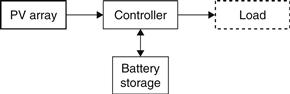
FIGURE 9.15 Basic principle of a PV solar energy system.
9.4.1 Direct-coupled PV system
In a direct-coupled PV system, the PV array is connected directly to the load. Therefore, the load can operate only whenever there is solar radiation, so such a system has very limited applications. The schematic diagram of such a system is shown in Figure 9.16. A typical application of this type of system is for water pumping, i.e., the system operates as long as sunshine is available, and instead of storing electrical energy, water is usually stored.

FIGURE 9.16 Schematic diagram of a direct-coupled PV system.
9.4.2 Stand-alone applications
Stand-alone PV systems are used in areas that are not easily accessible or have no access to an electric grid. A stand-alone system is independent of the electricity grid, with the energy produced normally being stored in batteries. A typical stand-alone system would consist of a PV module or modules, batteries, and a charge controller. An inverter may also be included in the system to convert the direct current generated by the PV modules to the alternating current form required by normal appliances. A schematic diagram of a stand-alone system is shown in Figure 9.17. As can be seen, the system can satisfy both DC and AC loads simultaneously.
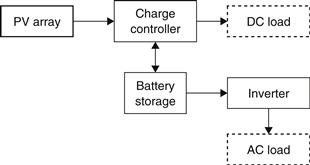
FIGURE 9.17 Schematic diagram of a stand-alone PV application.
9.4.3 Grid-connected system
Nowadays, it is usual practice to connect PV systems to the local electricity network. This means that, during the day, the electricity generated by the PV system can either be used immediately (which is normal for systems installed in offices, other commercial buildings, and industrial applications) or be sold to one of the electricity supply companies (which is more common for domestic systems, where the occupier may be out during the day). In the evening, when the solar system is unable to provide the electricity required, power can be bought back from the network. In effect, the grid is acting as an energy storage system, which means the PV system does not need to include battery storage. A schematic diagram of a grid-connected system is shown in Figure 9.18.
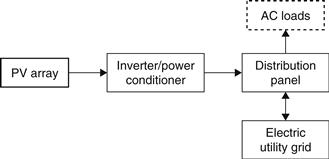
FIGURE 9.18 Schematic diagram of a grid-connected system.
9.4.4 Hybrid-connected system
In the hybrid-connected system, more than one type of electricity generator is employed. The second type of electricity generator can be renewable, such as a wind turbine, or conventional, such as a diesel engine generator or the utility grid. The diesel engine generator can also be a renewable source of electricity when the diesel engine is fed with biofuels. A schematic diagram of a hybrid-connected system is shown in Figure 9.19. Again, in this system, both DC and AC loads can be satisfied simultaneously.
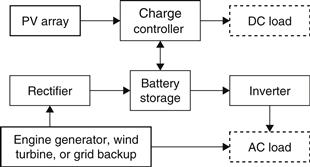
FIGURE 9.19 Schematic diagram of a hybrid connected system.
9.4.5 Types of applications
These are some of the most common PV applications:
• Remote-site electrification. Photovoltaic systems can provide long-term power at sites far from utility grids. The loads include lighting, small appliances, water pumps (including small circulators of solar water heating systems), and communications equipment. In these applications, the load demand can vary from a few watts to tens of kilowatts. Usually, PV systems are preferred to fuel generators, since they do not depend on a fuel supply, which can be problematic, and they do avoid maintenance and environmental pollution problems.
• Communications. Photovoltaics can provide reliable power for communication systems, especially in remote locations, away from the utility grid. Examples include communication relay towers, travelers’ information transmitters, cellular telephone transmitters, radio relay stations, emergency call units, and military communication facilities. Such systems range in size from a few watts for callbox systems to several kilowatts for relay stations. Obviously, these systems are stand-alone units in which PV-charged batteries provide a stable DC voltage that meets the varying current demand. Practice has shown that such PV power systems can operate reliably for a long time with little maintenance.
• Remote monitoring. Because of their simplicity, reliability, and capacity for unattended operation, photovoltaic modules are preferred in providing power at remote sites to sensors, data loggers, and associated meteorological monitoring transmitters, irrigation control, and monitoring highway traffic. Most of these applications require less than 150 W and can be powered by a single photovoltaic module. The batteries required are often located in the same weather-resistant enclosure as the data acquisition or monitoring equipment. Vandalism may be a problem in some cases; however, mounting the modules on a tall pole may solve the problem and avoid damage from other causes.
• Water pumping. Stand-alone photovoltaic systems can meet the need for small to intermediate-size water-pumping applications. These include irrigation, domestic use, village water supply, and livestock watering. Advantages of using water pumps powered by photovoltaic systems include low maintenance, ease of installation, and reliability. Most pumping systems do not use batteries but store the pumped water in holding tanks.
• Charging vehicle batteries. When not in use, vehicle batteries self-discharge over time. This is a problem for organizations that maintain a fleet of vehicles, such as the fire-fighting services. Photovoltaics battery chargers can help solve this problem by keeping the battery at a high state of charge by providing a trickle charging current. In this application, the modules can be installed on the roof of a building or car park (also providing shading) or on the vehicle itself. Another important application in this area is the use of PV modules to charge the batteries of electric vehicles.
• Building-integrated photovoltaics. BIPVs is a special application in which PVs are installed either in the façade or roof of a building and are an integral part of the building structure, replacing in each case the particular building component. To avoid an increase in the thermal load of the building, usually a gap is created between the PV and the building element (brick, slab, etc.), which is behind the PV, and in this gap, ambient air is circulated so as to remove the produced heat. During wintertime, this air is directed into the building to cover part of the building load; during summer, it is just rejected back to ambient at a higher temperature. A common example where these systems are installed is what is called zero-energy houses, where the building is an energy-producing unit that satisfies all its own energy needs. In another application related to buildings, PVs can be used as effective shading devices.
As this is an important application it is examined in more detail in the following section.
Building-integrated photovoltaics
According to Sick and Erge (1996), approximately 25–30% of energy consumed in buildings in industrialized countries is electricity. Photovoltaics can be integrated on virtually every structure. Grid-connected BIPV is the simplest low-voltage residential system which comprises a PV array and inverter. They feed electricity directly to an electricity grid and do not usually require batteries. The performance of a BIPV grid-connected system depends on PV efficiency, local climate, the orientation and inclination of the PV array, load characteristics and the inverter performance. A comprehensive review on BIPV systems is presented by Norton et al. (2011).
BIPV displaces conventional building materials, which leads to savings in the purchase and installation of conventional materials, thus the net cost of the BIPV is lower, which increases the cost effectiveness of the system. There would be some additional cost associated with the BIPV wiring, but this would be minimal in a new construction. BIPV walls, roofs, and sunshades provide fully integrated electricity generation while also serving as part of the weather protective building envelope (Archer and Hill, 2001). BIPV can serve as a shading device for a window, a semi-transparent glass facade, a building exterior cladding panel, a skylight, parapet unit or roofing system.
The sizing and design of a BIPV system is based on a building’s electrical load profile, PV output and balance-of-system characteristics, but must also consider building design constraints and its location, the local climate, and possible future increase of the load. A realistic estimation of load profile to be satisfied is the first step in the design of a stand-alone BIPV system design. In grid-connected BIPV applications the economically optimal diurnal load that must be met by the PV may not correspond to the total load, particularly at night and during wintertime.
There are also regulatory requirements concerning buildings that must be met; most local building codes and product certification requirements will specify specific standards for BIPV mounting, fixing, and fire resistance. These will often vary with the location of the building to take account of possible differences in wind loading, earthquake risk, and the attendant risks associated with particular failure modes (Norton et al., 2011). For this purpose, a product certification is required, usually carried out in an independent testing laboratory after passing satisfactorily a prescribed set of testing procedures (e.g. cycling of humidity, freeze/thaw, temperature, rain).
An advantage of BIPV is that as some of the PV power could be used in the building, the demand on the power grid is reduced and the reliability of supplied power to the building is improved. Another potential significant advantage is that the heat collected by PV modules can also be used for space heating or hot water-heating (see Section 9.8).
From architectural, technical and financial perspectives, building-integrated photovoltaics:
• Reduce the initial investment costs by displacing facade/roof/shading elements.
• Are aesthetically appealing.
• Electricity is generated at the point of use, reducing the costs and losses associated with transmission and distribution.
• Are suitable for installation on roofs and facades in densely populated areas.
• Require no additional land area for the installation.
• Can satisfy all, or a considerable part, of the electricity consumption of the building.
• Can act as a shading device.
• Can act as a source of day lighting if semi-transparent PVs are used for fenestration.
• Can provide part of the hot water or space-heating loads of the building.
Roofs are an attractive location for BIPV (Norton et al., 2011):
• They offer unshaded solar access.
• Cost is partially offset by the displacement of roofing materials by BIPV modules.
• Flat roofs generally enable more optimal solar cell placement and orientation.
• In a pitched roof which is near optimally inclined, the need for and cost of a support frame is eliminated.
Fully integrated BIPV roofing systems must perform the function of a standard roof and provide water tightness, drainage, and insulation.
PV glass curtain-walls and PV metal curtain-walls are used for integration of PV modules with wall materials (Toyokawa and Uehara, 1997). BIPV can be integrated into the building facade as:
• Structural glazing mullion/transom curtain-wall systems.
The performance ratio (PR) expresses the performance of a PV system in comparison to a system with no losses of the same design and rating at the same location. It is equal to the system efficiency under realistic reporting conditions (RRCs) divided by the module efficiency under standard test conditions (STCs) (Simmons and Infield, 1996). It indicates how close a PV system approaches ideal performance during real operation (Blaesser, 1997). The PR is independent of location and is influenced by:
• Insolation (remember that the efficiency of PV array depends on irradiance).
• The efficiency of the various system components.
• Size of the inverter relative to the PV array.
• Utilization factor of the system (i.e., the extent to which the system output is used).
Leave a Reply