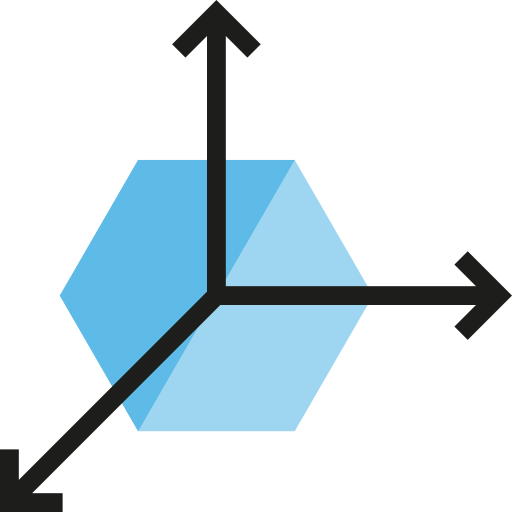
Vectors are often represented by arrows. The length of the arrow represents the magnitude, and the arrowhead indicates the direction.
Example:
A displacement vector might be drawn as an arrow pointing 10 meters to the north. The length of the arrow represents 10 meters, and the arrow points in the northward direction.
Operations with Vectors and Scalars
- Vector Addition:
- Vectors can be added by placing them “head-to-tail.” The resulting vector is drawn from the tail of the first vector to the head of the second.
- Alternatively, vectors can be added using components (breaking them into x and y components in a 2D plane).
- Scalar Multiplication:
- A scalar can multiply a vector, which changes the magnitude of the vector but does not affect the direction (unless the scalar is negative, which reverses the direction).
- Dot Product (Scalar Product):
- The dot product of two vectors produces a scalar quantity. It’s calculated by multiplying the magnitudes of the vectors and the cosine of the angle between them.
- Formula: A⋅B=∣A∣∣B∣cosθ\mathbf{A} \cdot \mathbf{B} = |\mathbf{A}| |\mathbf{B}| \cos \thetaA⋅B=∣A∣∣B∣cosθ
- Cross Product (Vector Product):
- The cross product of two vectors results in another vector that is perpendicular to both of the original vectors. The magnitude of the cross product depends on the angle between the vectors.
- Formula: A×B=∣A∣∣B∣sinθ n^\mathbf{A} \times \mathbf{B} = |\mathbf{A}| |\mathbf{B}| \sin \theta \, \hat{\mathbf{n}}A×B=∣A∣∣B∣sinθn^ where n^\hat{\mathbf{n}}n^ is the unit vector perpendicular to the plane formed by A\mathbf{A}A and B\mathbf{B}B.
Leave a Reply