
Electrochemical cells are of two types: galvanic cells and electrolytic cells
Galvanic Cell
The galvanic cell converts chemical energy into electrical energy, i.e., electricity can be obtained with the help of a redox reaction. The oxidation and reduction take place in two separate compartments. Each compartment consists of an electrolyte solution and a metallic conductor, which acts as an electrode. The compartment containing the electrode and the solution of the electrolyte is called half cells.
For example, the Daniell cell is a galvanic cell in which zinc and copper are used for a redox reaction to take place.
Zn(s) + Cu+2(aq) → Zn+2 + Cu(s)
At anode (oxidation half),
Zn(s) →Zn+2 + 2e–
At cathode( reduction half),
Cu+2(aq) + 2e– → Cu(s)
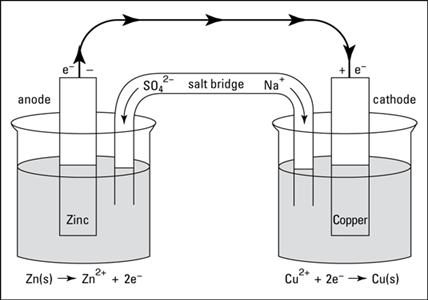
Salt bridge: The salt bridge is usually an inverted U-tube filled with a concentrated solution of inert electrolytes. It is used to maintain the charge balance and to complete the circuit by allowing the flow of ions through it. It contains a gel in which inert electrolytes like KNO3 or K2SO4 are mixed. Through the salt bridge, negative ion flows towards the anode and positive ion flows to the cathode, and the charge balance is maintained, and the cell keeps on functioning.
Electrode potential: In a galvanic cell, when two-electrode are dipped in their respective ion, there is a tendency for one of the electrodes (anode) to undergo oxidation, whereas the ion of the other electrode (cathode) has the tendency to gain an electron. This tendency of losing of electrons (oxidation) or gaining of electrons (reduction) is called electrode potential.
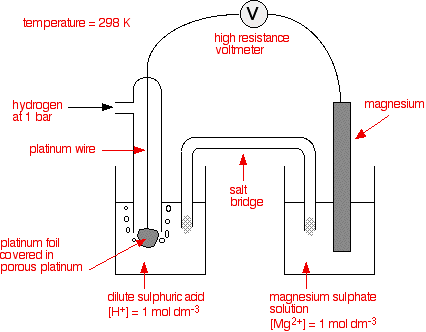
Standard electrode potential (E0): Standard electrode potential is defined as the electrode potential of an electrode relative to a standard hydrogen electrode under standard conditions. The standard conditions taken are as follows:
- 1 molar concentration of each ion in the solution.
- A temperature of 298 K.
- 1 bar pressure.
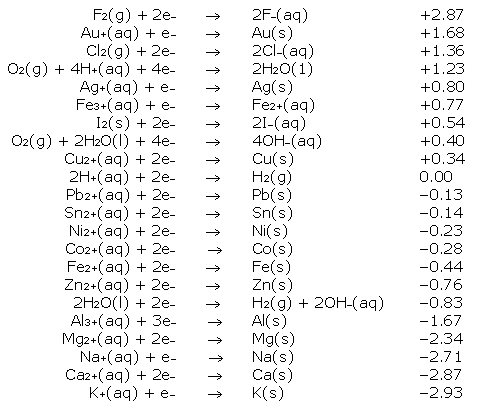
Electrochemical Series
A series of the standard electrode has been established by measuring the potential of various electrodes versus standard hydrogen electrodes (SHE). When the electrodes (metals and non-metals) in contact with their ions are arranged on the basis of the values of their standard reduction potential or standard oxidation potentials, the resulting series is called the electrochemical series.
Elements reduction reaction
Cell potential or emf of a cell: In the galvanic cell, there are two half-cells, the oxidation half-cell (anode) and the reduction half-cell (cathode). Due to the difference in the potentials of these half-cells, the electric current moves from the electrode of higher potential (cathode) to the electrode of lower potential (anode). The difference between the electrode potential of the two half-cells is called cell potential or emf of a cell.
Eocell= ECathode– Eanode
ECathode= standard reduction potential of the cathode.
Eanode= standard reduction potential of the anode.
If Eocell is positive, then the reaction is feasible.
If Eocell is negative, then the reaction is not feasible.
Electrode and cell potentials – Nernst equation: The electrode potential and the emf of the cell depend upon the nature of the electrode, temperature and the activities (concentrations) of the ions in solution.
For the general electrochemical reaction of the type:
aA + bB → cC +dD
Ecell = Eocell – RT/ nF ln [C]c [D]d / [A]a [B]b
Ecell = Eocell – 2.0303 RT / nF log [C]c [D]d / [A]a [B]b
Ecell = Eocell – 0.0591 / n log [C]c [D]d / [A]a [B]b at 298K
Electrolytic Cell
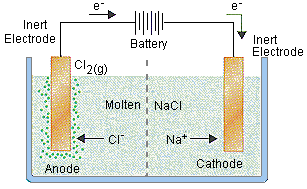
The electrolytic cell converts electrical energy to chemical energy. Here, the electrodes are dipped in an electrolytic solution containing cations and anions. On supplying current, the ions move towards electrodes of opposite polarity, and simultaneous reduction and oxidation take place.
For example, in the electrolysis of molten sodium chloride, sodium chloride is melted (above 801oC), two electrodes are inserted into the melt, and an electric current is passed through the molten salt. The chemical reaction that takes place at the electrodes is as follows:
● Sodium-ion migrates to the cathode, where sodium ion gains one electron and reduces to sodium metal.
Na+ + e–→ Na
● Chloride ions migrate towards the anode, where it loses one electron and gets oxidised to chlorine gas.
Cl–→1/2 Cl2 + e–
The overall reaction is the breakdown of sodium chloride into its elements
2NaCl→ 2Na(s) + Cl2(g)
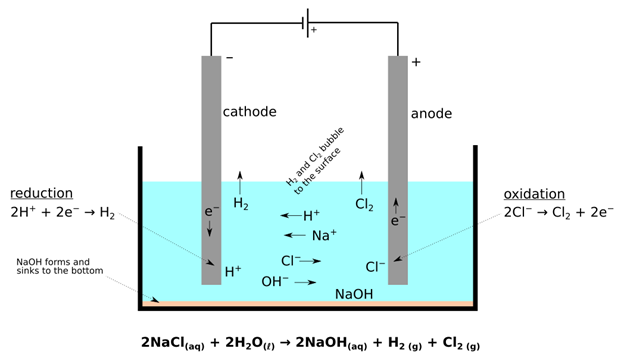
Preferential discharge of ions: When there is more than one cation or anion, the process of discharge becomes competitive in nature. For example, in the electrolysis of NaCl solution, apart from Na+ and Cl–ions, the solution of sodium chloride also contains H+ and OH– ions due to the ionisation of water. When the potential difference is applied between the two electrodes, Na+ and H+ ions move towards the cathode and Cl– and OH– ions move towards the anode. At the cathode, H+ ions get reduced in preference to giving hydrogen gas because hydrogen has a higher reduction potential than sodium. Similarly, at the anode, Cl– ions are oxidised in preference to OH– to give chlorine gas.
Leave a Reply