
Einstein first introduced this term in the year 1905. It is a theorem that deals with the structure of space-time. Einstein explained this theory based on two postulates –
- The laws of physics are the same for all, irrespective of the observer’s velocity.
- The speed of light is always constant regardless of the motion of the light source or the motion of the observer.
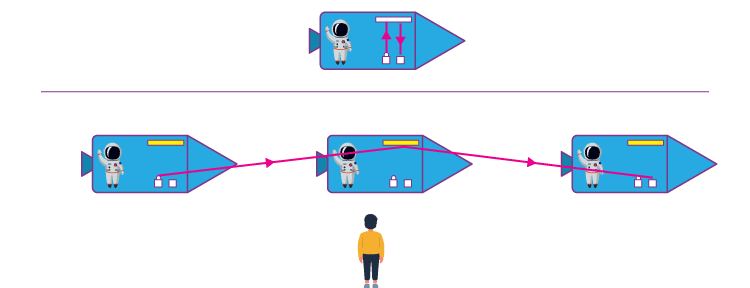
This is the theory which laid the foundation of time travel. According to Einstein, the rate at which time tics decreases with the increase of the person’s velocity. But this is hard to notice as the decrease in time is relatively very low compared to the increase in time. So, it can be assumed that if you can equal the velocity of light, you will be in a situation where time is still. This phenomenon is called Time Dilation. There are other surprising consequences of this theory, such as –
- Relativity of simultaneity – two actions, simultaneous for one person, may not be simultaneous for another person in relative motion.
- Length Shrinking: Objects are measured and appear shorter in the direction they are moving with respect to the observer.
- Mass – Energy Equivalence: Study of relativity led to one of the greatest inventions, i.e., E = mc2 where E is Energy, m stands for mass and c for the velocity of light. Many scientists observed that the object’s mass increases with the velocity but never knew how to calculate it. This equation is the answer to their problem, which explains that the increased relativistic weight of the object is equal to the kinetic energy divided by the square of the speed of light
Leave a Reply