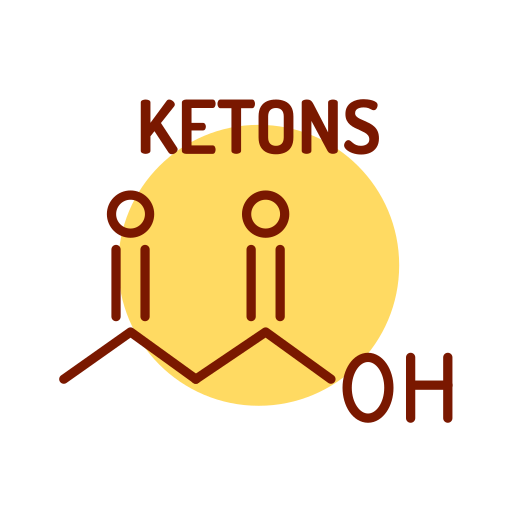
Ketones are organic compounds which have the functional group C=O and the structure R-(C=O)-R’.
These carbonyl compounds have carbon-containing substituents on both sides of the carbon-oxygen double bond. The carbonyl carbon of the ketone group is sp2 hybridized. The structure of ketones is a trigonal planar centred around the carbonyl carbon. The bond angles of this structure approximate at 1200. Since the carbon-oxygen bond makes the carbonyl group polar (oxygen is more electron-withdrawing than carbon), ketones tend to be nucleophilic at the oxygen atom and electrophilic at the carbon atom.
Ketones are mass-produced industrially for their use as solvents, pharmaceuticals, and as precursors for polymers. Important ketones include methyl ethyl ketone (also called butanone), cyclohexanone, and acetone.
Preparation of Ketones
Acid chlorides on reaction with dialkyl cadmium produce ketones. Dialkyl cadmium themselves are prepared from Grignard reagents.
2R-Mg-X + CdCl2 → R2Cd + 2 Mg(X)Cl
2RCOCl + R2Cd → 2R-CO-R + CdCl2
The method is useful in a way that the mixed ketones can be prepared very conveniently.
Properties of Ketones
- Ketones are polar in nature due to the presence of a polar carbonyl group. Therefore they have higher boiling points than non-polar compounds.
- It cannot form any intermolecular hydrogen bond-like alcohols because there is no hydrogen attached to an oxygen atom.
- Ketones have large dipole moments compared to alcohols or ethers due to the shifting of pi electrons.
- Ketones react with hydrogen cyanide to form cyanohydrins. The reaction is normally carried out in the presence of a base, which acts as a catalyst in the absence of a base the reaction proceeds slowly.
- Most of the ketones form bisulphite addition products when it is added to sodium bisulphite.
Nomenclature of Ketones
- Ketones are named after their parent alkanes with the suffix “-anone”. The carbonyl group’s position in the ketone is denoted by a number while naming the ketone. For example, CH3(CO)CH3 is called 2 propanone. However, this compound is generally referred to as acetone.
- Commonly, ketones are named by writing the name of each individual alkyl group attached to the carbonyl carbon and then “ketone” as the third word of the name. For example, butanone can be written as methyl ethyl ketone.
| Formula | Common name | IUPAC name |
| CH3-C(O)-CH3 | Acetone | Propanone |
| CH3-C(O)-CH2-CH3 | Ethylmethylketone | Butanone |
| CH3-CH2-C(O)-CH2-CH3 | Diethyl ketone | Pentan-3-one |
| CH3-CH(CH3)-C(O)-CH3 | Isopropyl methyl ketone | 3-Methylbutan-2-one |
Uses of Ketones
- Propanone is used to make polymers for example perspex.
- ketones are used as solvents and as a starting material for the synthesis of many organic compounds.
- Acetone and ethyl methyl ketone is mainly used as industrial solvents.
Leave a Reply