Author: workhouse123
-

Desalination processes
Desalination can be achieved using a number of techniques. Industrial desalination technologies either use phase change or involve semi-permeable membranes to separate the solvent or some solutes. Therefore, desalination techniques may be classified into the following categories: phase change or thermal processes and membrane or single-phase processes. All processes require a chemical pre-treatment of raw…
-
Introduction
The provision of freshwater is becoming an increasingly important issue in many areas of the world. In arid areas, potable water is very scarce and the establishment of a human habitat in these areas strongly depends on how such water can be made available. A brief historical introduction to solar desalination is given in Chapter 1,…
-
Greenhouses
Another application intended for the agricultural industry is the greenhouse. The basic function of a greenhouse is to provide environmental conditions that accelerate the process of photosynthesis. Photosynthesis is the driving force for plant growth, in which CO2 is transformed into H2O, using solar energy, to carbohydrates and oxygen. Photosynthesis is highly sensitive to environmental factors.…
-
Solar dryers
Generally, drying (or dewatering) is a simple process of excess water (moisture) removal from a natural or an industrial product to preserve it (foodstuff) or to reach a specified moisture content. Drying is an energy-intensive process, especially when used for food products, as these generally have a water content which is much higher (about 25–80%)…
-
Solar chemistry applications
Solar chemistry applications include a variety of fields; the main ones are the production of energy carriers (e.g. hydrogen), also called reforming of fuels; fuel cells; materials processing and detoxification; and recycling of waste materials. These are examined in this section. 7.3.1 Reforming of fuels Solar energy is essentially unlimited and its utilization does not create…
-
Solar steam generation systems
Parabolic trough collectors are frequently employed for solar steam generation because relatively high temperatures can be obtained without serious degradation in the collector efficiency. Low-temperature steam can be used in industrial applications, in sterilization, and for powering desalination evaporators. Three methods have been employed to generate steam using parabolic trough collectors (Kalogirou et al., 1997):…
-
Industrial process heat: general design considerations
Beyond the low-temperature applications, there are several potential fields of application for solar thermal energy at a medium and medium–high temperature level (80–240 °C). The most important of them is heat production for industrial processes, which represents a significant amount of heat. For example, industrial heat demand constitutes about 15% of the overall demand of final…
-
Solar cooling with absorption refrigeration
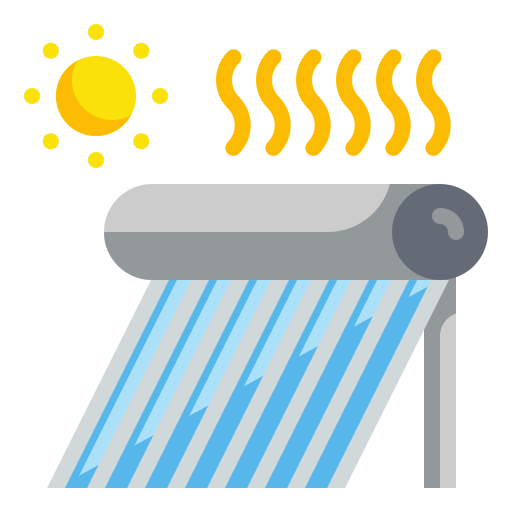
The greatest disadvantage of a solar heating system is that a large number of collectors need to be shaded or disconnected during summertime to reduce the danger of overheating. A way to avoid this problem and increase the viability of the solar system is to employ a combination of space heating and cooling and domestic…
-
Solar cooling
The quest for a safe and comfortable environment has always been one of the main preoccupations of the human race. In ancient times, people used the experience gained over many years to utilize in the best possible way the available resources to achieve adequate living conditions. Central heating was pioneered by the Romans, using double…
-
Solar space heating and cooling
Systems for space heating are very similar to those for water heating, described in the previous chapter; and because the same considerations apply to both systems for combination with an auxiliary source, array design, over-temperature and freezing, controls, and so on, these will not be repeated. The most common heat transfer fluids are water, water…