Category: 1. CONCEPTS OF CIRCUIT THEORY
-

D.C. CIRCUITS
The closed path in which direct current flows is called d.c. circuit. A simple d.c. circuit is shown in Figure 1.12 which contains a d.c. source (battery), a load (lamp), a switch, connecting leads and measuring instruments such as ammeter and voltmeter. The simplified line diagram of the same d.c. circuit is shown in Figure 1.13. The load…
-

MECHANICAL WORK
When a body, to which force is applied, moves in or opposite direction of the applied force, work is said to be done by or against the body. Mathematically, Work = Force × distance or W = F ×d Unit: The unit of work is Newton metre (Nm) or joule. If, F = 1 N and d = 1 m; then, W = 1…
-
TEMPERATURE CO-EFFICIENT OF RESISTANCE
Consider a metallic resistor having a resistance of R0 and 0°C and Rt at t°C. The increase in resistance (Rt − R0) is directly proportional to its initial resistance, that is, (Rt − R0) ∝ R0 (Rt − R0) is directly proportional to rise in temperature, that is (Rt − R0) ∝ t (Rt − R0) depends on the nature of its material. Thus, (Rt − R0) ∝ R0t or (Rt − R0)…
-
EFFECT OF TEMPERATURE ON RESISTANCE
The electrical resistance generally changes with the change of temperature. The resistance does not only increase with the rise in temperature but it also decreases in some cases. In fact, the increase or decrease in resistance with the rise in temperature depends on the nature of the resistance material discussed as follows:
-
Limitations of Ohm’s Law
Ohm’s law cannot be applied to the non-linear clients such as circuits containing electronic tubes or transistors and the circuits used to produce electric arc. Example 1.1 The specific resistance of platinum at 0°C is 10.5 microohm cm. What should be the length of platinum wire of No. 32 S.W.G. (diameter = 0.0274 cm) to have a…
-
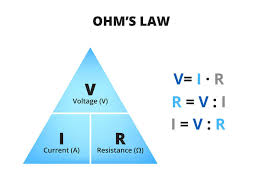
OHM’S LAW
Ohm’s law states that the current flowing between any two points of a conductor (or circuit) is directly proportional to the potential difference across them, as shown in Figure 1.8, provided physical conditions i.e. temperature etc. do not change. Fig. 1.8 Potential difference (voltage) applied across a wire having resistance R ohm Mathematically I ∝ V or In other words,…
-
EMF AND POTENTIAL DIFFERENCE
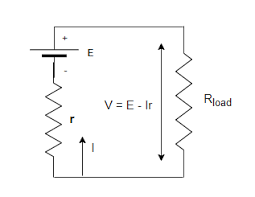
The amount of energy supplied by the source to each coulomb of charge is known as emf of the source, whereas the amount of energy used by one coulomb of charge in moving from one point to the other is known as potential difference between the two points. For instant, consider a circuit as shown in Figure 1.7.…
-
ELECTRIC CURRENT
When an electric potential difference is applied across the metallic wire, the loosely attached free electrons, as shown in Figure 1.3, start drifting towards the positive terminal of the cell (see Fig. 1.4). This continuous drifting of electrons constitutes the electric current. Therefore, a continuous drifting of electrons in an electric circuit is called electric current. Fig.…
-
ELECTRIC POTENTIAL
The capacity of a charged body to do work is called electric potential. Obviously, the measure of electric potential is the work done to charge a body to one coulomb, that is, Electric potential Unit: Since work done is measured in joule and charge in coulomb, the unit of electric potential is joule/coulomb or volt.
-

FREE ELECTRONS
The valance electrons that are very loosely attached to the nucleus of an atom and can be easily detached are called free electrons. These free electrons are so loosely attached to the nucleus that they do not know the atom to which they belong originally. Thus, they move from one atom to the other at…