Category: 2. DC CIRCUIT ANALYSIS AND NETWORK THEOREMS
-
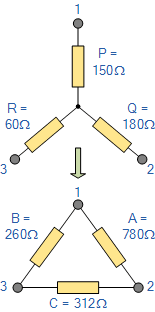
DELTA–STAR AND STAR–DELTA TRANSFORMATION
To apply simple series–parallel circuit technique for the solution of network, something is required to transform the resistors connected in delta to star or vice versa. At such places, just to simplify the network delta–star or star–delta transformations applied. 2.9.1 Delta–Star Transformation Consider a circuit shown in Figure 2.67(a), where three resistors RAB, RBC, and RCA are connected in delta. This…
-

NODAL ANALYSIS
In this method, one of the nodes is taken as the reference node and the other as independent nodes. The voltages at the different independent nodes are assumed and the equations are written for each node as per KCL. After solving these equations, the node voltages are determined. Then, the branch currents are determined. Consider…
-
WHEATSTONE BRIDGE
For the first time, Wheatstone (an English telegraph engineer) proposed this bridge for measuring the value of an unknown resistance. This bridge consists of four arms AB, BC, AD, and DC having resistances P, Q, X, and R, respectively (see Fig. 2.22). Resistance P and Q are the known (fixed value) resistances and are called ratio arms. While resistance R is a variable resistance of known…
-
KICHHOFF’S LAWS
Gustav Kirchhoff, a German scientist, summed up his findings in a set of two laws known as Kirchhoff’s laws. 2.5.1 Kirchhoff’s First Law Since this law relates the currents following through the circuit, it is also known as Kirchhoff’s Current Law (KCL). This law states that the algebraic sum of all the currents meeting at a…
-
SOURCE TRANSFORMATION (CONVERSION OF VOLTAGE SOURCE TO CURRENT SOURCE AND VICE VERSA)
In fact, a voltage source can be converted into current source and vice versa. Consider a DC source connected to a load resistance RL, as shown in Figure 2.13(a). The source can be treated as a voltage source, as shown in Figure 2.13(b), or as a current source as shown in Figure 2.13(c). Both types of representations appear the same…
-
Internal Resistance of a Source
The opposition to load current inside the DC source is called its internal resistance. All DC sources (battery, DC generator, or rectifier-type supply) have internal resistance and is represented by Ri. The equivalent circuit of a DC source is the generated emf E is in series with internal resistance Ri of the source as shown in Figure 2.7. Fig. 2.7 (a) Battery…
-

VOLTAGE AND CURRENT SOURCES
To operate electrical or electronic circuits, a source of electrical power is required. The basic purpose of a source is to supply power to a load. Therefore, a load is connected to the source as shown in Figure 2.2. The source may be either a DC (direct current) source or an AC (alternating current) source. Fig.…
-
ELECTRIC NETWORK
A simple electric network is shown in Figure 2.1. It contains two voltage sources E1 and E2 and three resistors R1, R2, and R3. In fact, the interconnection of either passive elements or the interconnection of active and passive elements constitute an electric network. Fig. 2.1 An electric network 2.2.1 Active elements The elements that supply energy in an electric network are called active elements.…
-

INTRODUCTION
The arrangement by which various electrical energy sources, resistance, and other parameters are connected together is called electrical circuit or electrical network. Various laws and theorems have been developed to analyse these simple and complex electrical circuits. One of them, that is, Ohm’s law, has already been discussed in the first chapter. In this chapter, we…