Category: Control and Instrumentation Systems
-
Dynamic Systems
The following describes how we can arrive at the input-output relationships for systems by representing them by simple models obtained by considering them to be composed of just a few simple basic elements. 18.10.1 Mechanical Systems Mechanical systems, however complex, have stiffness (or springiness), damping and inertia and can be considered to be composed of…
-

Gain
In the case of an amplifier system we might have the output directly proportional to the input and, with a gain of 10, if we have an input of a 1 V signal we can calculate that the output will be ten times greater and so 10 V. In general, for such a system where the output…
-

System Models
Suppose we have a control system for the temperature in a room. How will the temperature react when the thermostat has its set value increased from, say, 20°C to 22°C? In order to determine how the output of a control system will react to different inputs, we need a mathematical model of the system so…
-
Control Systems
The following are examples of closed-loop control systems to illustrate how, despite the different forms of control being exercised, the systems all have the same basic structural elements. 18.7.1 Control of the Speed of Rotation of a Motor Shaft Consider the motor system shown in Figure 18.61 for the control of the speed of rotation of the…
-
Correction Elements
The following are examples of correction elements that are commonly encountered in control systems. 18.6.1 Directional Control Valves A directional control valve on the receipt of some external signal, which might be mechanical, electrical or a pressure signal, change the direction of, or stop, or start the flow of fluid in some part of the pneumatic/…
-
Signal Processing
The output signal from the sensor of a measurement system or the signal from the control unit might have to be processed in some way to make it suitable to operate the next element in the control system. For example, the signal may be too small and have to be amplified, be analog and have…
-
Measurement Elements
The following are examples of sensors that are commonly used with the measurement systems of control systems. 18.4.1 Potentiometer A potentiometer consists of a resistance element with a sliding contact which can be moved over the length of the element and connected as shown in Figure 18.13. With a constant supply voltage Vs the output voltage Vo between terminals 1…
-
Control Systems Models
There are two basic types of control systems: 1. Open-loop In an open-loop control system the output from the system has no effect on the input signal to the plant or process. The output is determined solely by the initial setting. Open-loop systems have the advantage of being relatively simple and consequently cheap with generally good…
-
Systems
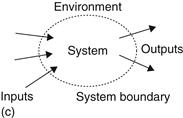
A car gear box can be thought of as a system with an input shaft and an output shaft (Figure 18.l(a)). We supply a rotation to the input shaft and the system then provides a rotation of the output shaft with the rotational speed of the output shaft being related in some way to the…
-
Introduction
The term automation is used to describe the automatic operation or control of a process. In modem manufacturing there is an ever increasing use of automation, e.g., automatically operating machinery, perhaps in a production line with robots, which can be used to produce components with virtually no human intervention. Also, in appliances around the home and in…