Category: Digital Electronics
-
The Commutative Rules
The commutative rules state that the order in which variables are specified will not affect the result of an AND or OR operation (Figure 10.35). Figure 10.35 The commutative rules 10.23 The Associative Rules The associative rules state that the order in which pairs of variables are associated together will not affect the result of multiple…
-
The Complementary Rules
The rules derived from the combination of a single variable with the inverse of itself are known as the complementary rules (Figure 10.33). Figure 10.33 The complementary rules 10.21 The Involution Rules The involution rule states that an even number of inversions cancel each other out; for example, two NOT functions connected in series generate an identical result…
-
Combining a Single Variable With Logic 0 or Logic 1
A set of simple but highly useful rules can be derived from the combination of a single variable with a logic 0 or logic 1 (Figure 10.31). Figure 10.31 Combining a single variable with a logic 0 or logic 1 10.19 The Idempotent Rules The rules derived from the combination of a single variable with itself…
-
Boolean Algebra
One of the most significant mathematical tools available to electronics designers was actually invented for quite a different purpose. Around the 1850s, a British mathematician, George Boole (1815–1864), developed a new form of mathematics that is now known as Boolean algebra. Boole’s intention was to use mathematical techniques to represent and rigorously test logical and philosophical…
-
Pass-Transistor Logic
In the BUF, NOT, AND, NAND, OR, and NOR gates described earlier, the input signals and internal data signals are only used to drive control terminals on the transistors. By comparison, transistors Tr3 and Tr4 in the XOR and XNOR gates shown above are connected so that input and internal data signals pass between their data terminals.…
-
XNOR and XOR Gates
The concepts of NAND, AND, NOR, and OR are relatively easy to understand because they map onto the way we think in everyday life. For example, a textual equivalent of a NOR could be: “If it’s windy or if it’s raining then I’m not going out.” By comparison, the concepts of XOR and XNOR can be a little harder to grasp…
-
NOR and OR Gates
A similar story occurs in the case of NOR gates and OR gates. First, consider a 2-input NOR, which requires four transistors (Figure 10.26). (A 3-input version could be constructed by adding an additional PMOS transistor in series with Tr1 and Tr2, and an additional NMOS transistor in parallel with Tr3 and Tr4.) Figure 10.26 CMOS implementation of…
-
Nand and AND Gates
The implementations of the NOT and BUF gates shown above illustrate an important point, which is that it is generally easier to implement an inverting function than its non-inverting equivalent. In the same way that a NOT is easier to implement than a BUF, a NAND is easier to implement than an AND, and a…
-
Not and BUF Gates
The simplest logic function to implement in CMOS is a NOT gate (Figure 10.20). The small circle, or bobble, on the control input of transistor Tr1 indicates a PMOS transistor. The bobble is used to indicate that this transistor has an active-low control, which means that a logic 0 applied to the control input turns the…
-
AND, OR, and XOR Functions
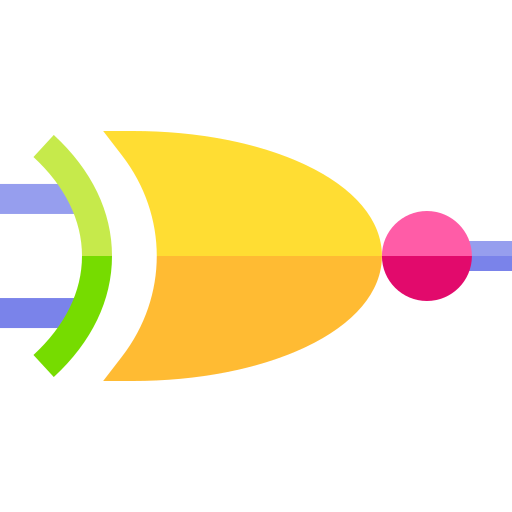
Three slightly more complex functions are known as AND, OR, and XOR (Figure 10.15). Figure 10.15 AND, OR, and XOR functions The AND and OR representations shown here are the abstract equivalents of our original switch examples. In the case of the AND, the output is only TRUE if both a and b are TRUE; in the case of the OR, the output is…