Category: Power Electronics
-

Per Unit Constants
Per unit quantities greatly simplify comparisons between items of power apparatus and aid in solving fault calculations. Per unit is a method of normalizing the characteristics of elements in a power electronics system so they can be represented independent of the particular voltage at that point in the system. Their characteristics are translated relative to…
-
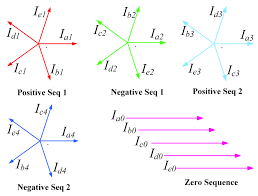
Symmetrical Components
Analysis of a three-phase AC circuit with unbalanced currents or voltages gets into some rather messy complex numbers. In 1918, Dr. C. L. Fortesque delivered a paper before the AIEE, predecessor organization to the IEEE, which laid the groundwork for symmetrical components, a method of representing unbalanced voltage or current phasors by symmetrical sets of phasors.…
-
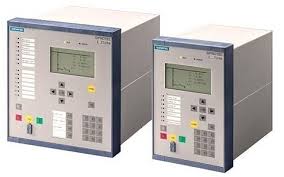
Protective Relays
Utilities and large industrial plants use a variety of relay types to protect the system and its components against fault currents. The most basic types are overcurrent relays, which are available in a number of styles. All will trip a breaker on overcurrent, but the timing is widely variable among the several types. Relays are…
-
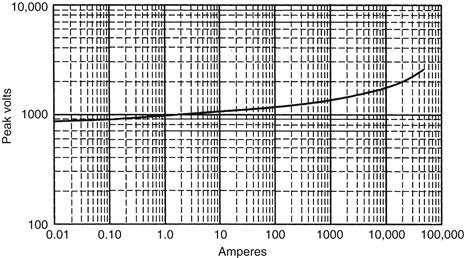
Metal Oxide Varistors
Metal oxide varistors (MOVs) are components that have a nonlinear V/I characteristic. In the case of varistors used for voltage protection, the voltage varies but little over a very wide range of current. The types used for power electronics are made by pressing and sintering wafers of zinc oxide ceramic with the characteristics determined by…
-
Spacings
Even the lowest-voltage systems require some consideration for the electrical clearances between conductors of different voltage. Standards have been developed by the Canadian Standards Association (CSA), Institute of Electrical and Electronics Engineers (IEEE), National Electrical Manufacturers Association (NEMA), and Underwriter’s Laboratories (UL). These standards cover everything from PC boards to high-voltage switchgear. Spacings are generally…
-
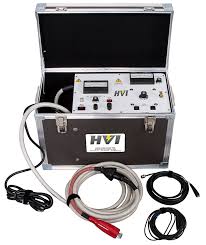
Hipot, Corona, and BIL
Any insulation system must be able to tolerate a continually applied voltage, a transient overvoltage, and a surge voltage. Furthermore, it must be free of partial discharge (corona) under the worst-case operating conditions. The hipot test is typically a 1-min application of a 50- or 60-Hz voltage between all conductors and ground, during which the…
-
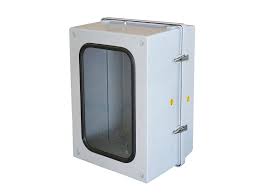
Enclosures
Equipment enclosures are described in NEMA standard ICS 1 110. Briefly, the designer may be expected to encounter Type 1, Type 4, and Type 12 enclosures most often. Type 1 is a general-purpose indoor, ventilated enclosure that protects personnel from accidental exposure to high voltages and protects equipment from dripping water. Type 4 is a watertight,…
-
Supply Voltages
The primary operating voltage for most power electronics is divided into two general classes: low-voltage, service voltages of 600 V or less, and medium-voltage, service voltages of 601 V through 34.5 kV. The vast majority of power electronics will wind up on either 600 V-, 5-kV, or 15-kV-class supplies in the U.S., but there are applications at 2400 V and…
-
Resistors
Power electronic systems employ a large variety of resistor types and ratings. At the low-power end, they are used in R/C snubber circuits, in voltage dividers, and as damping elements for various resonant circuits. The two general resistor classes in the lower power ranges are wirewound and metallized film. Wirewound resistors are wound from a…
-

Capacitors
The three major dielectric types of capacitors are those with various types of film dielectrics used mostly for power factor correction and R/C snubbers, electrolytic types used for filters, and ceramic types in the smaller ratings. The electrolytics have a much higher energy storage for a given volume, but they are not available in voltages above…