Category: Heat Transfer
-
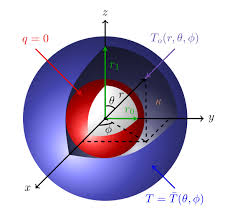
Heat Transfer Through Sphere
Consider a hollow sphere of internal radius r1 and external radius r2 as shown in Figure 7.8. Let the inside and outside surface temperature be t1 and t2; and let the thermal conductivity be k. Consider a small element of thickness dr at any radius r. It can be shown that the surface area of this spherical element is given by 4πr2. The heat transfer rate Figure 7.8 Heat…
-
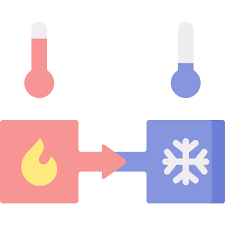
Combined Heat Transfer
Plane Walls with Convection on Sides There are many cases in practice when different materials are constructed in layers to form a composite wall. This wall may be composed of plaster layer, brick layer, tiles layer, etc. as shown in Figure 7.3. In Figure 7.3 there are three layers A, B, C, of thickness LA, LB, and LC, respectively. The thermal…
-
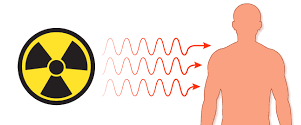
Radiation
All matter continuously radiates electromagnetic radiation unless its temperature is absolute zero. It is observed that the higher the temperature then the greater amount of energy is radiated. If two bodies at different temperatures are so placed that the radiation from each body is intercepted by the other, then the body at the lower temperature…
-
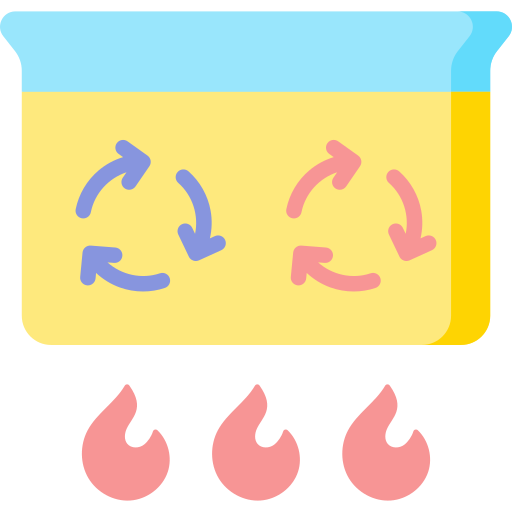
Convection
Convection is the term used for heat transfer mechanism which takes place in a fluid because of a combination of conduction due to the molecular interactions and energy transport due to the macroscopic motion of the fluid itself. In the above definition, the motion of the fluid is essential otherwise the heat transfer mechanism becomes…
-

Conduction
Conduction is the heat transfer from one part of a substance to another part of the same substance, or from one substance to another in physical contact with it, without appreciable displacement of the molecules forming the substance. On the elementary particle level, the conduction is visualized as the exchange of kinetic energy between the…
-

INTRODUCTION
This chapter deals with different modes of heat transfer which are usually classified as conduction, convection and radiation. From the second law of thermodynamics, we know that the heat flows whenever there is existence of temperature difference or temperature gradient. Heat is a form of energy which is transferred from one body to another body…