Category: Lifting Machines
-
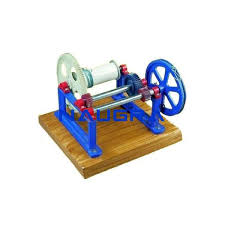
DOUBLE PURCHASE WINCH CRAB
shows the schematic diagram of double purchase winch crab. In this device, velocity ratio is increased by using two pairs of gears. There are three axles as effort axle, intermediate, and load axle, two pinion gears as P1 and P2, two spur gears as S1 and S2. Pinion P1 mounted on effort axle, pinion P2 and spur gear S1 are mounted on the intermediate axle while spur…
-
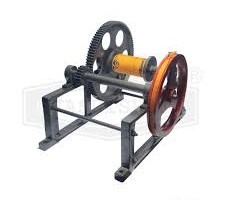
SINGLE PURCHASE WINCH CRAB
shows the schematic diagram of single purchase winch crab. There are two axles: effort axle and load axle. On the effort axle, a small toothed wheel of small diameter known as pinion is mounted. The pinion is a driving gear and is meshed with a large gear known as spur gear. Spur gear is a…
-
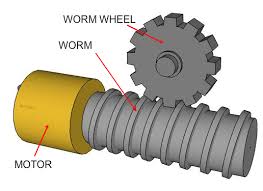
WORM AND WORM WHEEL
shows a worm and worm wheel arrangement. It consists of a threaded screw B called worm and a toothed wheel C called worm wheel. The worm B is in mesh with worm wheel C and their axes are perpendicular to each other. Figure 13.10 Worm and Worm Wheel On the axis of worm B, an effort…
-
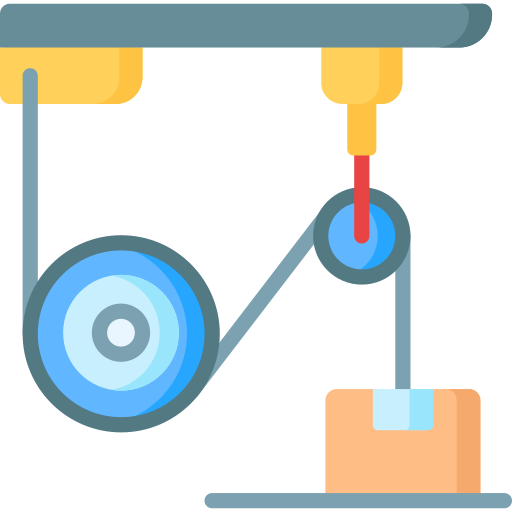
PULLEYS
shows a single fixed pulley arrangement which consists of a wheel with a groove around its circumference to receive a rope or chain. It is mounted on an axle about which it can rotate freely. The ends of the axle are supported by a frame called block. Block may be fixed or movable, if it…
-
DIFFERENTIAL WHEEL AND AXLE
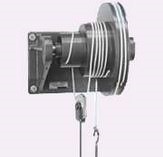
shows the arrangement of differential wheel and axle. It is used to lift the heavier loads. In this lifting machine, the axle is made up of two cylindrical axles B and C of different diameters d1 and d2, respectively. Wheel A has larger diameter, D. The wheel A and axles B and C are keyed to the same…
-
SIMPLE WHEEL AND AXLE
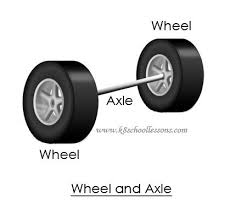
shows the working of simple wheel and axle. It consists of a wheel A of larger diameter and axle B of smaller diameter. Both wheel A and axle B are keyed to the same shaft. There are two strings—first is wound around the wheel A to which effort is applied and second is wound on…
-
REVERSIBLE AND IRREVERSIBLE MACHINES
The machine which starts to move in reverse direction after removal of effort, is called reversible machine. Simple rope and pulley drive is a reversible machine. The machine, which does not move in reverse direction after removal of effort, is called irreversible or self-locking machine. Screw jack, worm and worm wheel, and winch crab are examples of irreversible machine.…
-
Expression for Maximum Mechanical Advantage
From law of machine For maximum mechanical advantage denominator should be minimum. Therefore, will be minimum when W will be very large in comparison to C, i.e., is negligible. Hence, maximum mechanical advantage, Maximum efficiency, The graphical representation of relationship between load and efficiency is shown in Figure 13.3. Figure 13.3 Relationship Between Load and Efficiency
-
TERMINOLOGY RELATED TO THE LIFTING MACHINES
Velocity Ratio (VR): It is ratio of distance moved per unit time by effort to the distance moved per unit time by load. , where y is distance moved by the effort (P), and x is distance moved by the load (W). Mechanical Advantage (MA): It is ratio of load lifted and effort applied on a lifting machine. Its significance is…
-

INTRODUCTION
A machine is a device, which is capable to do some work on application of some effort. Here, effort means input in the form of force or energy supplied to the machine to do work. The work may be explained in the form of load lifting. An illustrative example of a lifting machine is explained…