
When a certain load is connected across the secondary, a current I2 flows through it as shown in Figure 10.16. The magnitude of current I2 depends upon terminal voltage V2 and impedance of the load. The phase angle of secondary current I2 with respect to V2 depends upon the nature of load, that is, whether the load is resistive, inductive, or capacitive.
(Neglecting winding resistance and leakage flux)
When a certain load is connected across the secondary, a current I2 flows through it as shown in Figure 10.16. The magnitude of current I2 depends upon terminal voltage V2 and impedance of the load. The phase angle of secondary current I2 with respect to V2 depends upon the nature of load, that is, whether the load is resistive, inductive, or capacitive.
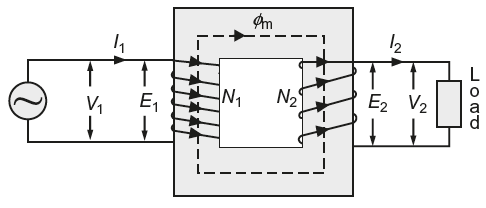
Fig. 10.16 Transformer on load
The operation of the transformer on load is explained below with the help of number of diagrams:
- When the transformer is on no-load as shown in Figure 10.17(a), it draws no-load current I0 from the supply mains. The no-load current I0 produces an mmf. N1I0 which sets up flux in the core.
- When the transformer is loaded, current I2 flows in the secondary winding. This secondary current I2 produces an mmf N2I2 which sets up flux ɸ2 in the core. This flux opposes the flux which is set up by the current I0 as shown in Figure 10.17(b), according to Lenz’s law.
- Since ɸ2 opposes the flux, and therefore, the resultant flux tends to decrease and causes the reduction of self-induced emf E1 momentarily. Thus, V1 predominates over E1 causing additional primary current
 drawn from the supply mains. The amount of this additional current is such that the original conditions, that is, flux in the core must be restored to original value ɸ, so that V1 = E1. The current I1 is in phase opposition with I2 and is called primary counterbalancing current. This additional current produces an mmf N1 which sets up flux, ɸ, in the same direction as that of ɸ as shown in Figure 10.17(c) and cancels the flux ɸ2 set up by mmf N2I2.Now, N1 = N2I2 (ampere-turns balance)∴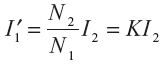
- Thus, the flux is restored to its original value as shown in Figure 10.17(d). The total primary current I1 is the vector sum of current I0 and I′, that is, I1 = I0+ .
This shows that flux in the core of a transformer remains the same from no-load to full load; this is the reason why iron losses in a transformer remain the same from no-load to full load
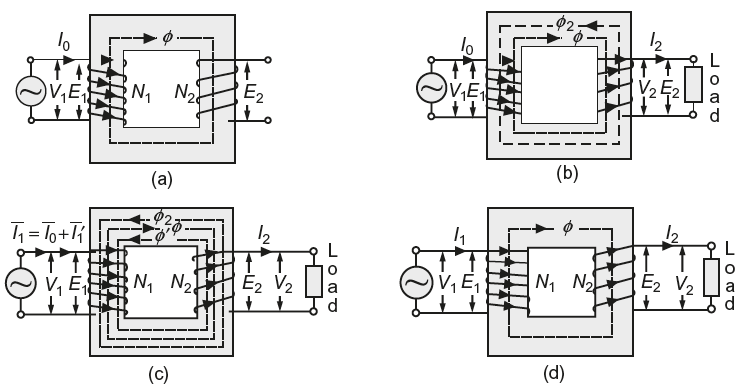
Fig. 10.17 (a), (b), (c) and (d) : Effect on the magnetic flux set-up in the core when transformer is loaded
10.10 PHASOR DIAGRAM OF A LOADED TRANSFORMER
(Neglecting voltage drops in the winding; ampere-turns balance)
Since the voltage drops in both the windings of the transformer are neglected,
V1 = E1 and E2 = V2
While drawing the phasor diagram, the following important points are to be considered.
- For simplicity, let the transformation ratio K = l be considered, and therefore, E2 = E1.
- The secondary current I2 is in phase, lags behind, and leads the secondary terminal voltage V2 by an angle ɸ2 for resistive, inductive, and capacitive load, respectively.
- The counterbalancing current
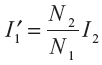 (i.e.,
  = KI2 here K = 1 ∴ = I2) and is 180° out of phase with I2.
 - The total primary current I1 is the vector sum of no-load primary current I0 and counter balancing current That is,
 Where θ is the phase angle between I0 and
 - The p.f. on the primary side is cos ɸ1 which is less than the load p.f. cos ɸ2 on the secondary side. Its value is determined by the relation.
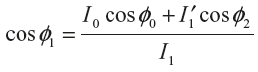
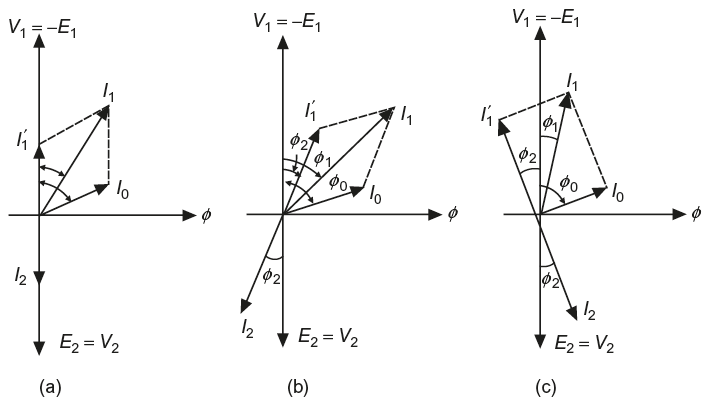
Fig. 10.18 Phasor diagram (a) for resistive load (b) for inductive load (c) for capacitive load
The phasor diagrams of the transformer for resistance, inductive, and capacitive loads are shown in Figure 10.18(a), (b), and (c), respectively.
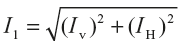
The primary current I1 can also be determined by resolving the vectors, that is,
Iv = I0 cos ɸ0 + cosɸ2 [where sin ɸ0 = sincos−1(cos ɸ0)
IH = I0 sin ɸ0 + sin ɸ2 and sin ɸ2 = sincos−1(cos ɸ2)]
Example 10.12
A single-phase transformer with a ratio of 440/110 V takes a no-load current of 5 A at 0.2 p.f. lagging. If the secondary supplies a current of 120 A at p.f. of 0.8 lagging, calculate the primary current and p.f.
Solution:
Transformation ratio, 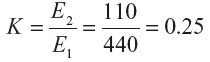
Let the primary counterbalancing current be
Then,
= KI2 = 0.25 × 120 =30A
Now,
cos ɸ0 = 0.2; ɸ0 = cos−10.2 = 78.46°
cos ɸ2 = 0.8; ɸ2 = cos−10.8 = 36.87°
θ = ɸ0 − ɸ2 = 78.46° − 36.87° = 41.59°


Primary p.f.,

= 0.7375 lag
Example 10.13
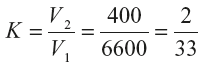
A single-phase transformer with a ratio of 6600/400 V (primary to secondary voltage) takes to no-load current of 0.7 A at 0.24 power factor lagging. If the secondary winding supplies a current of 120 A at a power factor of 0.8 lagging. Estimate the current drawn by the primary winding.
Solution:
Here,
I0 = 0.7 A; cos ɸ0 = 0.24 lag; I2 = 120 A; cos ɸ2 = 0.8 lag
Transformation ratio,
Let the primary counterbalance current be I1.
∴
N1 = N2I2
or

Now,
cos ɸ0 = 0.24; ɸ0 = cos−10.24 = 76.11°
cos ɸ2 = 0.8; ɸ2 = cos−10.8 = 36.87°
Angle between vector I0 and I1 (Figure 10.14(b))
θ = 76.11° − 36.87° = 39.24°
Current drawn by the primary,


Leave a Reply