
The rotor of an induction motor always rotates at a speed less than synchronous speed. The difference between the flux speed (Ns) and the rotor speed (N) is called slip. It is usually expressed as a percentage of synchronous speed (Ns) and is represented by symbol S.
Mathematically,
% slip,
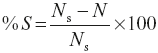
or fractional slip,

Rotor speed,
N = Ns(l−S)
The difference between synchronous speed and rotor speed is called slip speed, that is,
Slip speed = Ns− N
The value of slip at full-load varies from about 6 per cent small motors to about 2 per cent for large motors.
12.6.1 Importance of Slip
Slip plays an important role in the operation of an induction motor. We have already seen that the difference between the rotor speed and synchronous speed of flux determine the rate at which the flux is cut by rotor conductors and hence the magnitude of induced emf, that is, e2 ∝ Ns − N
i2 ∝ e2 and torque, T ∝ i2
T = K(Ns − N)
or
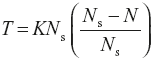
or
T = K1S
Hence
T ∝ S
Thus, greater the slip greater will be the induced emf or rotor current, and hence, larger will be the torque developed.
At no-load, induction motor requires small torque to meet with the mechanical, iron, and other losses, and therefore, slip is small. When the motor is loaded, greater torque is required to drive the load, and therefore, the slip increases and rotor speed decreases slightly.
Therefore, it is observed that slip in an induction motor adjusts itself to such a value to meet the required driving torque under normal operation.
Leave a Reply