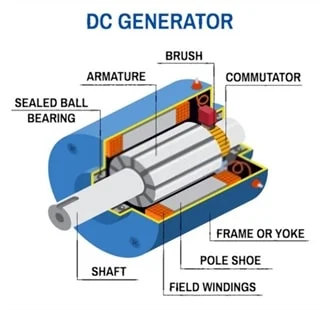
The shunt generator is a self-excited DC generator whose field winding is supplied with the current from the output of the generator itself. However, question arises how it can supply current to the field winding before the voltage being generated? And if the field current is not supplied, how can the voltage be generated? Let us find out its answer from the following explanation.
The open-circuit characteristics of a DC shunt generator are shown in Figure 11.30(b). The shunt field resistance is represented by a straight line OX. When armature is rotated at a constant speed of ω radians/s, the small residual flux of the poles is cut by the armature conductors, and very small emf (oa) is induced in the armature. Now, if key (K) connected in the shunt field winding, as shown in the Figure 11.30(a) is closed, current ob flows in the field winding. This current increases the flux produced by the poles and voltage generated in the armature is increased to oc that further increases the field current to od; further, this builds up the voltage. This building up action comes to an end at point f where the O.C.C. intersects the shunt field resistance line OX. It is because beyond this point, the induced voltage is less than that required to maintain the corresponding field current. Thus, the final current in the field winding is ef and the final voltage build-up by the generator for a given O.C.C. is oe as shown in Figure 11.30(b).
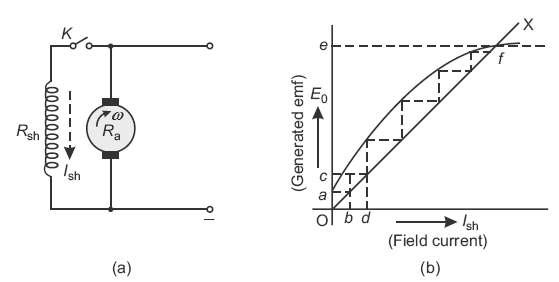
Fig. 11.30 (a) Conventional diagram of a shunt generator where field winding is open circuited (b) Open circuit characteristics of a DC shunt generator
Leave a Reply