
A chemical process typically consists of several units that may involve chemical reactions and/or simple physical separation and mixing operations, as described in previous chapters. The process streams may be constituted of a single phase (gas/liquid/solid) or may be multiphase in nature. A unit may or may not be operating at steady state. Regardless of the situation, the units and the process are amenable to the material balance analysis based on the common principles described in the sections that follow.
6.1.1 Overall Material Balance
Consider an arbitrary process represented by the block flow diagram shown in Figure 6.1. The process unit has two influent flows (streams 1 and 2) feeding into a tank and one effluent flow (stream 3) leaving the tank.
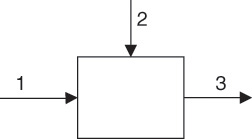
Figure 6.1 A simple process unit.
Physically, the material being fed to the process must either accumulate in it or exit the system. The principle of conservation of mass dictates that the total mass fed to the system must equal the sum of the mass exiting the system and the mass accumulating in the system [2, 3]:

If  ,
,  , and
, and  are the mass flow rates of the three streams, and mS is the total mass in the process unit,2 then
2. By convention, a variable with a dot placed on top indicates a rate, so while m represents the mass (g, kg, and so on),  represents the mass rate (g/s, kg/h, and so on).

Equation 6.1 is the mathematical representation of the overall material balance for the process. If the rate at which material is taken out of the system, , is smaller than the rate at which material is being fed to the system,  , material will accumulate in the process, increasing the system mass mS, as would be the case during process start-up. On the other hand, if is greater than —that is, material is removed at a faster rate from the process than being fed—then mS will decrease with time, as in the case of draining a tank. Generalizing for multiple input and output streams, the overall material balance equation is as follows:

Here,  and
and  represent the mass flow rates of the ith inlet and jth outlet streams. As mentioned previously, a large number of chemical processes operate at steady state, meaning that the conditions are invariant with respect to time. The overall material balance for such steady-state processes is then simplified to equation 6.3.

The overall balance clearly serves a valuable purpose in material accounting. The discrepancy between mass inflow and outflow may be used to estimate atmospheric fugitive emissions and leakages and to identify malfunctioning process equipment.
6.1.2 Component Material Balance
Chemical engineers require additional information (apart from the overall material balance) about material flows of components in the process and conduct component material balances over the process units. Let us assume that the process shown in Figure 6.1 is that of simple mixing of a concentrated aqueous solution of salt A (stream 1) with pure water (H2O; stream 2), yielding a dilute aqueous solution of the salt (stream 3). This is a two-component system composed of the components A and H2O. Applying the principle of the conservation of mass to each component leads to the two component balances shown in equations 6.4 and 6.5.


Here, mA and mH2O represent the masses of component A and H2O present in the system. Since component A is present in only one inlet stream, the left side of equation 6.4 involves only one inlet term. H2O, however, is present in both of the inlet streams, and hence, the left side of equation 6.5 has two terms. The generalized component balance equations for an n component, multistream unit can be written as follows:

The left side of this equation represents the mass of component k being fed to the unit through all the inlet streams (summation over i inlet streams), the first term on the right side represents the mass flow rate of component k out of the system through all outlet streams (summation over j outlet streams), and the last term represents the rate of accumulation of the component mass in the system. The accumulation term will drop out of the equation for a continuous, steady-state process, simplifying the equation from a first-order ordinary differential equation to an algebraic or a transcendental equation.
In total there will be n equations representing component balances for the n components. Thus, in an n-component system, we have n independent component balance equations and one overall material balance equation—a total of n + 1 equations. However, only n of these equations are independent (distinct), as the summation of all component balances will lead to the overall material balance—equation 6.2.
The application of these principles for solving material balance problems for systems that involve only physical operations is described in section 6.2, followed by the application to reacting systems in section 6.3.
Leave a Reply