
An exterior insulation and finish system (EIFS) consists of a layer of plastic foam insulation that is adhered or mechanically fastened to a backup wall, a reinforcing mesh that is applied to the outer surface of the foam by embedment in a base coat of a stuccolike material, and an exterior finish coat of a similar stuccolike material that is troweled over the reinforced base coat. In most cases, EIFS is constructed in place over a backup wall made either of concrete masonry or of steel studs and water-resistant sheathing (Figures 20.23 and 20.24), but the system also adapts readily to prefabrication (Figure 20.25). EIFS finds wide use over wood light framing as well, where it is used for small commercial and residential buildings.
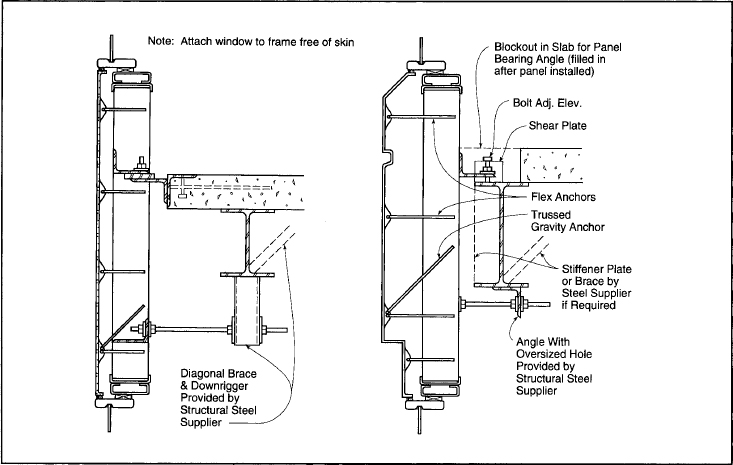
FIGURE 20.21 Typical connections of GFRC panels to a steel building frame. The lower connection in each case is a threaded rod that can flex as necessary as the height of the upper connection is adjusted with shims. (Courtesy of Precast/Prestressed Concrete Institute)
There are two generic types of EIFS, polymer based and polymer modified. Polymer-based EIFS uses a very low density expanded polystyrene bead foam insulation, a glass fiber reinforcing mesh embedded in a base coat that is formulated primarily from either portland cement or acrylic polymer, and a finish coat that consists of texture granules in an acrylic polymer vehicle. The foam insulation is adhered to the backup wall. Polymer-modified EIFS uses a slightly higher density, extruded polystyrene foam insulation rather than expanded bead foam. The foam panels are mechanically attached to the backup wall with metal or plastic screws (plastic screws minimize thermal bridging through the insulation). A metal reinforcing mesh is embedded in a relatively thick portland cement base coat, and the finish coat is formulated of portland cement with acrylic modifiers. Polymer-modified systems are more durable (and more expensive) than polymer-based systems. They are more susceptible to shrinkage cracking during curing but are much less susceptible to denting or puncture. Polymer-based systems, on the other hand, have a very thin coating that is more elastic and less prone to cracking but relatively easy to dent or puncture when applied to areas of a building that are within reach of passersby or vehicles.
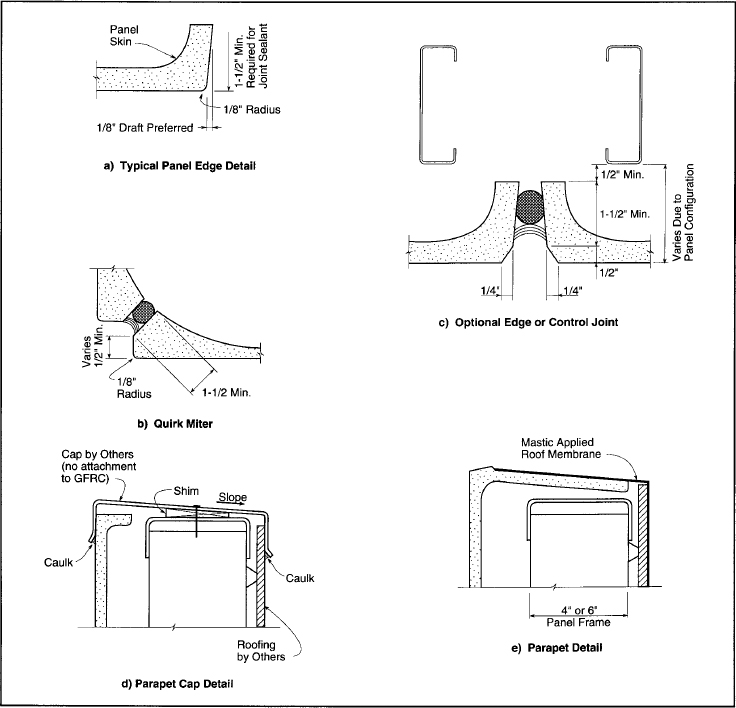
FIGURE 20.22 Typical edge details for GFRC cladding panels. (Courtesy of Precast/Prestressed Concrete Institute)
EIFS is an unusually versatile type of cladding, used for building types as diverse as single-family residences of wood or masonry construction as well as the largest buildings of noncombustible construction. It is used both for new construction and for refacing and insulating existing buildings. The insulating foam layer may be up to 4 inches (100 mm) thick, and there is little or no thermal bridging. The finish layer may be applied in a range of colors and textures. In appearance, at least from a distance, EIFS is virtually indistinguishable from conventional stucco.
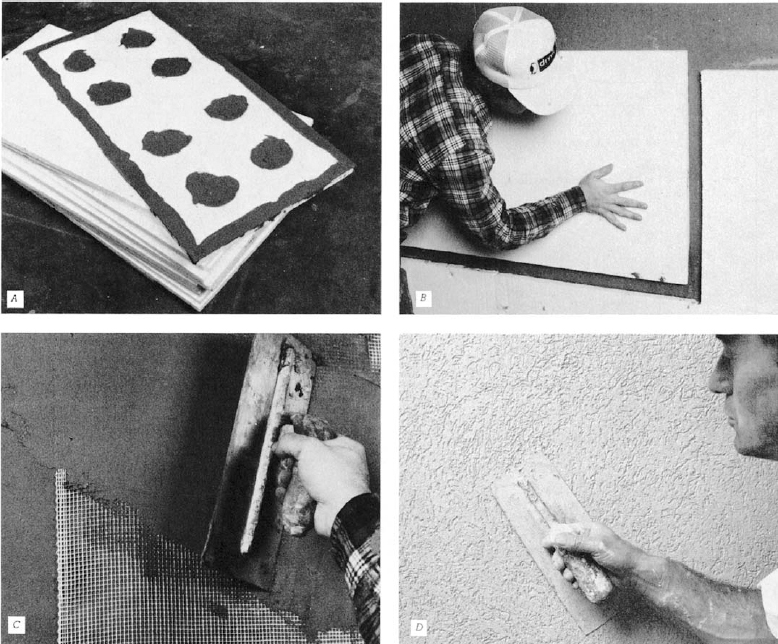
FIGURE 20.23 Four steps in installing an EIFS over a building with walls of masonry or solid sheathing. (a) A panel of foam is daubed with polymer-modified portland cement mortar. The foam may be as thick as required to achieve the desired thermal performance. (b) The foam panel is pressed into place, where it is held permanently by the daubs of mortar. (c) A thin base coat of polymer-modified stucco is applied to the surface of the foam panels, with an embedded mesh of glass fiber to act as reinforcing. (d) After the base coat has hardened, a finish coat in any desired color is troweled on. (Used by permission of Dryvit® System, Inc.)
A weakness of conventional EIFS of either type is that it is designed as a barrier system, without any means of internal drainage to prevent damage to the backup material if water leakage occurs at joints or through damaged areas. There have been numerous cases of extensive water damage in EIFS-faced buildings that have experienced leakage through poor detailing, faulty sealant joints, or failed coatings, especially around windows and doors. In response to this problem (and to the extensive litigation that arose out of it), EIFS producers now market water-managed or water-drainage EIFS. These systems utilize a layer of drainage matting behind the foam insulation that can capture water that does leak past the outer layer and conduct it to plastic flashings and weeps above wall openings and at the base of the wall, lessening the risk of water penetrating deeper into the system, where it can cause greater damage (Figure 20.26).
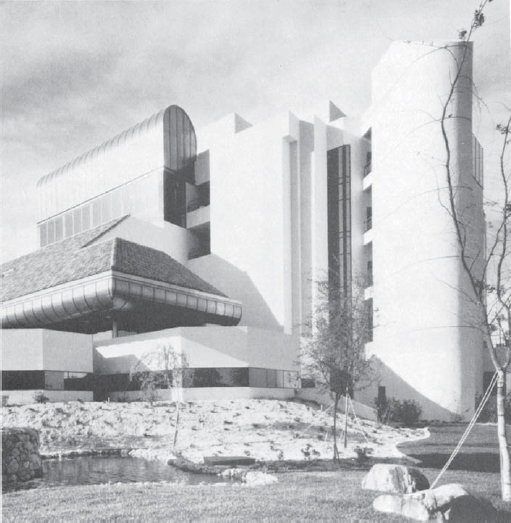
FIGURE 20.24 A new bank building clad in EIFS. (Architect: Paul Thoryk. Photo by John Bare. Used by permission of Dryvit® System, Inc.)
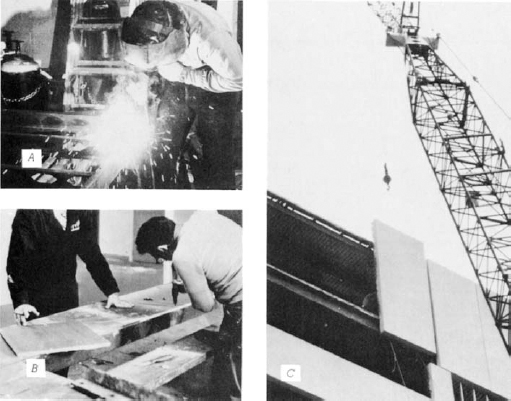
FIGURE 20.25 EIFS cladding can be shop fabricated and erected in panel form. (a) Steel studs are welded together to make panel frames. (b) Rigid sheathing is screwed to the panel frames and finished with EIFS as shown in Figure 20.23. (c) The finished panels are bolted to the frame of the building. (Used by permission of Dryvit® System, Inc.)
Another weakness of polymer-based EIFS is the ease with which it is dented or punctured; this problem may be overcome by specifying a polymer-modified system or a specially reinforced polymer-based system in areas subject to damage. Damaged spots are easily and unobtrusively patched.
Because of these weaknesses and problems, the designer is advised to proceed with extreme care in detailing and specifying EIFS cladding and to avoid the use of barrier EIFS except in combination with backup systems, such as cast-in-place concrete, that are highly tolerant of moisture intrusion.
Leave a Reply