
shows the use of prefabricated reinforced brick panels for cladding. Masons construct the panels while working comfortably at ground level in a factory. Horizontal reinforcing may be laid into the mortar joints or grouted into channel-shaped bricks. Vertical reinforcing bars are placed in grouted cavities of hollow-core bricks. These panels are self-rigid; they need no structural backup and can be fastened to the building in much the same way as precast concrete panels. A steel stud backup wall is required to carry thermal insulation, electrical wiring, and an interior finish layer, but it has no structural role.
STONE CURTAIN WALLS
Chapter 9 discusses types of stone and illustrates conventionally set stone facing systems that tie relatively small blocks of cut stone set in mortar to a concrete masonry backup wall. Slabs of stone that are larger in surface area may be fastened to framed buildings in several different ways.
Stone Panels Mounted on a Steel Subframe
Figure 20.8 shows a system for mounting stone panels on a steel subframe, called grid-system-supported stone cladding. The vertical members of the subframe are erected first. They are designed to transmit gravity and wind loads from the stone slabs to the frame of the building. The horizontal members are aluminum shapes that engage slots in the upper and lower edges of each panel to attach them firmly to the building. They are added as the installation of the stone panels progresses. Backer rods and sealant fill the spaces between the panels, allowing for a considerable range of movement. A nonstructural backup wall, usually made of steel studs and gypsum sheathing panels, is constructed within the frame of the building but is not attached to the subframe. Its functions are to provide an air barrier, to house thermal insulation batts and electrical wiring, and to support the interior wall finish layer, which is usually plaster or gypsum board.
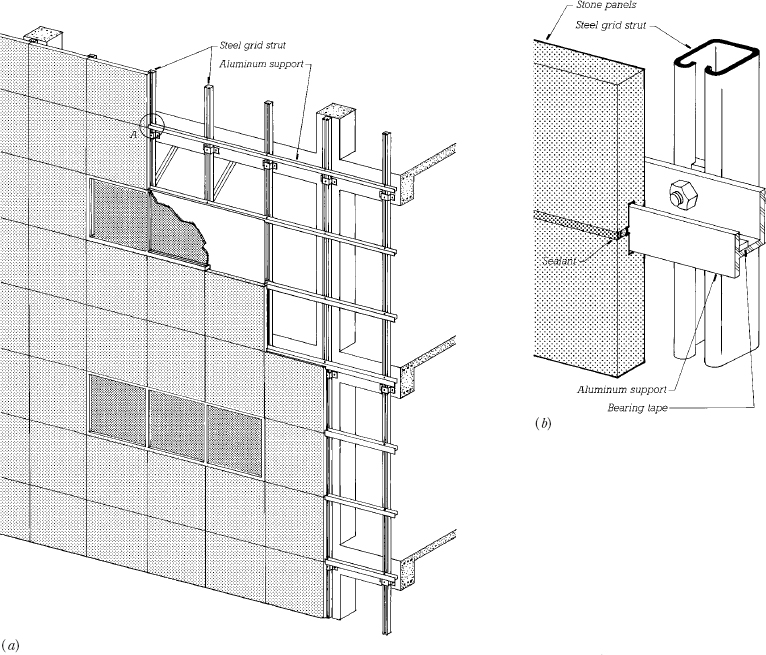
FIGURE 20.8 A subframe of vertical steel struts supports a facing of stone panels by means of horizontal metal clips that engage slots in the upper and lower edges of the panels. In order to avoid corrosion and staining problems, the steel struts should be galvanized, and the clips should be made of a nonferrous metal (aluminum or stainless steel) that is chemically compatible with the type of stone that is used.
FIGURE 20.9 (a) Parapet and (b) spandrel details for a stone panel curtain wall made of limestone, marble, or granite. The broken lines indicate the outline of the interior finish and thermal insulation components, which are not shown. Each support plate holds edges of two adjacent wall panels, which are pocketed as shown to rest on the plate. The plate should be made of a noncorroding metal. The vertical joints between panels are closed with a backer rod and sealant.
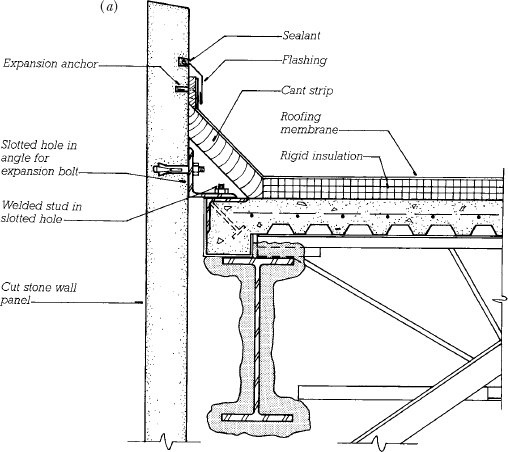
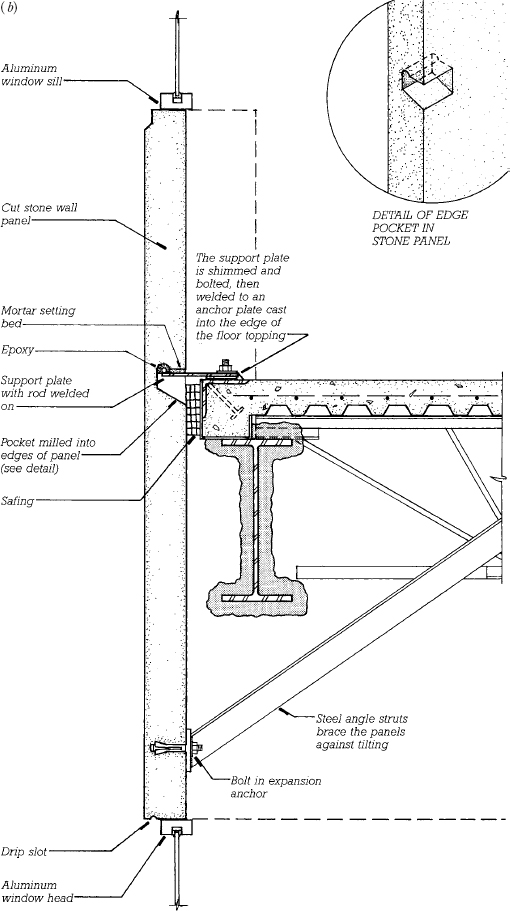
FIGURE 20.10 A granite panel curtain wall of the type illustrated in Figure 20.9 wraps around the corner of a Boston office building. The upper-floor windows have not yet been installed, but the window frames have been mounted in two of the middle floors, and the lower floors have been glazed. (Architect: Hugh Stubbins and Associates. Photo by Edward Allen)

A weakness of this system is its dependence on the integrity of the sealant joints. If a sealant joint leaks, water may accumulate in the slots in the tops of the stone panels, and freeze-thaw deterioration may ensue.
Monolithic Stone Cladding Panels
Figures 20.9 and 20.10 illustrate the use of monolithic stone cladding panels that are fastened directly to the frame of the building. The weight of each panel is transferred to two steel support plates by means of edge pockets that are cut into both sides of each panel at the stone mill. Each panel is stabilized by a pair of steel angle struts that are bolted to the stone with expansion anchors in drilled holes. Joints are closed with backer rod and sealant, and a nonstructural backup wall is required.
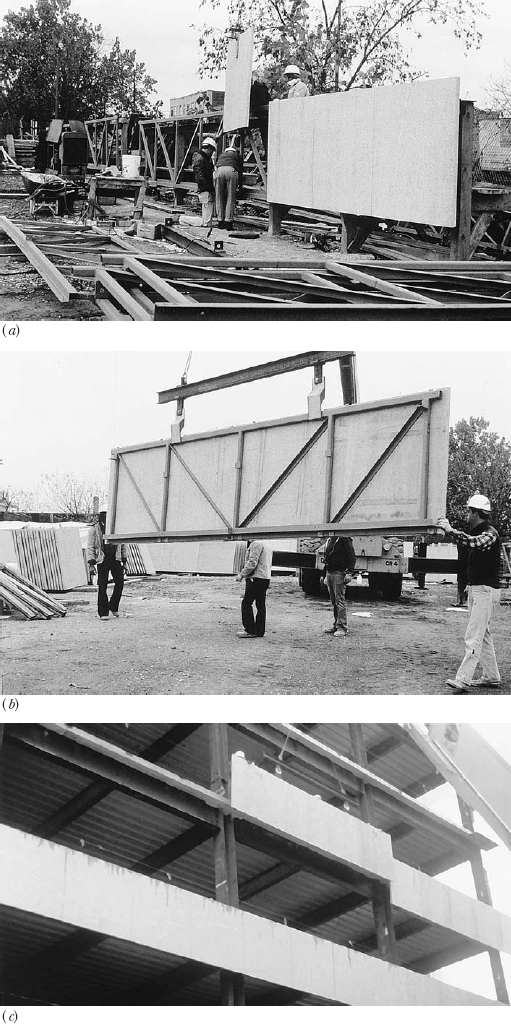
FIGURE 20.11 A steel truss system for stone cladding. (a) Masons working in a fabrication yard attach thin sheets of stone to welded steel trusses. The vertical joints are closed with backer rods and sealant. (b) The fabricated spandrel panel is lifted onto a truck using a crane. The metal clips that are just visible along the top and bottom edges of the panel engage slots in the edges of the sheets of stone to hold the stone securely to the truss. The steel angle clips at the two upper corners of the truss will support the panel on brackets welded to the steel columns of the building frame. (c) The panel is installed. (Courtesy of International Masonry Institute, Washington, DC)
Stone Cladding on Steel Trusses
In truss-supported stone cladding, sheets of stone are combined into large prefabricated panels by mounting them on structural steel trusses (Figure 20.11). Each truss is designed to carry both wind loads and the dead load of the stone to steel connection brackets that transfer these loads to the frame of the building. Sealant joints and a nonstructural backup wall finish the installation.
Posttensioned Limestone Spandrel Panels
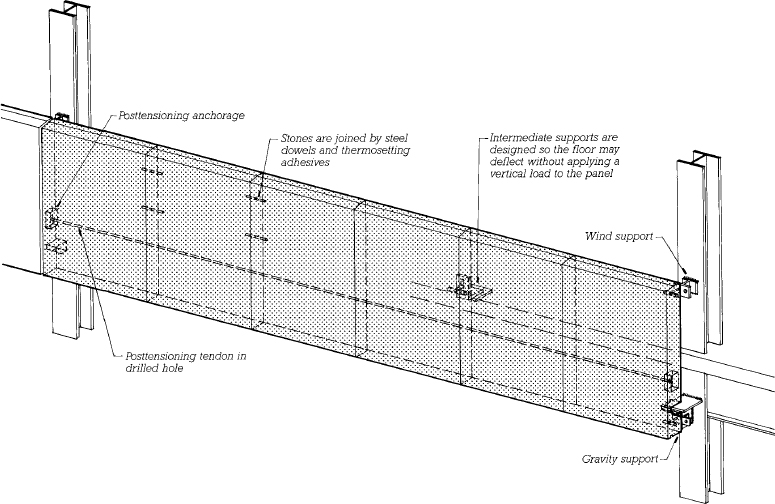
Thick blocks of limestone may be joined with adhesives into long spandrel panels and posttensioned with high-strength steel tendons so that the assembly is self-supporting between columns (Figure 20.12). Such posttensioned limestone spandrel panels are a relatively costly type of panel because of their use of comparatively large quantities of stone per unit area of cladding.
Very Thin Stone Facings
Extremely thin sheets of stone (as thin as ¼ inch, or 6.5 mm, for granite) may be stiffened with a structural backing such as a metal honeycomb and mounted as spandrel panels in an aluminum mullion system such as those described in Chapter 21.
Very thin sheets of stone may also be used as facings for precast concrete curtain wall panels. The stone sheets are laid face down in the forms. Stainless steel clips are inserted into holes drilled in the backs of the stone. A grid of steel reinforcing bars is added, and then the concrete is poured and cured to complete the panel. The clips anchor the stone to the concrete.
When specifying the thickness of stone for any exterior cladding application, the designer should work closely with the stone supplier and also consult the relevant standards of the building stone industry. Stone that has been sliced thinner than industry standards has caused a number of failures of cladding systems.
FIGURE 20.12 Thicker blocks of Indiana limestone may be posttensioned together to make spandrel panels that span from column to column but require little steel. The posttensioning tendon is threaded through matching holes that are drilled in the individual stones prior to assembly.
Leave a Reply