The major impact of building codes on the design of the exterior wall is in the areas of structural strength, fire resistance, and energy efficiency. Strength requirements relate to the strength and stiffness of the wall system itself and to the adequacy of its attachments to the building frame, with special reference to wind and seismic loadings.
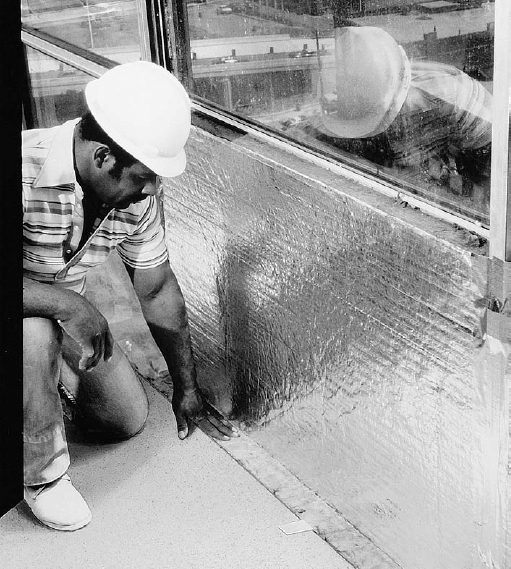
FIGURE 19.15 Safing is a high-temperature, highly fire-resistant mineral batt material that is inserted between a curtain wall panel and the edge of the floor slab to block the passage of fire from one floor to the next. It is seen here behind a metal-and-glass curtain wall with insulated spandrel panels. The safing is held in place by metal clips such as the one seen in the foreground. (Courtesy of United States Gypsum Company)
Fire requirements are concerned with the combustibility of the wall materials, the fire resistance ratings and vertical dimensions of parapets and spandrels, the fire resistance ratings of exterior walls facing other buildings that are near enough to raise questions of fire spread from one building to the other, and the closing off (firestopping) of any vertical passages in the wall that are more than one story in height. At each floor, the space inside column covers and the space between the exterior wall system and the edges of floors must be firestopped, using a steel plate and grout, metal lath and plaster, mineral wool safing, or other material that can restrict the passage of smoke and fire through these gaps (Figure 19.15).
Energy conservation requirements are becoming more and more demanding. Most energy codes allow several alternative approaches to demonstrating compliance. In the prescriptive approach, minimum thermal resistances of panels, spandrels, and glass; vapor retarder performance; and maximum levels of air leakage are specified. For example, in the International Energy Conservation Code’s prescriptive approach for commercial buildings, up to 40 percent of the above-grade walls may be glazed, with a maximum U-factor ranging from 1.20 to 0.35 (6.8-2.0 W/m2-°K), depending on the climate zone in which the building is located.
Component trade-off and systems analysis approaches give the building designer more flexibility in selecting enclosure systems while demonstrating that the overall energy performance of the proposed design is equal or superior to that of the same building constructed to meet the prescriptive code requirements.
Leave a Reply