
Interior finishing operations follow a carefully ordered sequence that varies somewhat from one building to another, depending on the specific requirements of each project. The first finish items to be installed are usually hanger wires for suspended ceilings, and full-height partitions and enclosures, especially those around mechanical and electrical shafts, elevator shafts, mechanical equipment rooms, and stairways. Firestopping is inserted around pipes, conduits, and ducts where they penetrate floors and fire-rated walls (Figure 22.3). The full-height partitions and enclosures, fire-stopping, joint covers (Figure 22.4), and safing around the perimeters of the floors constitute a very important system for keeping fire from spreading through the building.
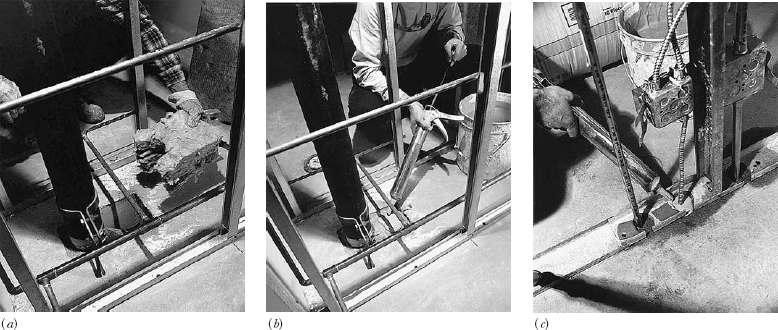
FIGURE 22.3 Applying firestopping materials to floor penetrations. (a) Within a plumbing wall, a layer of safing insulation is cut to fit and inserted by hand into a large slab opening around a cast iron waste pipe. Then a mastic firestopping compound is applied over the safing to make the opening airtight (b). (c) Applying firestopping compound around an electrical conduit at the base of a partition. (Courtesy of United States Gypsum Company)
After the major horizontal electrical conduits and air ducts have been installed, the grid for the suspended ceiling is attached to the hanger wires so that the lights and ventilating louvers can be mounted to the grid. Then, typically, the ceilings are finished, and framing for the partitions that do not penetrate the finish ceiling is installed. Electrical and communications wiring is brought down from the conduits above the ceilings to serve outlets in the partitions. The walls are finished and painted. The last major finishing operation is the installation of the finish flooring materials. This is delayed as long as possible to let the other trades complete their work and get out of the building; otherwise, the floor materials could be damaged by dropped tools, spilled paint, heavy construction equipment, weld spatter, coffee stains, and construction debris ground underfoot.
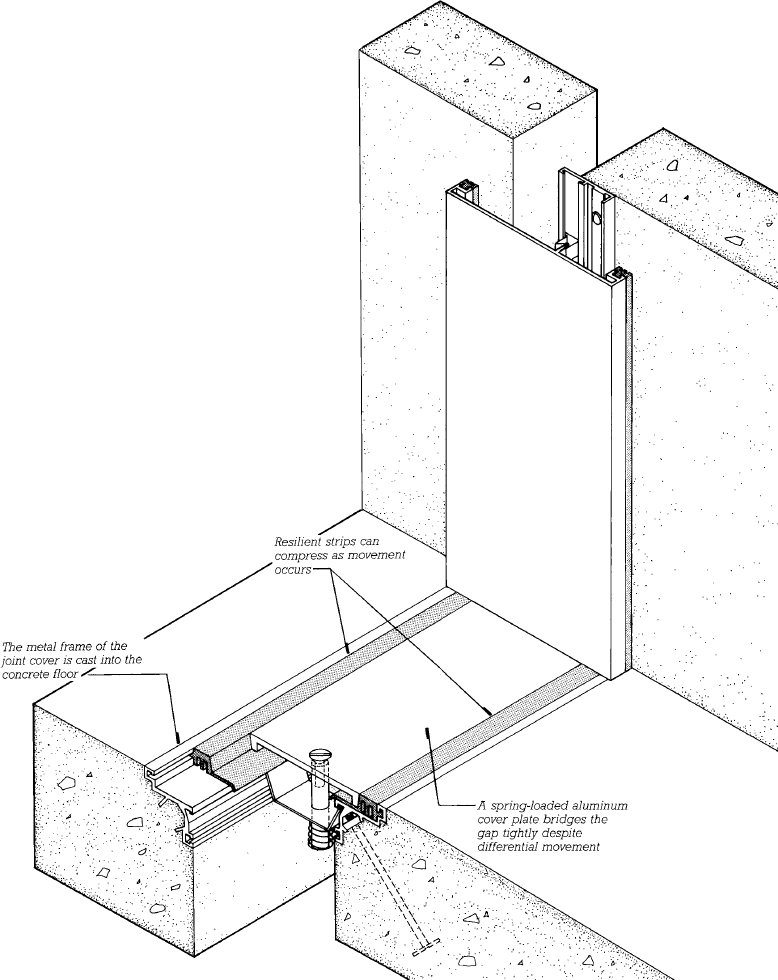
FIGURE 22.4 Building separation joints need to be covered on the interior of the building to make them safe, attractive, and airtight. The covers must be able to adjust readily to expected movements between the separate parts of the building. Shown here are proprietary joint covers for a floor and a wall. Both are ingeniously designed to remain tightly in place while accommodating differential movements of any type. (Courtesy of Architectural Art Manufacturing, Inc., Wichita, Kansas. For a general discussion of movement joints in buildings, see pages 396–399.)
CONSIDERATIONS OF SUSTAINABILITY IN SELECTING INTERIOR FINISHES
In addition to sustainability considerations related to specific materials and systems discussed in the next two chapters, selection of interior finishes for sustainable buildings should be guided by the following general principals:
Materials
• Finish materials that have a high recycled content reduce the demand for virgin materials and make productive use of materials that would otherwise be treated as waste. The availability of finish materials with recycled content continues to increase in many finish product categories.
• Finish materials that can be recycled when they exceed their useful life also reduce waste. Some manufacturers, such as those of ceiling tile, carpet, and gypsum products, have established recycling or reclamation programs to divert such products from the waste stream. At present, however, recycling remains in its infancy, and most construction and demolition waste continues to end up in landfills.
• Interior finishes derived from rapidly renewable sources, such as bamboo flooring, or from certified woods reduce the depletion of raw materials of limited supply and protect forest ecosystems.
• Finish materials that are extracted, processed, and manufactured locally require less energy to transport, and their use helps to support local economies.
Indoor Air Quality
• Indoor finish materials and coatings present large surface areas to the interior environment of a building, making them potentially significant sources of emissions and indoor air quality problems. Potential emitters include glues and binders used in wood panels and other manufactured wood products, leveling compounds applied to subflooring, carpet fabrics and backings, carpet cushions, carpet adhesives, antimicrobial and mothproofing carpet treatments, wall covering adhesives, resilient flooring adhesives, vinyl in all its forms, gypsum board joint compounds, curtain and upholstery fabrics, paints, varnishes, stains, and more.
• Formaldehyde gas is an irritant to building occupants, causes nausea and headaches, and can exacerbate asthma. Potential sources include processed wood products, glues, adhesives, carpets, and permanent press fabrics.
• Volatile organic compounds are air pollutants, can act as irritants, and some are significant greenhouse gases. Common emitters include processed wood products, glues, adhesives, paints and other coatings, carpets, and plastic welding processes. The chemical 4-phenylcyclohexene, emitted by rubber binders used in some carpets and pads, is carcinogenic.
• Increasingly, manufacturers are publishing emissions data for their products, offering products with reduced emissions, and participating in rating systems meeting the low emission standards of LEED and other green building programs, making it easier for designers and specifiers to select green products. Examples of such programs include the Resilient Floor Covering Institute’s FloorScore rating for resilient flooring, the Carpet and Rug Institute’s Green Label Plus for carpet, and Greenguard Environmental Institute’s GreenGuard Indoor Air Quality Certification for interior materials, finishes, and furnishings.
• Mold and mildew growth in carpets, wall coverings, gypsum board assemblies, and fabrics can cause acute respiratory distress in many people. Generally, this problem occurs only when these materials are repeatedly wetted by leakage or condensation. In response to this concern, many manufacturers now offer finish materials with improved resistance to moisture and mold growth.
• Construction dust, if not fully removed before the building is occupied, can be a source of irritating particulates after occupancy.
Design
• Floor plans that are flexible and easily adapted to new uses and partition systems that are easy to modify encourage building reuse.
• The strategic use of high ceilings, low partitions, transparency, reflective surfaces, and light colors can maximize daylighting potential and views to the exterior.
• Spaces designed with exposed structure and without suspended ceilings save materials
Leave a Reply