
The vast majority of gypsum board partitions are finished with several coats of paint. For more information about paints and coatings, see pages 234–237. Ceramic tile facings are often added to walls for reasons of appearance, durability, sanitation, or moisture resistance. In a thickset or mortar bed application, tile is applied to a base of portland cement mortar (Figure 23.41).
Lower-cost tile wall facings eliminate the mortar base and are thin-set onto tile backing boards, also called backer boards, most frequently made of fiber-reinforced lightweight cement or glass-mat faced water-resistant gypsum board, similar to the floor tile assembly illustrated in Figure 24.29. Cement backer board is the more water resistant, but is more difficult to cut and handle than lighter-weight gypsum backer board. Water-resistant paper-faced gypsum backer board, used in the past for low-cost thin-set tile setting applications, is no longer considered sufficiently durable for tile backing applications, particularly in wet areas such as shower surrounds.
Tiles are bonded to the backer board with a variety of compounds, the most common of which are dry-set mortar, latex/polymer modified portland cement mortar, and organic adhesive. Dry-set mortar is a mix of cement, fine sand, and water retention compounds that allow the thin mortar layer to cure properly. Latex/polymer modified portland cement mortar is similar to dry-set mortar, but with additives that improve the cured mortar’s freeze-thaw resistance, flexibility, and adhesion. Organic adhesives, various proprietary synthetic polymer adhesives, are used for light-duty tile applications. After the tiles have become fully adhered, a cementitious grout of any desired color is wiped into the tile joints with a rubber-faced trowel. Thin-set compounds and grouts formulated with epoxies or furan resins (colorless, highly volatile solvents distilled from wood) may also be used for tiling applications where greater strength, impact resistance, or chemical resistance is required.

FIGURE 23.39 Obsolete partition systems found in existing buildings: hollow clay tiles and plaster (left) and gypsum tiles and plaster (right).
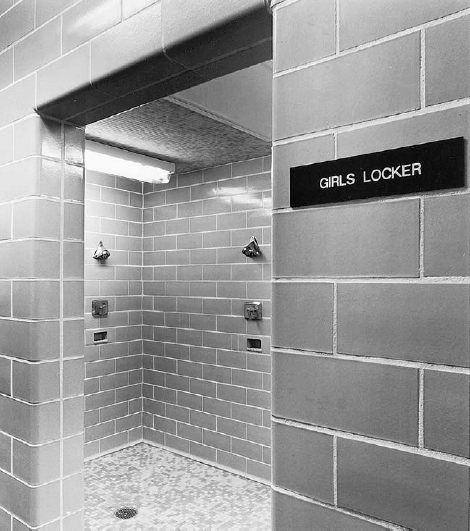
FIGURE 23.40 A glazed structural clay tile partition installation. The floor is finished with glazed ceramic tiles. (Courtesy of Stark Ceramics, Inc.)
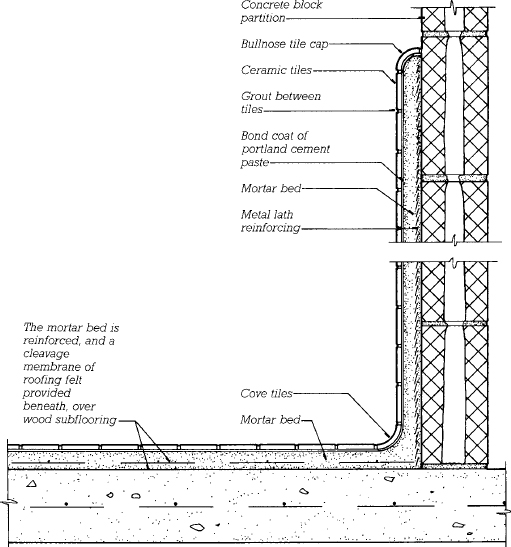
FIGURE 23.41 Example details of a thickset ceramic tile installation. Thickset applications are used where the face of the partition or the surface of the floor is cracked, coated, rough, unstable, or so uneven as to make it unsuitable for direct bonding of tile using thin-set methods. Depending on the quality of the substrate, metal reinforcing of the portland cement mortar base may or may not be required, and the mortar base may or may not be isolated from the substrate with a layer of felt paper acting as a slip sheet. Thickset mortar beds for wall tiling are typically ¾ to 1 inch (19–25 mm) thick, while those for floors are typically 1¼ to 2 inches (32–50 mm) thick.
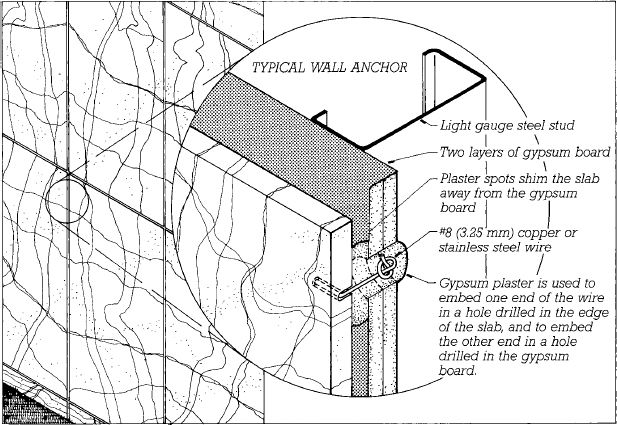
FIGURE 23.42 Attaching a stone facing over a backup of gypsum boards and steel studs.
FIGURE 23.43 Imaginative use of gypsum products is coordinated with concealed sources of light to create a singularly dramatic space for the D. E. Shaw & Company office and trading area in New York. (Stephen Holl Architects. Photo by Paul Warchol)
In showers, steam rooms, and other wet locations, a waterproofing membrane should be added to the tile assembly to prevent water from seeping through the tile and into the wall behind. Either liquid-applied or flexible sheet membranes may be used, positioned either behind the base material or between the base and the finish tile.
Facings of granite, limestone, marble, or slate are sometimes used in public areas of major buildings. A common method of mounting is shown in Figure 23.42.
Wood wainscoting and paneling may be used in limited quantities in fire-resistant buildings, as discussed on pages 877–878. They are mounted over a backing of plaster or gypsum board to retain the fire-resistive qualities of the partition.

Leave a Reply