Author: workhouse123
-

ARMATURE RESISTANCE
The resistance between the armature terminals is called armature resistance. It is generally represented by Ra. The value of armature resistance is usually quite small (less than 1 Ω). Armature resistance depends upon the following factors:
-
MAIN CONSTRUCTIONAL FEATURES
The complete assembly of various parts in a scattered form of a DC machine is shown in Figure 11.4. The essential parts of a DC machine are described as follows: Fig. 11.4 Main parts of DC machine
-
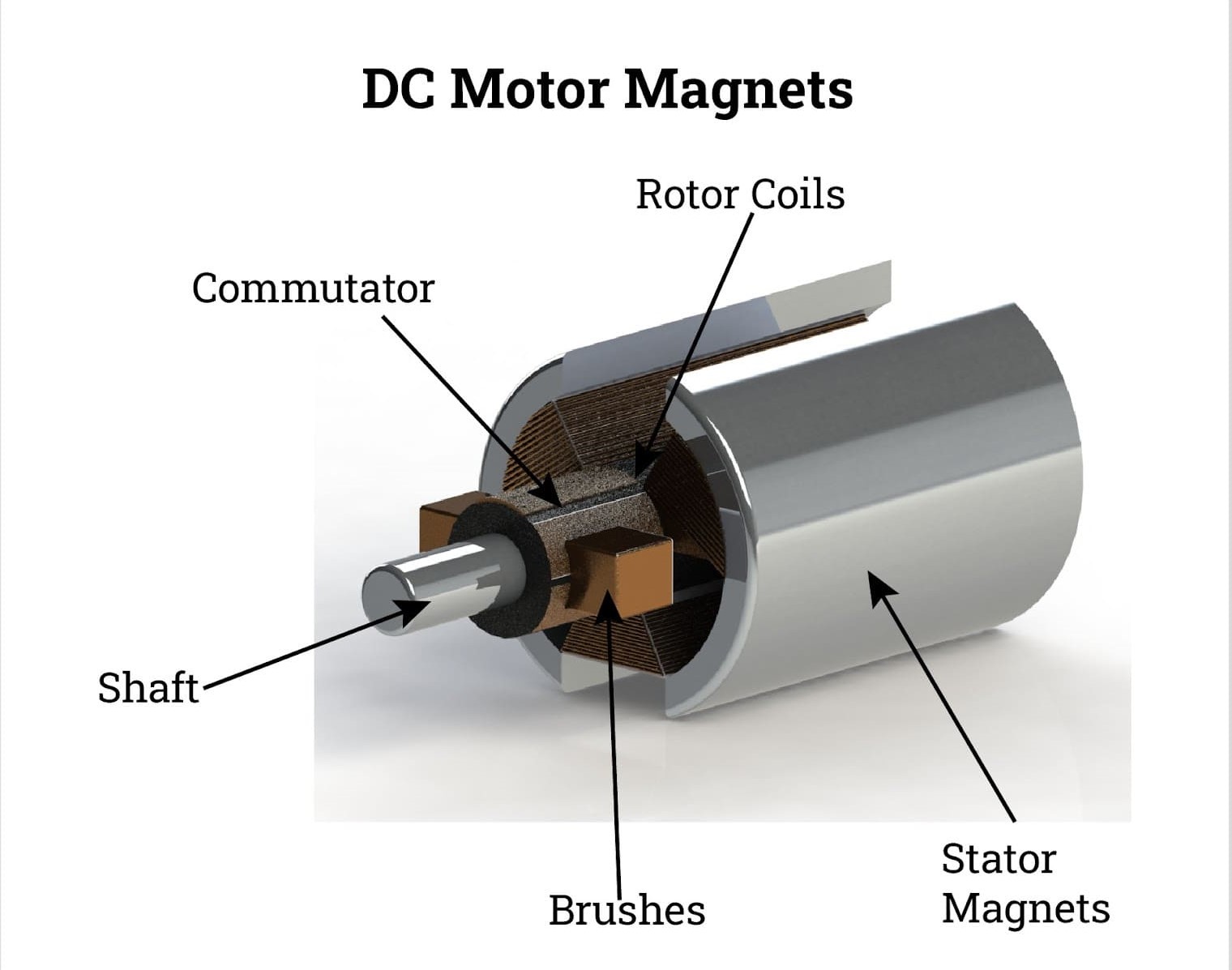
Motor
An electromechanical device (electrical machine) that converts electrical energy or power (EI) into mechanical energy or power (ωT) is called a motor. Electric motors are used for driving industrial machines, for example, hammer presses, drilling machines, lathes, shapers, blowers for furnaces, etc., and domestic appliances, for example, refrigerators, fans, water pumps, toys, mixers, etc. The…
-
ELECTROMECHANICAL ENERGY CONVERSION DEVICES (MOTORS AND GENERATORS)
A device (machine) that makes possible the conversion of energy from electrical to mechanical form or from mechanical to electrical form is called an electro-mechanical energy conversion device or electro-mechanical transducer, as shown in Figure 11.1. Fig. 11.1 Electro-mechanical energy conversion Depending upon the conversion of energy from one to the other, the electromechanical device can be…
-

INTRODUCTION
A DC machine is an electromechanical energy conversion device. It can convert mechanical power (ωT) into DC electrical power (EI) and is known as a DC generator. On the other hand, when it converts DC electrical power into mechanical power, it is known as a DC motor. Although battery is an important source of DC…
-

ADDITION AND SUBTRACTION OF ALTERNATING QUANTITIES
In AC circuits, it is required to add or subtract the alternating quantities. In such cases, it should be proceed as follows: 6.19.1 Addition of Alternating Quantities The given alternating quantities are represented as phasor, and then, they are added in the same manner as forces are added. Only phasors of the similar quantities are…
-

PHASE AND PHASE DIFFERENCE
The phase of an alternating quantity (current or voltage) at an instant is defined as the fractional part of a cycle through which the quantity has advanced from a selected origin (Fig. 6.23). In actual practice, we are more concerned withthe phase difference between the two alternating quantities rather than their absolutephase. Fig. 6.23 Phasor representation…
-
FORM FACTOR AND PEAK FACTOR
There exists a definite relation among the average value, rms value, and peak value of an alternating quantity. The relationship is expressed by the two factors, namely form factor and peak factor. Example 6.1 The equation of an alternating current is i = 42.42 sin 628 t Determine (i) its maximum value; (ii) Frequency; (iii) rms value; (iv)…
-
RMS VALUE OF SINUSOIDAL CURRENT
An alternating current varying sinusoidally is given by the following equation: i = Im sin θ To determine the rms value, the squared wave of the alternating current is drawn as shown in Figure 6.11. Fig. 6.11 Squared-wave shape of a sine wave Considering an elementary strip of thickness dθ in the first half-cycle of the squared wave, let i2 be…
-
EFFECTIVE OR RMS VALUE
The steady current when flows through a resistor of known resistance for a given time produces the same amount of heat as produced by an alternating current when flows through the same resistor for the same time is called effective or rms value of an alternating current. Let i be an alternating current flowing through a resistor…