Author: workhouse123
-
Ratio of Tensions
Let T1 is tension in tight side of the belt T2 is tension in slack side of the belt θ is angle of lap of belt over the pulley μ is coefficient of friction between the belt and pulley Figure 15.5 Tensions in Belt Consider a short length of belt subtending an angle δθ at the centre of the pulley as shown…
-
Crossed-belt Drive
Cross-belt drive is used to provide reverse direction of rotation to driven shaft as the direction of rotation of driving shaft. Similar to open-belt drive, let A and B be the pulley centres and CD and EF be the common tangents to the two pulleys as shown in Figure 15.4. Figure 15.4 Crossed-belt Drive In Figure 15.4, belt length, L = 2 (Arc GC + CD + Arc DH) Example 15.2: Two shafts drive are…
-
Creep
When belt passes from slack to tight side, a certain portion of belt extends and again contracts when belt passes through tight to slack side. Due to fluctuation in length of the belt, there is relative motion between belt and pulley surface. This relative motion is known as creep. Considering the creep, velocity ratio can…
-
Type of Belt Cross-sections
shows flat belt and V-belt. In the flat belt drive, rim of pulley is slightly crowned which helps to keep the belt running centrally on the pulley rim as shown in Figure 15.2(a). For the V-belt drive, grooves are made on rim of pulley for wedging action. The belt does not touch the bottom of the groove…
-
BELT DRIVE
In belt drive, the velocity of two shafts can be varied by variation in diameter of pulley on which belt is mounted. But in chain or gear drive, the velocity of two shafts is varied by variation in the number of teeth on sprocket and gear, respectively. If an unstretched belt is mounted on the…
-

INTRODUCTION
Power transmission is a process to transmit motion from one shaft to another by using some connection between them like belt, rope, chain, and gears. To connect the shafts, mainly two types of connectors are used, one is flexible and other is rigid. In flexible types of connection, there is relative velocity between shaft and…
-
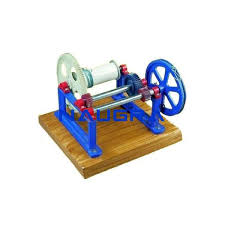
DOUBLE PURCHASE WINCH CRAB
shows the schematic diagram of double purchase winch crab. In this device, velocity ratio is increased by using two pairs of gears. There are three axles as effort axle, intermediate, and load axle, two pinion gears as P1 and P2, two spur gears as S1 and S2. Pinion P1 mounted on effort axle, pinion P2 and spur gear S1 are mounted on the intermediate axle while spur…
-
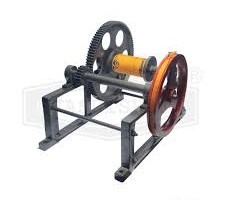
SINGLE PURCHASE WINCH CRAB
shows the schematic diagram of single purchase winch crab. There are two axles: effort axle and load axle. On the effort axle, a small toothed wheel of small diameter known as pinion is mounted. The pinion is a driving gear and is meshed with a large gear known as spur gear. Spur gear is a…
-
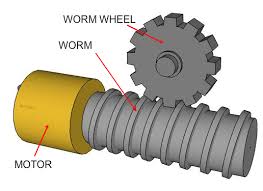
WORM AND WORM WHEEL
shows a worm and worm wheel arrangement. It consists of a threaded screw B called worm and a toothed wheel C called worm wheel. The worm B is in mesh with worm wheel C and their axes are perpendicular to each other. Figure 13.10 Worm and Worm Wheel On the axis of worm B, an effort…
-
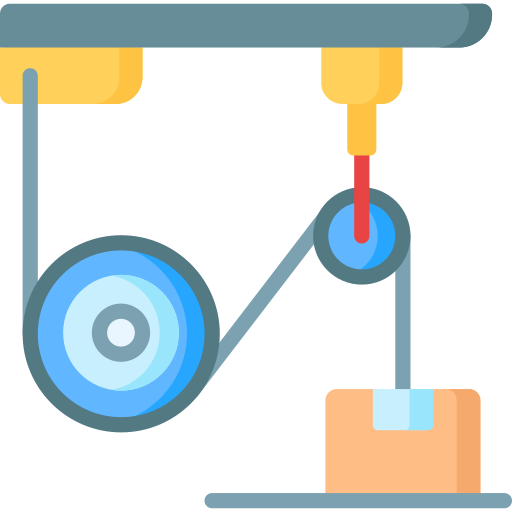
PULLEYS
shows a single fixed pulley arrangement which consists of a wheel with a groove around its circumference to receive a rope or chain. It is mounted on an axle about which it can rotate freely. The ends of the axle are supported by a frame called block. Block may be fixed or movable, if it…