Author: workhouse123
-
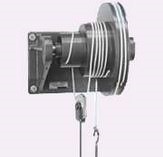
DIFFERENTIAL WHEEL AND AXLE
shows the arrangement of differential wheel and axle. It is used to lift the heavier loads. In this lifting machine, the axle is made up of two cylindrical axles B and C of different diameters d1 and d2, respectively. Wheel A has larger diameter, D. The wheel A and axles B and C are keyed to the same…
-
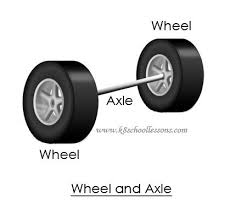
SIMPLE WHEEL AND AXLE
shows the working of simple wheel and axle. It consists of a wheel A of larger diameter and axle B of smaller diameter. Both wheel A and axle B are keyed to the same shaft. There are two strings—first is wound around the wheel A to which effort is applied and second is wound on…
-
REVERSIBLE AND IRREVERSIBLE MACHINES
The machine which starts to move in reverse direction after removal of effort, is called reversible machine. Simple rope and pulley drive is a reversible machine. The machine, which does not move in reverse direction after removal of effort, is called irreversible or self-locking machine. Screw jack, worm and worm wheel, and winch crab are examples of irreversible machine.…
-
Expression for Maximum Mechanical Advantage
From law of machine For maximum mechanical advantage denominator should be minimum. Therefore, will be minimum when W will be very large in comparison to C, i.e., is negligible. Hence, maximum mechanical advantage, Maximum efficiency, The graphical representation of relationship between load and efficiency is shown in Figure 13.3. Figure 13.3 Relationship Between Load and Efficiency
-
TERMINOLOGY RELATED TO THE LIFTING MACHINES
Velocity Ratio (VR): It is ratio of distance moved per unit time by effort to the distance moved per unit time by load. , where y is distance moved by the effort (P), and x is distance moved by the load (W). Mechanical Advantage (MA): It is ratio of load lifted and effort applied on a lifting machine. Its significance is…
-

INTRODUCTION
A machine is a device, which is capable to do some work on application of some effort. Here, effort means input in the form of force or energy supplied to the machine to do work. The work may be explained in the form of load lifting. An illustrative example of a lifting machine is explained…
-
HEAT EXCHANGER
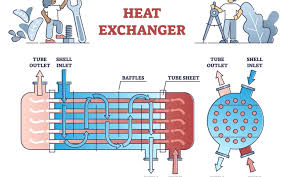
Heat exchanger is used to exchange the heat from one fluid to another. In heat exchangers the temperature of each fluid changes as it passes through the exchanger, and hence the temperature of the dividing wall between the fluids also changes along the length of exchanger. Heat exchangers have many applications in engineering such as…
-
Heat Transfer Through Sphere
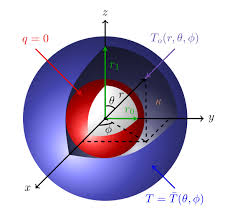
Consider a hollow sphere of internal radius r1 and external radius r2 as shown in Figure 7.8. Let the inside and outside surface temperature be t1 and t2; and let the thermal conductivity be k. Consider a small element of thickness dr at any radius r. It can be shown that the surface area of this spherical element is given by 4πr2. The heat transfer rate Figure 7.8 Heat…
-
Combined Heat Transfer
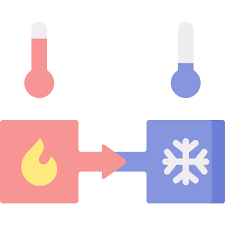
Plane Walls with Convection on Sides There are many cases in practice when different materials are constructed in layers to form a composite wall. This wall may be composed of plaster layer, brick layer, tiles layer, etc. as shown in Figure 7.3. In Figure 7.3 there are three layers A, B, C, of thickness LA, LB, and LC, respectively. The thermal…
-
Radiation
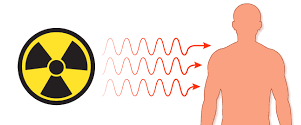
All matter continuously radiates electromagnetic radiation unless its temperature is absolute zero. It is observed that the higher the temperature then the greater amount of energy is radiated. If two bodies at different temperatures are so placed that the radiation from each body is intercepted by the other, then the body at the lower temperature…