Author: workhouse123
-

Volumetric Efficiency
The volumetric efficiency of a compressor is the ratio of actual free air delivered to the displacement of the compressor. Substituting the value of V4 in Eq. (10.1), we get Where ∈ is clearance ratio and r is pressure ratio Example 10.1: A single cylinder, single acting air compressor has a cylinder diameter of 150 mm and stroke of 300 mm. It…
-

-
Polytropic Compression
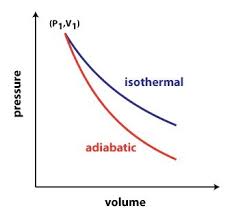
Area 0−1−2−3 in Figure 10.4 represents the net work done, when the compression follows the polytropic law. Net work on air per cycle = Area 0−1−2−3 = Work done during compression (1−2) + Work done during air delivery (2−3) − Work done during suction (0−1). Similarly, for isentropic compression 10.3.2 Isothermal Compression In isothermal compression work done is minimum…
-

RECIPROCATING COMPRESSORS
In these compressors, the gas volume decreases and pressure increases due to the action of one or more reciprocating piston moving axially in one or more cylinders. It may be single acting or double acting, single cylinder or multicylinder and single stage or multistage compressors. Figure 10.2 shows the schematic of a reciprocating compressor. Reciprocating compressors…
-

CLASSIFICATION OF COMPRESSORS
Compressors can be classified on the basis of range of pressures, capacity, pressure ratio and design, and principle of operations. Figure 10.1 Classification of Compressors Positive Displacement Compressor: In this compressor, pressure is raised by decreasing the volume of gas, i.e., positive displacement of gas. Dynamic Compressor: In this compressor, the kinetic energy imparted to the gas by…
-

INTRODUCTION
The function of compressor is to compress the gases and vapours from low pressure to high pressure. According to second law of thermodynamics this is only possible when work is done on the system, i.e., on the gas or vapour. Compressors have wide industrial and domestic applications such as compression of refrigerants in refrigerators and…
-

Impulses-reaction Turbine (Reaction Turbine)
If steam expands both in nozzle as well as in blades of turbine, i.e., pressure at inlet of the turbine is more than that of outlet, it is known as impulse-reaction turbine. In this case, expansion of steam in nozzle creates impulse on blades and reaction due to minor expansion of steam during passing through…
-

Pressure–Velocity Compounding
It is combination of pressure compounding and velocity compounding as shown in Figure 5.9a. There are two rotors and only two rows of moving blades are attached on each rotor because two row wheels are more efficient than three row wheels. The steam on passing through each row of moving blades reduces its velocity, but pressure remains…
-
Pressure Compounding or Reteau Staging
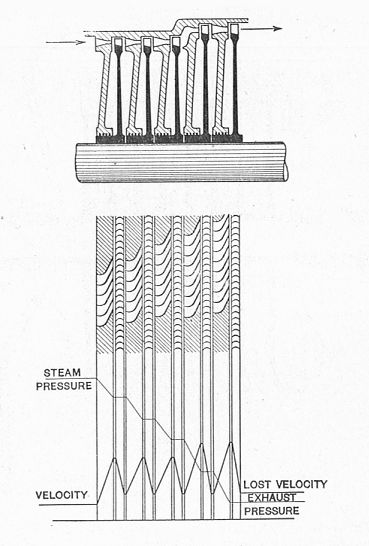
Pressure compounding is splitting of whole pressure drop of steam from steam chest pressure to condenser pressure into series of small pressure drops across several stages of impulse turbine. The whole pressure drops occur in series of nozzles and there is no pressure drop in fixed blades as shown in Figure 5.11. The kinetic energy of steam…
-

Compounding of Impulse Turbine
Single row of nozzle with single row of blade is called one stage of turbine. If steam at very high pressure is allowed to expand in single stage of turbine, the blade velocity will be too high. Such a high rotational speed cannot be used properly and also there will be velocity loss at the…